
How far can KYET get on 1 watt at night?
As i said above, i heard it in SE WY one night years ago and verified it was on one watt

How far can KYET get on 1 watt at night?
How far can KYET get on 1 watt at night?
KLEY 1130 in Wellington Kansas.
and
KYET 1170 in Golden Valley (Kingman), Arizona.
Both have a nighttine power of 1 watt !! 😱😮🌌
I've heard both locally at night,
and both have about 5 miles of night time coverage range before the noise floor takes over.
Thankfully, Both stations broadcast on these
FM Translators as well ...
KLEY is on FM 104.1 (K281DI)
KYET is on FM 92.3 (K222CZ)
Your reception may differ from others...As I said in a previous post:
Normal Night Time Coverage Range of 1170 KYET was reliable about 5 miles away (and up to 10 miles away, weak DX). Groundwave signal that is.
(Coverage to the West almost Halfway to Bullhead City, or Reaches East, the Western Half of Kingman AZ).
As far as DX skywave, at least Not in Las Vegas 100 Miles away (some bleedover from KSL on 1160).
KLEY 1130 is another Example of 1 watt nighttime, also 5 miles average nighttime coverage, and 250 watts daytime easily reaches into and beyond Wichita 30-40 miles away.
Your reception may differ from others...
What type of radio/receiver are you using? Is it highly sensitive like a C.Crane radio with a specialized attached antenna, a vehicle radio, a clock radio on your nightstand?
Let's be honest...a DX'ers listening experience is different from the average listener.
The problem with all of these DX claims is that no one explains what equipment is used to catch these signals.
I would have thought ZNS, being the only Bahamian clear channel, would be an absolute powerhouse in every direction.That is a pretty big piece of the world... ZNS dos get to the north coast of Hispaniola pretty well, but it does not cover central and western Cuba nor does it hit Puerto Rico. The rest of the Caribbean is not well covered at all.
Your reception may differ from others...
What type of radio/receiver are you using? Is it highly sensitive like a C.Crane radio with a specialized attached antenna, a vehicle radio, a clock radio on your nightstand?
Let's be honest...a DX'ers listening experience is different from the average listener.
The problem with all of these DX claims is that no one explains what equipment is used to catch these signals.
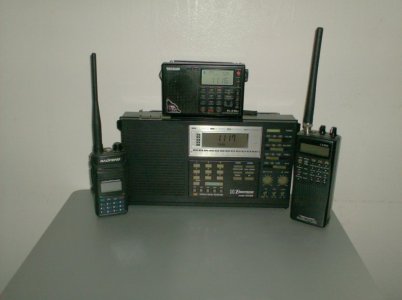
The blind members of this forum can't see this picture, so why don't you tell us what brands/model numbers/types of radios these are?My humble listening post. Fully portable. Everything fits in a shoulder bag if needed.
View attachment 12142
ZNS-1 1540 AM can just barely be picked up along the South Florida beaches. Even at night, they don't put a good signal into Florida.I would have thought ZNS, being the only Bahamian clear channel, would be an absolute powerhouse in every direction.
The blind members of this forum can't see this picture, so why don't you tell us what brands/model numbers/types of radios these are?
Of course! For SW/MW/FM monitoring I use a 1990's Emerson AT803 which is a clone of the Sangean ATS803a and a newer Tecsun PL-310e. For scanning and monitoring the VHF/UHF bands I have a Realistic Pro-26 200 channel handheld scanner. I also hold a valid amateur radio license and have a Baofeng UV-P15 VHF/UHF handheld transceiver. I hope this helps!
Getting back to the subject of this thread, I see that the CBC now has 24-hour-a-day flea powered AM radio stations in both Ontario and British Columbia. I'm wondering how effective those stations are at covering the areas they are located in.
I'm in Ontario. I wasn't aware of this. Do you know where they transmit from? Not that I'm a huge CBC listener.
Curiously, there are still frequency assignments for stations that ceased broadcasting due to the migration from AM to FM. For example, the former 1370 kHz frequency in Nogales, which had belonged to Radio Fórmula in the city of Nogales, was later reassigned by Mexico's new telecommunications regulator to the municipal government of Nogales, Sonora. The new authorization retained the same technical characteristics, the same station class, and the same authorized power level.Remember, clear channels (old 1-A and 1-B) "belong" to the nation or nations they are assigned to, and they have to be protected up to that nation's borders.
Good example: 1580 in Hermosillo, Sonora, Mexico was a 50 kw non-directional clear channel. It is gone, but 1580 still is protected to the Mexican border to the south (and to Canada to the north). Perhaps Mr Fybush can expand on those international protections.
I thought those either moved to FM or just shut down years ago.Getting back to the subject of this thread, I see that the CBC now has 24-hour-a-day flea powered AM radio stations in both Ontario and British Columbia. I'm wondering how effective those stations are at covering the areas they are located in.


