• Get involved.
    We want your input!
    Apply for Membership and join the conversations about everything related to broadcasting.

    After we receive your registration, a moderator will review it. After your registration is approved, you will be permitted to post.
    If you use a disposable or false email address, your registration will be rejected.

    After your membership is approved, please take a minute to tell us a little bit about yourself.
    https://www.radiodiscussions.com/forums/introduce-yourself.1088/

    Thanks in advance and have fun!
    RadioDiscussions Administrators

AM Frequency of the Week: 800

Status
Not open for further replies.
This was my very first "DX" channel - when I was about 6 or 7 I discovered I could hear an exotic Canadian station all the way from Rochester NY.

That was CJBQ, directly across the lake in Belleville, and not only is it still my regular daytime signal here, I've gotten to be friends with some of the crew there and hang out occasionally on the air with their very talented afternoon jock, Freddy Vette.

At night it's a mix of CKLW, CJBQ and sometimes Bonaire depending what antenna they're using.
I spent quite a few nights in Belleville. Handy overnight stop on my frequent runs between either Toronto-Montreal or Toronto-Ottawa. Nice hotel(s) just off the 401 Freeway and several good restaurants within five minutes or less. 100% fits my description of a great place to spend the night. In a very nice town, to boot!

My memory of CJBQ was a very tight pattern sandwiched in between CJAD and CKLW. Along with good audio and a country music format.
 
I turned on the radio tonight and heard CKLW loud and clear with news stories about Windsor. WTMR was in the distant backround with Gospel music. Steve Green NEPA mentioned hearing popular music on WTMR before it went Christian and I do remember hearing the Fifth Dimension in the late 60's or early 70's. The oldest WRTH I have is 1972 and it was WTMR then but I don't know what the format was.
 
CKLW was 5000 watts nondirectional on 1030 until moving to 5000 watts nondirectional on 800 in 1941.In the late 1940s, CKLW went directional with 50000 watts. The null areas are roughly equivalent to 5000 watts. About the same time WSGW 790 came on the air. They had to have had some agreement with Canada for signal overlap with CKLW. When WSGW went to 5000 watts Day, the 0.5 mV/m contours barely missed overlapping with WBBM. With the rules changes, WBBM had to reduce mutual 0.25 mV/m to 0.5 mV/m overlap when they moved. Someone here said that wasn't the power limiting factor, but that it had to be considered.

The first time I was in East Central Indiana, I was surprised at how well CKLW came in Days, and also WIND. Both eliminate a big lobe toward there at Night.

Although 800 is a Clear Channel, CKLW was never a Class I/Class A facility. Without CKLW and PJB interference, it was/is received well in the large Lobes at Night, both of which exceed typical 50000 watt nondirectional Class I/Class A inverse field.
 
Last edited:
That's why I've always been surprised to see when CKLW is received in places like Texas at night. They definitely have a lobe pointing southwest at night, but it's nothing like the daytime lobe. It's listenable in Toledo, for instance, but noticeably weaker. Traveling south on 75, I'd usually lose it for good right around Findlay.
I remember trying for CKLW in the northern Detroit suburbs one night many years ago and the frequency sounding like a graveyard. I figured CKLW would blast in those areas.
 
Last edited:
That's why I've always been surprised to see when CKLW is received in places like Texas at night. They definitely have a lobe pointing southwest at night, but it's nothing like the daytime lobe. It's listenable in Toledo, for instance, but noticeably weaker. Traveling south on 75, I'd usually lose it for good right around Findlay.
I remember trying for CKLW in the northern Detroit suburbs one night many years ago and the frequency sounding like a graveyard. I figured CKLW would blast in those areas.
CKLW has not be using its night pattern regularly at night for some time, thus the Texas receptions. There were occasions when The Big 8 would "forget" to ake the switch to night pattern, and we loved that. There was also a week in the late 60s when they either stayed on night pattern, or possibly lower power non-directional. We weren't happy.

CKLW of course started life as CKOK on 540 (which was eventually the home of CBEF.
 
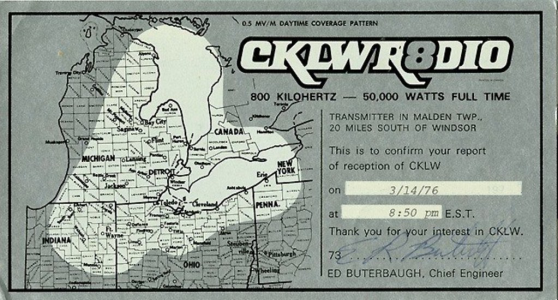
In the Northwest and West suburbs of Detroit, they shouldn't be that strong at Night, or even during the Day to the Northwest. I have to wonder whether in the 1960s the pattern was better in those directions. One QSL Card suggests that. Or maybe the lack of CKLW service in the Western suburbs created an opening for WKNR Keener 13, until WCAR The Giant 1130 changed, and WDRQ 93.1 began Top 40, and other FM formats started to take over the harder rock audience. CanCon turned off a lot of CKLW listeners on both sides of the border when it became more aggressive. It was great when the Canadian Hits were really Hits, and not just percentages and categories of the playlist.

 
Last edited:
Looking at the Dataworld maps on worldradiohistory.us, I realized that it should have been possible to receive XEROK in Albuquerque in the daytime, at least theoretically and if XEROK had been at full licensed power. Of all the times I've been in New Mexico, though, I never even thought to do this, and with XEROK's dismantling, it's highly unlikely that I could be able to prove or disprove this possibility. This wouldn't have been possible in Santa Fe due to 810 KSWV.
 
Here in west Houston TX, daytime is all slop from local KBME 790. Slop is reduced at sunset and I usually hear PJB start to come in. I've also heard WSHO at sunset. CKLW us usually in the mix as well, sometimes strong enough to dominate the channel. XEROK used to be a regular, but apparently they're off now.

Retro, Tulsa OK in the early 70's, the Oklahoma City station was there in the daytime. At night, XELO/XEROK was dominant, with PJB always there in the XE's null. My first car initially had only and AM radio, and I had XEROK as one of my presets for a while. IIRC, at least before they switched to X-rock, XELO was off on Monday morning and CKLW could be heard with a good signal.
 
The reason you might hear a lot of interfering stations on 800 after Sunset is because of all the 800 stations to the West that used to be Daytimers operating at powers of as much as 10000 watts. At Night, those stations are generally no more than 500 watts, so it might clear up somewhat. There was also a period when CKLW operated at 12500 watts nondirectional while they rebuilt the array.
 
Last edited:
Dayton, NV

Daytime: Nothing
Nighttime: Mess

Vallejo, CA

Daytime: Splatter from KGO 810 San Francisco
Nighttime: Splatter from KGO 810 San Francisco
 
QSL Card that appears to show a different Day pattern.

View attachment 5566

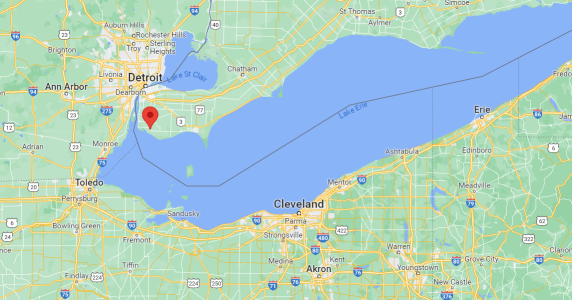
CKLW was a freak of geography as their transmitter was located about as far south in Canada as you can get.

1692764068981.png

At night they were very strong in the Northeast as they were not limited beaming on the US side of Lake Erie like they were on the Canadian side.

In the late 60's CKLW was owned by RKO General which had developed a new tighter Top 40 format at KHJ in Los Angeles and WOR-FM in New York and then in the spring of 1967 flipped WNAC-AM to WRKO in Boston and CKLW (Windsor-Detroit) to the Drake format.


It changed radio.

CKLW did go overboard with 20/20 News but it worked.

 
In the late 60's CKLW was owned by RKO General which had developed a new tighter Top 40 format at KHJ in Los Angeles and WOR-FM in New York and then in the spring of 1967 flipped WNAC-AM to WRKO in Boston and CKLW (Windsor-Detroit) to the Drake format.
First, WOR-FM in NYC was never like KHJ or KFRC or or WRKO or WHBQ or CKLW or even KAKC or KGB. It was a modified format for that market and it was not truly successful. All the others were (Except for trying to make a 250 watt station in Cincinatti work against WSAI).

RKO did not develop a format; they hired Bill Drake as consultant and Drake brought in Ron Jacobs for KHJ and Tom Rounds for KFRC. RKO did that because they were clueless on what to do with their stations. Drake had developed his format in Fresno competing wiith Jacobs, in fact.

For the actual KHJ story, see BOOKSHELF: Programming - Personalities - Techniques and look for "Inside Boss Radio" by Jacobs on the first line of listings.

Drake did not do a tighter Top 40. Drake and Jacobs developed a much faster and precise presentation with very short and aggressive jingles and avoidance of what Drake called "the Bakersfield sound" where jocks rambled and had poor pacing and excitement.

In fact, Drake and Jacobs in LA developed a format that had more precise use of gold, expanding the "just 40 songs" list to very strong older songs.
 
Last edited:
First, WOR-FM in NYC was never like KHJ or KFRC or or WRKO or WHBQ or CKLW or even KAKC or KGB. It was a modified format for that market and it was not truly successful. All the others were (Except for trying to make a 250 watt station in Cincinatti work against WSAI).

RKO did not develop a format; they hired Bill Drake as consultant and Drake brought in Ron Jacobs for KHJ and Tom Rounds for KFRC. RKO did that because they were clueless on what to do with their stations. Drake had developed his format in Fresno competing wiith Jacobs, in fact.

For the actual KHJ story, see BOOKSHELF: Programming - Personalities - Techniques and look for "Inside Boss Radio" by Jacobs on the first line of listings.

Drake did not do a tighter Top 40. Drake and Jacobs developed a much faster and precise presentation with very short and aggressive jingles and avoidance of what Drake called "the Bakersfield sound" where jocks rambled and had poor pacing and excitement.

In fact, Drake and Jacobs in LA developed a format that had more precise use of gold, expanding the "just 40 songs" list to very strong older songs.
@DavidEduardo - Not to stray too far off-topic but you are correct about WOR-FM.


RKO General was to be kind dysfunctional as a group owner. In any event, they rolled the dice on blowing up WNAC-AM and rebranded as WRKO in March of 1967 and at the time WNAC was the #3 billing station in the market behind WBZ and WHDH. CKLW followed a month later. The only station off the table was WOR-AM which was highly profitable.

CKLW was the rare exception of a non-Canadian government-owned station allowed to beam into the US at night with limited restrictions. CKAC (730) Montreal also enjoyed that luxury.

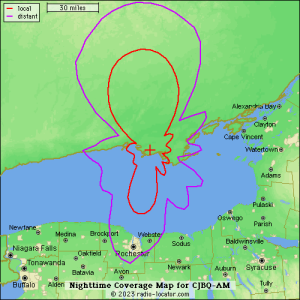
CJBQ was granted a nice figure 8 pattern that protected Windsor and Montreal.

1692782028461.png

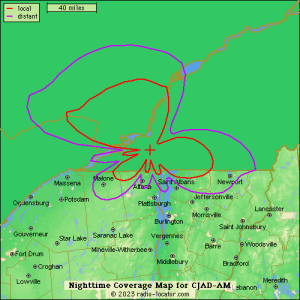
CJAD Montreal has a brutal night pattern towards the US

1692782634712.png
 
CKLW was a freak of geography as their transmitter was located about as far south in Canada as you can get.

View attachment 5567

At night they were very strong in the Northeast as they were not limited beaming on the US side of Lake Erie like they were on the Canadian side.

In the late 60's CKLW was owned by RKO General which had developed a new tighter Top 40 format at KHJ in Los Angeles and WOR-FM in New York and then in the spring of 1967 flipped WNAC-AM to WRKO in Boston and CKLW (Windsor-Detroit) to the Drake format.


It changed radio.

CKLW did go overboard with 20/20 News but it worked.

The parts of Canada further South than the CHYR (and now the CJSP 92.7 tower) towers were, at 42 00 35 N, Pelee Point and Pelee Island, are geographically farther South than the Northern edge of California, which goes up to 42 00 00 N.

There weren't any stations on 800 at Night in the US when the pattern was designed. If you look at the 1960 NAB Engineering Handbook Link on the other thread that David posted, you'll find a footnote that shows what was allowed up to the early 1980s under the NARBA agreement and US Mexico Agreement on 800, just Daytime only stations. They had to protect the Class I-A XEROK Skywave in the US.
 
Last edited:
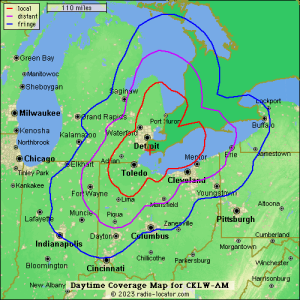
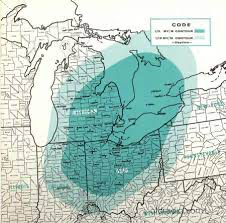
To my eyes, these look like basically the same pattern with possibly different tweaks.
It looks like they measured the CKLW contour during Daytime Skywave conditions, where the IDF at elevation angles above the Horizon is more than the Horizontal IDF in that direction. In some directions it matches the 0.5 mV/m, others the 0.15 mV/m shown on Radio Locator. While the real conductivity exceeds M-3 about out to Ann Arbor, it quickly conks out West and Northwest of there, and I would suspect that the Day ground wave isn't even close to 0.5 mV/m. The WJR 760 tower is fairly close to CKLW. They did a measured 0.5 mV/m contour, and has a much higher inverse field toward Grand Rapids, and the WJR 0.5 mV/m barely reaches that area.

1692788426251.png
 
Last edited:
Status
Not open for further replies.


Back
Top Bottom