• Get involved.
    We want your input!
    Apply for Membership and join the conversations about everything related to broadcasting.

    After we receive your registration, a moderator will review it. After your registration is approved, you will be permitted to post.
    If you use a disposable or false email address, your registration will be rejected.

    After your membership is approved, please take a minute to tell us a little bit about yourself.
    https://www.radiodiscussions.com/forums/introduce-yourself.1088/

    Thanks in advance and have fun!
    RadioDiscussions Administrators

AM Frequency of the Week: 820

40 miles northwest of downtown Chicago....

Days: All WCPT from Chicago. Good signal, but not as strong as Chicagos 50kw blowtorches....or for that matter, WIND {560).

Nights: WCPT drops from 5kw ND to 1500 watts direcbtional (north), and moves to a transmitter site about 20 miles further away from me. The result is a nightly battle with WBAP. WCPT generally gets the better of it...But not by much. Basically it's tilt the radio to the southeast and get WCPT. Tilt it to the southwest, and it's WBAP. At sunrise, the Columbus, Ohio 820 has been known to sneak in on occasion.

Finally, on very rare occasions, CHAM turns up. Most recently being just last week. Maybe. There was something just before sunrise under WCPT that I couldn't ID. CHAM is my best guess, because you normaly only have to go an hour or two north of here into Wisconsin to start hearing it on a more frequent basis.

Fun Fact: CHAM is a station I/ve heard on two different channels. First on 1280 as CJJD, then later on 1280 as CHAM before they moved to 820. IIRC the move took place at some point around the early 1990s. 1280 became a TIS statiion serving the Toronto airport.....which is located about 30 miles north of CHAM;s COL, Hamilton, ON.
 
Chicago by the lakeshore:

The local station WCPT rules day and night. I was able to ID WBAP (Fort Worth) once by patiently waiting for an identification during the pauses on WCPT. Most of the time I don't even hear WBAP in the background.
 
In the near north Chicago suburbs days are all WCPT with a good signal. At night it's a battle between WCPT and WBAP.
As cyberdad pointed out it depends on which way I position the radio. Occasionally I hear CHAM. I used to hear it more often before the Chicago 820 went 24 hrs.
 
East Tennessee: Absoluetely nothing.
Critical hours: WVSG (I'll never get used to not calling it WOSU) 5 days out of 7. Otherwise, if the band goes the other way, it can be WWBA.

Night: WBAP
 
In the late 1960s, we had a Sony 6R-11 Supersensitive TRF Potable. In the Daytime, you could get both WAIT and WOSU just by turning the radio. At Night, it was WFAA/WBAP. Sometime in the 1980s, CHAM moved to 820 and it was next to imposssible to separate the three in the Daytime.
 
I forgot to mention that I occasionally hear WWBA during morning critical hours in winter.
I've never heard it at my location, which is a little surprising, given that other area DXers have snagged it. At our beach location near Pensacola, WWBA is a daytime regular (with a weak signal) and sometimes turns up mixing with or under WBAP at night.
 
I've never heard it at my location, which is a little surprising, given that other area DXers have snagged it. At our beach location near Pensacola, WWBA is a daytime regular (with a weak signal) and sometimes turns up mixing with or under WBAP at night.
I have caught it most often right before sunrise usually in February. Conditions must be just right then.
 
Here in Wood Dale, IL in the near NW suburb of Chicago:

Daytime: WCPT
Nighttime: WCPT mixing with WBAP

DX/Retro: others heard in the past include WMGG (Largo, FL), WWAM (Jasper, TN), CHAM (Hamilton, ON), CMBU Radio Ciuda Cadena, Cuba. Also WXEZ from their old site in Elmhurst, IL on a land now occupied by a church that I attend, as well as WSCR that used to broadcast from the Belmont Avenue stick.
 
South Mississippi:

Day- nothing, WWBA Largo, FL "The Big 8" can be heard along the coast
Night- WBAP with strong signal, WWBA occasionally comes in during critical hours
 
From south Overland Park, Kansas:

Day: Nothing but splatter from local 50 kW non-directional WHB on 810 kHz.

Critical Hours: When WHB is on their 5kW directional nighttime pattern, WBAP is often very listenable mornings and evenings. I have logged WWBA on (2) occasions [the only Florida log at my location].

Night: A typically strong and listenable WBAP. In fact, WBAP is the most consistently strong nighttime skywave signal at my location and is stronger than other non-directional 50 kW signals that are closer in distance such as WHO and WCCO. The only closer 50 kW non-directional signal that can rival WBAP is KMOX.

Bob
 
From the southwest suburbs of Chicago, it's best to take this one chronologically.

First, there was WAIT, transmitter by I-290 in Elmhurst. Chicago sunrise to Grapevine, Tex., sunset to protect WBAP/WFAA with 5kW. Long after it's "World's Most Beautiful Music" phase, it was WXEZ and WPNT. This was my mom's go-to station when at the pool in the backyard, both for the music and for weather warnings. That was the simple part.

WBAP/WFAA was there just about every night after WAIT signed off. I heard it both ways and eventually found out about the curious twice-daily swap of the stations with 570, but the network affiliations stayed on the frequency.

Eventually WAIT was authorized a puny nighttime power. So puny, you could drive by the four towers on I-290 and still hear WBAP underneath.

WAIT goes silent in Jan. 1991, the towers come down and a manufacturing plant / warehouse goes up. I pick up WRFA Largo, Fla., and CHAM Hamilton, Ont., on back-to-back days soon after. How I didn't hear Kansas City in this time, I don't know.

On 1/2/1992, WSCR signs on with 5 kW and the old daytime limitation from the Belmont Ave. site on Chicago's north side. After WSCR moves to 1160, displacing WJJD, the call sign is WYPA, then WCSN, and then back to WAIT.

Eventually, it's WCPT and moves to an office on Milwaukee Ave. (shared with co-owned WSBC 1240, which moved from Belmont Ave. to the WEDC 1240 studio and transmitter). But that 5.8 kW transmitter is only the daytime site. At night, WCPT transmits from an array near Joliet with 1.5 kW beamed northeast. That's where we are today.

So here, the log reads seven different transmitter sites for six licensees with 12 call signs, two repeated and another alternating, over the years.
 
As I am sure you are aware there is not a station in Kansas City on 820 kHz. Rather, there is on 810 kHz. Perhaps, this was your reference. WHB would likely only be listenable in the Chicago area during critical hours when they are at 50 kW non-directional. At night, they are at 5 kW and highly directional north-south with sharp nulls east-west.

Bob
 
From the southwest suburbs of Chicago, it's best to take this one chronologically.

First, there was WAIT, transmitter by I-290 in Elmhurst. Chicago sunrise to Grapevine, Tex., sunset to protect WBAP/WFAA with 5kW. Long after it's "World's Most Beautiful Music" phase, it was WXEZ and WPNT. This was my mom's go-to station when at the pool in the backyard, both for the music and for weather warnings. That was the simple part.

WBAP/WFAA was there just about every night after WAIT signed off. I heard it both ways and eventually found out about the curious twice-daily swap of the stations with 570, but the network affiliations stayed on the frequency.

Eventually WAIT was authorized a puny nighttime power. So puny, you could drive by the four towers on I-290 and still hear WBAP underneath.

WAIT goes silent in Jan. 1991, the towers come down and a manufacturing plant / warehouse goes up. I pick up WRFA Largo, Fla., and CHAM Hamilton, Ont., on back-to-back days soon after. How I didn't hear Kansas City in this time, I don't know.

On 1/2/1992, WSCR signs on with 5 kW and the old daytime limitation from the Belmont Ave. site on Chicago's north side. After WSCR moves to 1160, displacing WJJD, the call sign is WYPA, then WCSN, and then back to WAIT.

Eventually, it's WCPT and moves to an office on Milwaukee Ave. (shared with co-owned WSBC 1240, which moved from Belmont Ave. to the WEDC 1240 studio and transmitter). But that 5.8 kW transmitter is only the daytime site. At night, WCPT transmits from an array near Joliet with 1.5 kW beamed northeast. That's where we are today.

So here, the log reads seven different transmitter sites for six licensees with 12 call signs, two repeated and another alternating, over the years.

Nice recap tvnut. Just to add to your post few more details.

Locally (Chicago area) we have 4 different transmitters site and 2 different Cities of License.

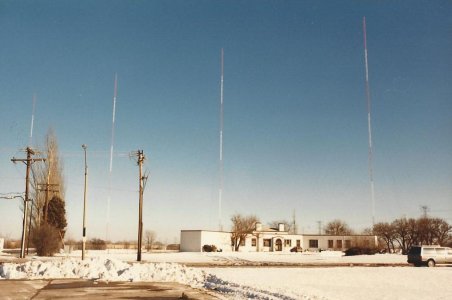
The Elmhurst, IL site (4 towers on Church Road) was used between 1941 - 1/3/1991. Call letters WAIT (1941 - 1980's), WZSE (1980's - 1988), WXEZ (1988 - 1990), WPNT (1990 - 1/3/1991)

WSCR signed on from the 4949 W. Belmont site in Chicago ( 5 kW - 1 tower - daytime only) on 2/1/1992. WSCR's last day on 820 was on 4/7/1997. Next day WYPA took over the frequency. Other calls used on this stick WCSN (2001 - 2005), WAIT (2005 - 2007), WCPT (2007 - 2016?). In 2005 the COL was changed from Chicago, IL to Willow Springs, IL

The nighttime site (1.5 kW, 6 towers) in Joliet, IL was authorized by FCC in 2010.

Not sure when they moved their daytime signal to the 5475 N. Milwaukee Avenue in Chicago. I want to say 2016, but I could be wrong. There they use 5.8 kW and are diplexed with WSBC (1240 kHz) on the old WEDC stick.

Here is a picture of their original site in Elmhurst, Illinois:

820-WXEZ-1.jpg
 
Ancient memory: in the early 60’s when the Texas operation would go off the air at midnight, CST every night, directional HJED,La Voz del Río Cauca in Cali with 50 kw would come in with it’s tropical cumbia all night show, sponsored by Chrysler Colmotores. Nearly every night it was listenable in NE Ohio, and I would set a timer and my tape recorder would give me 3 hours of music to listen to while I did my homework the next evening.

Several years later, I visited the station and they even interviewed me for their newscast!
 
That’s an all-night show I didn’t know about! Settled for Franklyn MacCormack on WGN when I got to stay up really late as a kid.
 
That’s an all-night show I didn’t know about! Settled for Franklyn MacCormack on WGN when I got to stay up really late as a kid.
Meister Brau Showcase. Sponsored by Meister Brau.... "Custom brewed for us Midwesterners". Tagline delivered throughout the wee hours of the morning by those great pipes posessed by Franklyn MacCormack. Memories!
 
Thanks for jogging my memory tvnut. In the early days of my DXing I first heard WFAA on 820. The next day another DXer and I were comparing notes. He claimed he heard WBAP on 820. We had a friendly argument about this until we found out about the frequency sharing arrangement.
 
Status
This thread has been closed due to inactivity. You can create a new thread to discuss this topic.


Back
Top Bottom