
-
Get involved.
We want your input!
Apply for Membership and join the conversations about everything related to broadcasting.
After we receive your registration, a moderator will review it. After your registration is approved, you will be permitted to post.
If you use a disposable or false email address, your registration will be rejected.
After your membership is approved, please take a minute to tell us a little bit about yourself.
https://www.radiodiscussions.com/forums/introduce-yourself.1088/
Thanks in advance and have fun!
RadioDiscussions Administrators
You are using an out of date browser. It may not display this or other websites correctly.
You should upgrade or use an alternative browser.
You should upgrade or use an alternative browser.
AM Radio is dying
- Thread starter Ronnie Milsoup
- Start date
- Status
- Not open for further replies.
I shall endeavor to do so, although it isn't always easy when you're typing half-asleep late into the night as I was. I just hope my clarification (the post you're responding to) was adequate. I didn't mean to put down all consultants -- the side-effect of everyone wanting them (homogenization from the DX'er's perspective) was the target of my lament, but that wasn't to say they didn't bring good to local radio. The much beloved soundtrack of my childhood was consultant Rick Carroll's KROQ, just for the record.May I politely suggest, then, that you choose your words a bit more cautiously when talking about us consultants? We've been attacked so often over the years -- usually blamed for things that happened which were not our doing -- that our skins are no longer thick enough to easily shake off more of the same.

Edit -- in fact, thinking back to the many stations I loved in my youth, just as many were novel and freeform as carefully crafted by consultants. I'm simply glad there was room for both back then, pre-Telecom Act of 1996. Nowadays, stations like the fictional KBHR 570 in "Northern Exposure" simply don't seem to exist anymore (except as streaming fan tributes like https://www.kbhr570.com/).
Last edited:
OK, but every smartphone in the world works off of radio waves. It all goes through a transmitter. The cell site is the transmitter. If you are streaming via your phone in an automobile that phone is getting the Pandora, Spotify, or other programming via a transmission, just as the FM radio in the car would be getting audio programming via a transmission.Radio is a means of transmission. It is literally sound transmission via radio waves.
Pandora and anything else that doesn't go through a transmitter is audio.
Radio is in decline. Audio is not.
So one could argue that Pandora, Spotify, IHeart's platform, et. al. are Radio, especially in the case of IHeart or other Radio-related streaming sites.
But by that logic, cosmic background noise from interstellar nebulae and stars would be radio too.OK, but every smartphone in the world works off of radio waves. It all goes through a transmitter. The cell site is the transmitter. If you are streaming via your phone in an automobile that phone is getting the Pandora, Spotify, or other programming via a transmission, just as the FM radio in the car would be getting audio programming via a transmission.
So one could argue that Pandora, Spotify, IHeart's platform, et. al. are Radio, especially in the case of IHeart or other Radio-related streaming sites.
Radio as most people understand it is the experience delivered via RF. It's radio if it sounds like radio, regardless of if the medium is AM, FM, XM, IBOC, or 5G TCP/IP.
They are. After all, radio-astronomy and radio-telescopes have been around for decades.But by that logic, cosmic background noise from interstellar nebulae and stars would be radio too.
Anything that is generated as a modulated RF carrier is radio, if you want to get technical about it. There may be many different modes of transmission and content, but they are still radio.Radio as most people understand it is the experience delivered via RF. It's radio if it sounds like radio, regardless of if the medium is AM, FM, XM, IBOC, or 5G TCP/IP.
Radio as most people understand it is the experience delivered via RF. It's radio if it sounds like radio, regardless of if the medium is AM, FM, XM, IBOC, or 5G TCP/IP.
I agree. If you read Marconi's writings, what he was trying to invent was a form of wireless telegraphy. The main characteristic was that it was wireless. So using Marconi's own definition, if it's wireless, then it's radio.
But can they play Hotel California and Brown Eyed Girl until you start pulling your hair out and tune to another star?They are. After all, radio-astronomy and radio-telescopes have been around for decades.But by that logic, cosmic background noise from interstellar nebulae and stars would be radio too.
And that's what my response was essentially aimed at -- being too technical about it. Radio is the cultural and business phenomenon of broadcasting one-to-many for information and entertainment that became popular over RF. That phenomenon is no longer linked to RF and can exist separately from it. This is why someone sitting at a board playing records and taking to the audience over nothing more than a Shoutcast stream can be considered radio, while something like Spotify or Pandora cannot. The latter are not one-to-many shared communal experiences; they are cloud-based CD changers that uniquely serve you, whether driven by a playlist you manually populated, one someone else populated, or one that an algorithm that watches your behavior populates.Anything that is generated as a modulated RF carrier is radio, if you want to get technical about it.
This is so much fun.I agree. If you read Marconi's writings, what he was trying to invent was a form of wireless telegraphy. The main characteristic was that it was wireless. So using Marconi's own definition, if it's wireless, then it's radio.
So, first, there was wireless, which was called radio because wireless radiated.
Next, what radio broadcast (the aural product) became such a powerful cultural institution that, to the ordinary man, the word radio became synonymous with that institution more than with the radiation medium.
Such that when that institution began appearing elsewhere than on wireless, it was still called radio. Example: Mike Horn's "Cable Radio Network" -- which was on coaxial cable television, not wireless.
Which then opened the door to internet streams being called radio -- whether one listened to them over ethernet, fiber, coax, or, ironically, over wireless (e.g. 802.11/5G).
But the catch was, those streams were only called radio if they sounded like (were formatted identically to) the aural product first invented on radio.
Otherwise (when they're glorified CD changers), those internet streams are called streaming, not radio. Even when they are experienced wirelessly instead of over wires.
Because as of modern times, the common man has completely re-defined the word "radio" away from meaning "wireless technology." He now just calls wireless "wireless," as Marconi originally did (see "wireless phones," "wireless laptops," "wireless devices," and "wireless speakers" -- none of which are called "radio phones," "radio laptops," "radio speakers," or what have you. The young even now refer to the energy these devices send/receive as "wireless signals, not "radio signals.").
Leaving the word "radio" to now mean just the cultural institution in common parlance, with only those of us who can remember The Before Times seeing it otherwise.
Long story short: you can now say "I'm listening to the radio wirelessly" without being redundant.

I remember when Paul Harvey was on KGO back when it was worth listening to.
I think I remember hearing, by chance, some of his last few broadcasts. He sounded very hoarse and weak, and it didn't seem like he was going to be around much longer.
c
He was 90. I was amazed he stayed on the air past 70 or 75.

K.M. Richards
Program Director, The Eighties Channel™
I shall endeavor to do so, although it isn't always easy when you're typing half-asleep late into the night as I was. I just hope my clarification (the post you're responding to) was adequate. I didn't mean to put down all consultants -- the side-effect of everyone wanting them (homogenization from the DX'er's perspective) was the target of my lament, but that wasn't to say they didn't bring good to local radio. The much beloved soundtrack of my childhood was consultant Rick Carroll's KROQ, just for the record.
Yes, your clarifying statement did a lot to soothe my bruised ego. I think part of the problem is that I somehow survived the era where practically every PD who could no longer find salaried work, hung out a "consultant" shingle. Many of them did not have the mindset for the job -- it is very different from being an in-house PD -- and they ruined a lot of stations. Those failures tainted all of our reputations.
As is probably well-known by now, I am both a consultant and a hands-on programmer for my client in Albuquerque. I program one of their stations (KRKE/93.7 & 1100) with The Eighties Channel™ format and I consult all of the other stations that they either own or LMA throughout New Mexico. The owner and I had a long discussion when he decided to "hire me back" in 2022 -- I had worked with him back in 2014-15, when he did the predecessor version of the format with me consulting -- and he was so totally convinced that the format was saleable in ABQ (he has turned out to be correct on that point) that I have a separate service agreement for KRKE which essentially designates me as a virtual PD.
The best consultants these days -- like my friend Mike McVay -- do not force anything on their clients. They work with the client to find the unserved (or not well-served) listener groups in the market and then help to craft programming that fills that niche.
The late Rick Carroll was a friend (going back to the early 1970s at KKDJ). His instinct about New Wave in the early 1980s was something I was only vaguely aware of, but MTV was the convincer. KROQ was successful enough that he really never had to sell himself or the "Rock Of The 80s" format to other stations. 91X in San Diego asked him to bring them the format, the success of L.A. replicated, and after that all of his clients were stations that approached him. I do not recall ever seeing him run an ad in the trades. He didn't need to.
Sadly, those days are past, and only those of us who have adapted to the changes in the industry and put our own preferences (and egos) aside to really help stations with what works in their markets are surviving.
And, to get this thread back on topic: I do believe that there are a large number of AMs that would be better off going silent, surrendering their licenses, dismantling the towers, and selling the real estate. But there are many AMs, both with and without FM translators, who still serve their local communities, and I would much rather see the band decluttered in their favor than see the umpteenth ESPN affiliation take up the space.
K.M. Richards
Program Director, The Eighties Channel™
Long story short: you can now say "I'm listening to the radio wirelessly" without being redundant.
And in the U.K., you can "listen to the wireless wirelessly." 😝
This is so much fun.
So, first, there was wireless, which was called radio because wireless radiated.
Next, what radio broadcast (the aural product) became such a powerful cultural institution that, to the ordinary man, the word radio became synonymous with that institution more than with the radiation medium.
Such that when that institution began appearing elsewhere than on wireless, it was still called radio. Example: Mike Horn's "Cable Radio Network" -- which was on coaxial cable television, not wireless.
Which then opened the door to internet streams being called radio -- whether one listened to them over ethernet, fiber, coax, or, ironically, over wireless (e.g. 802.11/5G).
But the catch was, those streams were only called radio if they sounded like (were formatted identically to) the aural product first invented on radio.
Otherwise (when they're glorified CD changers), those internet streams are called streaming, not radio. Even when they are experienced wirelessly instead of over wires.
Because as of modern times, the common man has completely re-defined the word "radio" away from meaning "wireless technology." He now just calls wireless "wireless," as Marconi originally did (see "wireless phones," "wireless laptops," "wireless devices," and "wireless speakers" -- none of which are called "radio phones," "radio laptops," "radio speakers," or what have you. The young even now refer to the energy these devices send/receive as "wireless signals, not "radio signals.").
Leaving the word "radio" to now mean just the cultural institution in common parlance, with only those of us who can remember The Before Times seeing it otherwise.
Long story short: you can now say "I'm listening to the radio wirelessly" without being redundant.
Okay.
Now, if it's that simple, you should have no problem whatsoever getting every person under the age of 35 to stop asking the question "what's radio?"
But you won't, because they don't use that word. They understand "audio".
Telling them they're listening to radio will be about like my grandmother complimenting the "victrola" I bought myself with the money from my first real job:
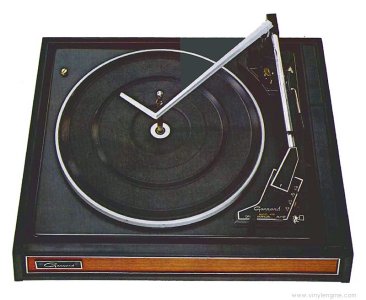

That's no Cue-Master!Okay.
Now, if it's that simple, you should have no problem whatsoever getting every person under the age of 35 to stop asking the question "what's radio?"
But you won't, because they don't use that word. They understand "audio".
Telling them they're listening to radio will be about like my grandmother complimenting the "victrola" I bought myself with the money from my first real job:
View attachment 7635
That's no Cue-Master!
No, but it wasn't bad for a 15-year-old kid making $1.65 an hour.
Seven years later, I retired it for one of these:
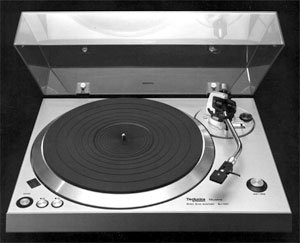

And the following year you bought another one, a Numark mixer, and 'DJ Mikey-Mike' was born!No, but it wasn't bad for a 15-year-old kid making $1.65 an hour.
Seven years later, I retired it for one of these:
View attachment 7637
(Clears throat)And the following year you bought another one, a Numark mixer, and 'DJ Mikey-Mike' was born!
(Checks notes)
(Clears throat again)
Yo.
Word, Daw.

And my mother, until she died in the 1990's, still called the refrigerator an "ice box".Okay.
Now, if it's that simple, you should have no problem whatsoever getting every person under the age of 35 to stop asking the question "what's radio?"
But you won't, because they don't use that word. They understand "audio".
Telling them they're listening to radio will be about like my grandmother complimenting the "victrola" I bought myself with the money from my first real job:
And most of us still talk about "records" and "albums". Yet most don't realize that an "album" was originally a binder with a half-dozen sleeves in it, each with a disk placed inside. And they spun really, really fast, didn't they?
(Unfortunate misspelling of Disk) has been fixed. My dog also had his disk fixed, but with surgery)
Last edited:
My first one was similar to this....No, but it wasn't bad for a 15-year-old kid making $1.65 an hour.
Seven years later, I retired it for one of these:
View attachment 7637
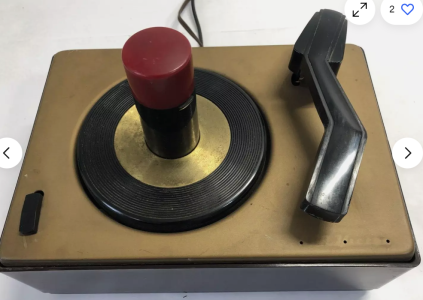
And the first record I bought, if I recall correctly, was "At The Hop" by Danny & The Juniors.
And most of us still talk about "records" and "albums". Yet most don't realize that an "album" was originally a binder with a half-dozen sleeves in it, each with a disk placed inside.
I'm sorry. What, now?
And they spun really, really fast, didn't they?
I'm by no means an expert, but I would think that would cost extra...
- Status
- Not open for further replies.