• Get involved.
    We want your input!
    Apply for Membership and join the conversations about everything related to broadcasting.

    After we receive your registration, a moderator will review it. After your registration is approved, you will be permitted to post.
    If you use a disposable or false email address, your registration will be rejected.

    After your membership is approved, please take a minute to tell us a little bit about yourself.
    https://www.radiodiscussions.com/forums/introduce-yourself.1088/

    Thanks in advance and have fun!
    RadioDiscussions Administrators

AM Radio - Static - Armstrong - Sarnoff

IIRC, David Sarnoff requested that Edwin Armstrong reduce the audibility of static in AM radio.

Did anyone actually make an AM radio static reducer (perhaps a system that detected the fast risetime of static and substituted a little stored audio or muted the sound, similar to the way some click/pop reducers work for vinyl records)?

Maybe SDR based receivers could implement such a system.


Kirk Bayne
 
IIRC, David Sarnoff requested that Edwin Armstrong reduce the audibility of static in AM radio.
He did. He called it FM radio.
Did anyone actually make an AM radio static reducer (perhaps a system that detected the fast risetime of static and substituted a little stored audio or muted the sound, similar to the way some click/pop reducers work for vinyl records)?
They're called Noise Blankers, and they've been around for decades, mostly in ham equipment. Some work better than others.
Maybe SDR based receivers could implement such a system.


Kirk Bayne
There are noise reduction systems in DSP already. My Yaesu FT-450D incorporates it. I'm not all that impressed when using it on SSB or CW, and since I work digital modes (mainly FT8) most of the time, I don't want the audio distorted in any way. DSP Noise Reduction stays off on my rig.
 
I know the request led to FM, I just wondered if any tech was developed for AM (no car radio I know of advertised any kind of AM static reduction, even though noise blanker tech existed).


Kirk Bayne
 
He did. He called it FM radio.
And Sarnoff tried to quash it, fearing that lower priced radios would hurt his expected sales of television which was well on its way to final mass marketing by then.
 
And Sarnoff tried to quash it, fearing that lower priced radios would hurt his expected sales of television which was well on its way to final mass marketing by then.
Not just less expensive, but better audio quality and massively lower noise that AM too. And yes, the expectation would be that consumers would move on from AM radio listening, to TV.
 
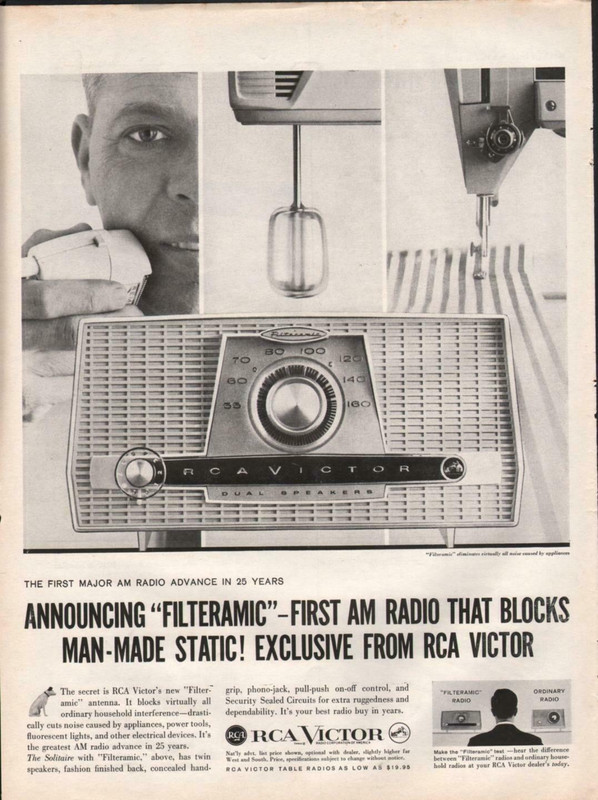
RCA did it with their Filteramic radios in the '50s and '60s:

filteramic.jpg
 
Interesting...anyone have a circuit diagram of this type RCA radio to see how the "Filteramic" system worked?


Kirk Bayne
 
I don't know of anything specific, but I have heard of those noise-blankers. It depends on if you're talking about regular static (easily overcome on AM) or RFI noise (not so much). My 4 local stations overcome the electromagnetic noise of the city fairly decently (the exception being 650 for some odd reason), and the semi-local stations from the next town over do have some noise in their broadcasts, but not bad for listening.
 
I don't know what was wrong with my grandparents' 1978 Mailbu, which was the first one we ever had with FM, but while I almost never heard static, I almost never heard an AM signal period if I got far enough from the transmitter. Only a few really strong stations worked.
 
After hearing a lot of horror stories about modern vehicles screwing up AM reception, I held back, however it would seem they actually perform better in this department, particularly a 2017 Ford and a 2021 Jeep Grand Cherokee I've had to rent for travel purposes. It's nice to hear that 2007 Kia has that capability on it as well. Things are looking up! :D
 
After the characteristics of (AM band) static were quantified, I would think that it would make sense to work on circuits to mitigate the audible effect of static (I can't see a downside to this type of research, even with vacuum tube AM radios, possibly a simple circuit could have been devised and implemented on most AM radios).

Maybe if AM NR had been perfected, we would have wide band low noise Discrete Quadraphonic AM and wouldn't have bothered with FM for radio.


Kirk Bayne
 
I'm not an engineer but I recall the CE at one of my former stations said the noise problem could be greatly helped if AM radio manufacturers would use a symmetrical detector in their designs. It was many years ago and I'm going by memory but as I recall, he explained that the upper and lower sideband of an AM signal are symmetrical while most noise is asymmetrical. Letting the symmetrical signal through while rejecting the asymmetrical parts of the waveform could reduce a lot of AM noise. I think this was around the time the Denon TU-680NAB tuner came out so maybe this was part of their AMAX design?

I found this engineering report (PDF) from Fujitsu-Ten that seems to speak to this. Looks like it was published in 1992 which would put it around that same time period. Maybe this is old news and it's part of most AM radio designs now? I never kept up with it.

I do remember the factory radio made by Fujitsu-Ten in my mother's Toyota Corolla from around that time sounded fantastic, supported AM stereo and had a wide/narrow AM bandwidth switch, so that company was clearly putting some effort into their AM designs at the time. I was upset when I found out she had sold the car without letting me know because I wanted to save that factory radio for myself and put a nice looking aftermarket radio into the car before it was sold. I guess I never told her, though.
 
I'm not an engineer but I recall the CE at one of my former stations said the noise problem could be greatly helped if AM radio manufacturers would use a symmetrical detector in their designs. It was many years ago and I'm going by memory but as I recall, he explained that the upper and lower sideband of an AM signal are symmetrical while most noise is asymmetrical. Letting the symmetrical signal through while rejecting the asymmetrical parts of the waveform could reduce a lot of AM noise. I think this was around the time the Denon TU-680NAB tuner came out so maybe this was part of their AMAX design?

I found this engineering report (PDF) from Fujitsu-Ten that seems to speak to this. Looks like it was published in 1992 which would put it around that same time period. Maybe this is old news and it's part of most AM radio designs now? I never kept up with it.

I do remember the factory radio made by Fujitsu-Ten in my mother's Toyota Corolla from around that time sounded fantastic, supported AM stereo and had a wide/narrow AM bandwidth switch, so that company was clearly putting some effort into their AM designs at the time. I was upset when I found out she had sold the car without letting me know because I wanted to save that factory radio for myself and put a nice looking aftermarket radio into the car before it was sold. I guess I never told her, though.
Would this symmetrical stuff count as polarization? UV glasses does just this, and radio stations do it all the time (horizontal vs vertical)
 
I remember reading about a homebrew AM noise cancellation system using two receivers, one tuned to the desired signal and another tuned to an unoccupied frequency nearby. If you invert the phase of the audio of the blank channel receiver and combine it with the audio of the desired signal receiver, it cancels out the noise and static, leaving only the audio of the desired signal.
 
I used to have a Palomar Engineers amplified/tuneable ferrite shielded rod antenna which worked very well with many AM tuners. The device tilted as well as swiveled. Its output was a 52 ohm "UHF" type connector, and it was powered by a simple 9V battery.
 
Status
This thread has been closed due to inactivity. You can create a new thread to discuss this topic.


Back
Top Bottom