• Get involved.
    We want your input!
    Apply for Membership and join the conversations about everything related to broadcasting.

    After we receive your registration, a moderator will review it. After your registration is approved, you will be permitted to post.
    If you use a disposable or false email address, your registration will be rejected.

    After your membership is approved, please take a minute to tell us a little bit about yourself.
    https://www.radiodiscussions.com/forums/introduce-yourself.1088/

    Thanks in advance and have fun!
    RadioDiscussions Administrators

Am station with the largest night land coverage?

With TWR's pattern aimed directly at Cuba and landing in east Central Mexico, not really. They cover a lot of water.
That is one of two patterns. One is aimed at Cuba in evening hours, and the other at NW Brazil in early morning hours. TWR has zero respect for local broadcasters. It drove the AM on 800 in Maracaibo out of business, destroyed the 800 AM in Bucaramanga and ruined the fringe coverage of HCFV-805 in Quito as well as killing the 800 AM in Panama City. TWR made no effort to help any of those stations move to another channel or otherwise remedy the damages (I know: I owned the Quito station). They are truly dreadful people.
 
That is one of two patterns. One is aimed at Cuba in evening hours, and the other at NW Brazil in early morning hours. TWR has zero respect for local broadcasters. It drove the AM on 800 in Maracaibo out of business, destroyed the 800 AM in Bucaramanga and ruined the fringe coverage of HCFV-805 in Quito as well as killing the 800 AM in Panama City. TWR made no effort to help any of those stations move to another channel or otherwise remedy the damages (I know: I owned the Quito station). They are truly dreadful people.
Not to mention blowing CKLW away while I was growing up in Ohio (even with the pattern change we'd have had something). There was interference even in their groundwave coverage area.
 
So... I think a consensus of the stations with the largest nighttime land coverage area are below.
Stations listed in geographic order, east to west.
  • WLW
  • WBAP
  • WOAI
  • KOA
  • KSL
Strong contenders:
  • WSM
  • WBBM
  • WWL
others
  • WGN
  • KRLD
  • KFMB
  • KNX
KFMB, now KGB, is highly directional out over the water. Not even a good signal in East County San Diego at night. KNX wastes half the power over the ocean and is not on a 1 A Clear Channel so it shares with lots of others, as does KRLD. KOA is similarly on a very populated channel, and has limited night coverage because of that.

You are missing the Chicago 1-A stations on 670 and 890, both of which have very good night signals. WCCO in Minneapolis is a former 1-A, as is KMOX in St Louis, WHAS in Louisville, KDKA in Pittsburgh, 1100 in Cleveland, WHAM in Rochester, WHO in Des Moines.

Several of the "new" clear channel stations, like 660 on the Navajo Nation in AZ, are directional but with 50 kw and have enormous coverage.
 
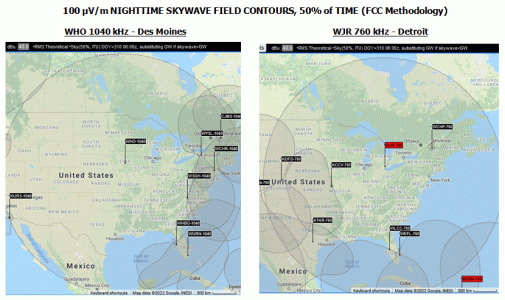
I believe WHO would definitely be a contender. It has the largest Nondirectional Theoretical Inverse Field of any US station as I recall. It has an inverse field of about 3334 mV/m at 1 km, 2072 mV/m at 1 mile with its Sectionalized Tower. It is centrally located on the continent, wasting little signal over large bodies of water.
 
Last edited:
Oops. Was thinking I was overlooking a station.
  • WLW
  • KMOX
  • WHO
  • WBAP
  • WOAI
  • KOA
  • KSL
Strong contenders

  • WSM
  • WBBM
  • WWL
others
  • WGN
  • KRLD
  • KFMB
  • KNX
 
There's land coverage and there's useful land coverage. To use WSCR 670 as an example, that's much different from the 1950s. There was no blaring Cuban on 670 then and KBOI was at 950. Old WMAQ was heard all the way to the West Coast. Now, not so much.

WGN 720's another example. Still a sometimes catch in Hawaii, its western coverage was hampered by the presence of KDWN Las Vegas with 50 kW. But KDWN has recently cut back to 15 kW nights, and WGN is again a possible catch in the Pacific Northwest. The signal was there all along, but KDWN was in the way.

Finally, KNX 1070, the subject of much chatter recently. I could get it occasionally despite WIBC Indianapolis, WAPI Birmingham and WTSO Madison, Wis. WIBC/WFNI is a memory now, but others on 1070 have turned the station into a graveyard listen in the Chicago area. (And 640, where KFI and Cuba were virtually nightly visitors, null one and you get the other, into the 1980s, became a jumble as well because of WOI and WWLS' getting night power. Then WFMN came along and Chicago has no shot at all.)

The signal is there, but if it's swamped by another, forget it. If I was king, the clears would still be clear, and the new kids would be moved carefully to other spots, including 1620-1700.

 
There's land coverage and there's useful land coverage. To use WSCR 670 as an example, that's much different from the 1950s. There was no blaring Cuban on 670 then and KBOI was at 950. Old WMAQ was heard all the way to the West Coast. Now, not so much.

WGN 720's another example. Still a sometimes catch in Hawaii, its western coverage was hampered by the presence of KDWN Las Vegas with 50 kW. But KDWN has recently cut back to 15 kW nights, and WGN is again a possible catch in the Pacific Northwest. The signal was there all along, but KDWN was in the way.

Finally, KNX 1070, the subject of much chatter recently. I could get it occasionally despite WIBC Indianapolis, WAPI Birmingham and WTSO Madison, Wis. WIBC/WFNI is a memory now, but others on 1070 have turned the station into a graveyard listen in the Chicago area. (And 640, where KFI and Cuba were virtually nightly visitors, null one and you get the other, into the 1980s, became a jumble as well because of WOI and WWLS' getting night power. Then WFMN came along and Chicago has no shot at all.)

The signal is there, but if it's swamped by another, forget it. If I was king, the clears would still be clear, and the new kids would be moved carefully to other spots, including 1620-1700.
KNX is difficult. However, I caught it last night, very weakly, under another station, but enough of them to say their FM frequency and "Southern California weather."
 
no mention of WJR?
WJR covers a lot of water. But I doubt that too many people were listening except JP McCarthy and John McMurray on their boats on Lake Huron. Also, are we counting Canada and Mexico or just the land area in the US? There aren't many people in those areas of Canada that WJR covers. Also, WJR uses a 195 degree Monopole, whereas WHO uses a Sectionalized antenna that is more efficient than WJR. If Mexico counts, WBAP and WOAI may be in the running.
 
KSL is. definitely DX in the eastern half of the US now
Yes, thanks to WJJD Chicago - which pesters KSL as far away as Minneapolis/St. Paul at night. However, even from the Chicago north suburbs, I have been able to null WJJD and detect KSL. Farther west this is easier to do. But as far as having a listenable signal, WJJD destroys it over thousands of square miles.
 
Yes, thanks to WJJD Chicago - which pesters KSL as far away as Minneapolis/St. Paul at night. However, even from the Chicago north suburbs, I have been able to null WJJD and detect KSL. Farther west this is easier to do. But as far as having a listenable signal, WJJD destroys it over thousands of square miles.

1160 is the only chicago station ive heard here in central alaska... and heard it fairly well i might add
 
1160 is the only chicago station ive heard here in central alaska... and heard it fairly well i might add
The inverse field has a maximum close to the Great Circle Direction of Alaska. With it's six tower array near Lockport, IL at Night, the maximum inverse field is the equivalent of around 400 kW, depending on the reference. It is somewhat off maximum though. It's probably best toward Norway.
 
I just had a wild thought.... what if we talk about FM's with the largest service area?

Some of the native networks in Canada, like NCI FM... span hundreds of miles.

The station i manage in Alaska, has a service area of about 600 miles or so. Between our main fm signal (KSKO) and all our class d non comm licenses (we call them repeaters, they arent translators!) along with the two stations who simulcast us part time, KRFF and KZPA .... we have a service area of about 600 miles and thats a bit conservative with the AM thrown in, assuming 100-150 miles day, and 200 miles night
 
1160 is the only chicago station ive heard here in central alaska... and heard it fairly well i might add
Interesting that the old Chicago 1160 at night put a very poor signal to the north at night from the Ballard Rd location.
Now from Lockport they blast into Northern Minnesota and points north.
 
WJJD/WYLL has/had a null equivalent to the old 20 kW nondirectional facility, originally from…get ready…Mooseheart! When they went to 50 kW in Des Plaines, originally near Ballard Rd. and Greenwood Ave., then out to Ballard Rd. and I-294, they went directional, radiating the equivalent of 20 kW toward WISN 1150 and KSL 1160. At some point, 1160 was allocated to Thunder Bay, ON. Even though WISN moved to 1130. they couldn’t remove the null, and WHBY Kimberly took over 1150. In order to go 50 kW Night, they had to pay to upgrade WHBY to 20/25 U4, and reallocate 1170 as a replacement for 1160 in Thunder Bay. This also required a second site near Lockport, IL.

WYLL may be dug in at the Des Plaines site for now due to the much better Day signal in the Northern Chicago Area, and the licensed AUX for WIND 560, which at 1000 watts Day, 580 watts Night, non directional, now appears to meet all new FCC requirements for a Main facility. If suddenly somebody decided to buy the Griffith, IN site for an astronomical amount of money, it’s ready to go, at least temporarily. Much better prepared than WIBC 1070 and other stations are.
 
Last edited:
Just for the record, these are the non-directional 50,000 watt stations in North America.

540 CBK Regina and XEWA San Luis Potosí (100 kw?)
640 KFI Los Angeles
650 WSM Nashville
660 WFAN New York
670 WSCR Chicago
680 KNBR San Francisco (Class I-B but non-directional)
690 CKGM Montreal
700 WLW Cincinnati
720 WGN Chicago
730 XEX Mexico City (100 kw days/50 kw nights)
740 CFZM Toronto
750 WSB Atlanta
760 WJR Detroit
770 WABC New York
780 WBBM Chicago (35 kw days/42 kw nights)
800 XEROK Ciudad Juarez
810 WGY Schenectady (Class I-B but non-directional)
820 WBAP Fort Worth
830 WCCO Minneapolis
840 WHAS Louisville
850 KOA Denver (Class I-B but non-directional)
860 CJBC Toronto
870 WWL New Orleans (slight directional antenna)
880 WCBS New York
890 WLS Chicago
900 XEW Mexico City (100 kw)
940 XEQ Mexico City (Class I-B but non-directional)
990 CBW Winnipeg
1020 KDKA Pittsburgh
1030 WBZ Boston (slightly directional antenna)
1040 WHO Des Moines
1050 XEG Monterrey (100 kw)
1070 KNX Los Angeles (Class I-B but non-directional)
1100 WTAM Cleveland
1120 KMOX St. Louis
1160 KSL Salt Lake City
1180 WHAM Rochester
1200 WOAI San Antonio
1210 WPHT Philadelphia
1220 XEB Mexico City (100 kw)
1570 XERF Ciudad Acuña (100 kw)
 
Last edited:
Status
This thread has been closed due to inactivity. You can create a new thread to discuss this topic.


Back
Top Bottom