• Get involved.
    We want your input!
    Apply for Membership and join the conversations about everything related to broadcasting.

    After we receive your registration, a moderator will review it. After your registration is approved, you will be permitted to post.
    If you use a disposable or false email address, your registration will be rejected.

    After your membership is approved, please take a minute to tell us a little bit about yourself.
    https://www.radiodiscussions.com/forums/introduce-yourself.1088/

    Thanks in advance and have fun!
    RadioDiscussions Administrators

AM Stations that alternated frequencies and days

In the mid-sixties I lived in Louisiana. There were AM stations in Baton Rouge that either swapped frequencies on alternate days (WAIL and WXOK 1260/1460) or used the same frequency on alternate days (WLUX and WUNE on 1550). I believe WFAA and WBAP in Texas used to alternate frequencies also 570/820. Were there any others that did this?

kw- Melbourne
 
In the mid-sixties I lived in Louisiana. There were AM stations in Baton Rouge that either swapped frequencies on alternate days (WAIL and WXOK 1260/1460) or used the same frequency on alternate days (WLUX and WUNE on 1550). I believe WFAA and WBAP in Texas used to alternate frequencies also 570/820. Were there any others that did this?

kw- Melbourne
If you pull the YouTube videos (all audio) of WBAP on the day of the JFK assassination, you'll hear the back-and-forth in action.
 
I don't know if this counts, but I just came across a 1981 audio clip on YouTube of News/Talk/Sports WIBW in Topeka, Kansas, signing off to make way for KSAC out of Manhattan, Kansas, to take over the 580 frequency for the next five hours. KSAC was on the campus of Kansas State University.
 
I don't know if this counts, but I just came across a 1981 audio clip on YouTube of News/Talk/Sports WIBW in Topeka, Kansas, signing off to make way for KSAC out of Manhattan, Kansas, to take over the 580 frequency for the next five hours. KSAC was on the campus of Kansas State University.
I can look it up later, but WLEE in Richmond (at one time the #1 station in the market with Top 40) shared 1480 with a religious station on Sunday morning only.

An unusual one was a religious AM in Pasadena, CA, which only operated on a limited schedule. But it was right next to a station in Los Angeles, and the latter had to reduce power when the Pasadena station was on. Nearby in LA, two religious stations (which ended up after the reallocation of 1941 on 1150) shared their channel. One was owned by the famed Amy Semple McPherson, the prohibitionist and evangelist.

There were many more, including several channels in New York City such as 1280, 1330, 1380, 1480 which had multiple shared licensees and a (former) Class IV in Chicago which had 3 occupants for its lowly 250 watt channel.

Before the Federal Radio Commission put some order in the band in the late 1920's, many more stations shared frequencies, even if they were not in the same city. And originally, if you look at early station log books, there were just a few wavelengths for stations and sharing was very common:


The farther back in time that you go, the more of these that you see.
 
WIBW/KSAC -sounds like what I was talking about.
As best I recall the Baton Rouge stations were either R&B or Gospel formats - probably run by different
organizations. I moved to east central Florida in 1966 - but never heard any alternating/sharing like that here....

kw- Melbourne FL
 
WIBW/KSAC -sounds like what I was talking about.
As best I recall the Baton Rouge stations were either R&B or Gospel formats - probably run by different
organizations. I moved to east central Florida in 1966 - but never heard any alternating/sharing like that here....

kw- Melbourne FL
In the later years of the arrangement, the Kansas State calls were KKSU
 
In the mid-sixties I lived in Louisiana. There were AM stations in Baton Rouge that either swapped frequencies on alternate days (WAIL and WXOK 1260/1460) or used the same frequency on alternate days (WLUX and WUNE on 1550). I believe WFAA and WBAP in Texas used to alternate frequencies also 570/820. Were there any others that did this?

kw- Melbourne

I don't see any evidence in the history cards or Broadcasting Yearbook that any of these stations were ever share-timers.

There was a 1966 call swap in which WXOK, Inc. and Merchants Broadcasting (WAIL) exchanged licenses, with WXOK moving to 1460 from 1260 and WAIL moving to 1260 from 1460. And on 1550, WUNE changed calls to WYNE in 1961 and then to WLUX in 1963 when Jimmie Noe sold the station. But there was only ever one license and one callsign on each of these frequencies at any given time.
 
In its specific form, it was indeed unique! While 800 (later 820) wasn't the only Class I clear-channel frequency that had two licensees sharing it, it was the only one where those licensees found a second frequency for a reverse split. WLS and WENR in Chicago shared 870/890 from the 1920s until 1960, but they never had a second frequency to share. And if you didn't start with a superior Class I facility, there wasn't any reason to do an unusual and confusing deal like WFAA/WBAP - you just put one station full-time on one channel and one on the other.

But... there was almost a similar arrangement in the 1950s on TV. When VHF channels were in short supply, there were several markets where two prospective licensees agreed to do share-times to get on the air quickly. KOY and KOOL shared 10 in Phoenix, WHB and KMBC shared 9 in Kansas City, and WHEC and WVET shared 10 in Rochester. Most of those share-times ended quickly with a buyout, but WHEC/WVET endured all the way to 1962. They had separate studios and separate staffs but shared a transmitter and a primary CBS/secondary ABC affiliation.

Around 1957, the two stations went to the FCC with a proposal: there had been a channel 27 permit in Rochester issued to WRNY-TV that was unbuilt. They applied to build channel 27 as a WFAA/WBAP-style reverse split: channel 10 would always be CBS, channel 27 would always be ABC, and the operators would swap back and forth between the two signals on their existing schedule.

The FCC stalled out on ruling on the proposal, and it became irrelevant in 1961 when WVET (Veterans Broadcasting) bought out WROC-TV/FM. The entire Veterans staff moved to WROC, WVET radio became WROC(AM), and Veterans sold its half of channel 10 to WHEC, which became a full-time CBS affiliate. The market then got a full ABC affiliate later in 1962 with the debut of WOKR(TV).
 
For many years, KPPC 1240 was just 100 watts, because of KGFJ 1230, now KYPA, being a first adjacent. Under the new AM rules, there was a special clause which only applied to KPPC, but didn't mention it specifically, which allowed them to increase to 250 watts, but no further increases were allowed. In 1996, KPPC went dark after considering a simulcast with KYPA. There is no History Card immediately available, but it would have said 100 watts up to 1980.

In Chicago, at one point, WSBC, WCRW, and WEDC 1240 all operated with separate transmitting facilities, each with a series limiting resistor to reduce efficiency to 150 mV/m at one mile, because of prohibited overlap with WJOB 1230 (where Jean Shepherd began his career, Steve King, and I believe Vivian Carter started there also). I think they all were mutually increased to 1000 watts in the 1960s. WSBC STILL uses reduced input power because of that. They combined two, and when WSBC bought them out, it was consolidated at the WSBC site. WSBC has a 95.3 degree tower, which would have about 310 mV/m at 1 km with full 1000 watt input. The actual efficiency is 241.4 mV/m @ 1 km.

Much negotiation was allowed to adjacent Regional and Clear Channels to allow stations on Local Channels to increase to 1000 watts in the 1960s. Many stations on Local Channels applied for available FM channels early in the game, which supplemented Class IV 1000 watt Day, and 250 watt Night facilities, even well before they allowed 1000 watts Night. Daytimers also acquired FMs early in the game. KPPC had an FM early on 106.7, which still exists as KROQ-FM.
 
Last edited:
There was one other recent TV share-time arrangement, in Chicago on Channel 60 from 1982 to 1986. WBBS (7 p.m.-2:30 a.m.) and WPWR (2:30 a.m.-7 p.m.) shared the air until a complicated set of sales and channel switches ended the arrangement. The studios were separate, the transmitter shared and on Sears Tower. Their early commonality was feeding the scrambled pay-TV SportsVision operation to the few homes that paid for it (and a bunch more that bought bootleg decoder boxes).
 
CHYR in Leamington, Ontario, Canada used to do this back when they were on AM. During the day they were on 710, then they shifted to 730 at night.

The frequency change was preceded by a sign-off announcement and a series of distinct sounding tones meant to help listeners find them on the other channel, which also played the same tones for a minute or so. IIRC the station could be heard in Detroit, At some point they migrated to 96.7 FM and turned off the AM signals.

Apologies, I re-read the thread and realized this is about frequency sharing, not just a nighttime frequency change. But I can't really delete the comment so I'll leave it up anyway. I guess it's tangentially related.
 
Last edited:
During the years that WBAP and WFAA shared 570 and 820, the NBC Red/NBC Radio Network affiliation was always on 820 (800 prior to 1941) and the NBC Blue/ABC Radio/ABC American Entertainment Radio Network affiliation was always on 570, regardless of which station was on which frequency.
If you listen to the WBAP recordings from November 22, 1963 you'll hear that, NBC news and coverage when WBAP is on 820, ABC on 570.
 
I recently digitized some aircheck tapes I have of Chicago radio in 1997. Among those tapes is one where I recorded each of the handoffs between WSBC and WEDC (on 1240) on April 18, 1997. They passed the baton *10* times that day: at 6 am, 8:30 am, 10 am, 3:30 pm, 5 pm, 7 pm, 8 pm, 10 pm, 11 pm, and midnight. There were a couple of times when WSBC and WEDC, which had separate transmitter sites, were transmitting *simultaneously* for a few seconds. A couple of other times, there was a gap between the two stations, as WSBC tended to leave the air a little early and WEDC tended to linger a bit. I was recording off a GE Superradio III in wideband mode - living just a couple of miles from the transmitter sites, I could get away with that - and, during the gaps, WJOB at 1230 in Hammond, Indiana was audible and steady, if noisy. By June, WSBC had bought out WEDC, and started using WEDC's transmitter site on Milwaukee Avenue where it remains today.

 
I grew up in the DFW area and remember well the WFAA/WBAP frequency sharing arrangement. I especially remember the cowbell that WBAP used to announce the changeover. They hung onto that for many years after the arrangement ended. When the DFW Spurs baseball games would run late you had to change the tuner at midnight to hear the conclusion of the game. That would have been in the 1965-69 period.
 
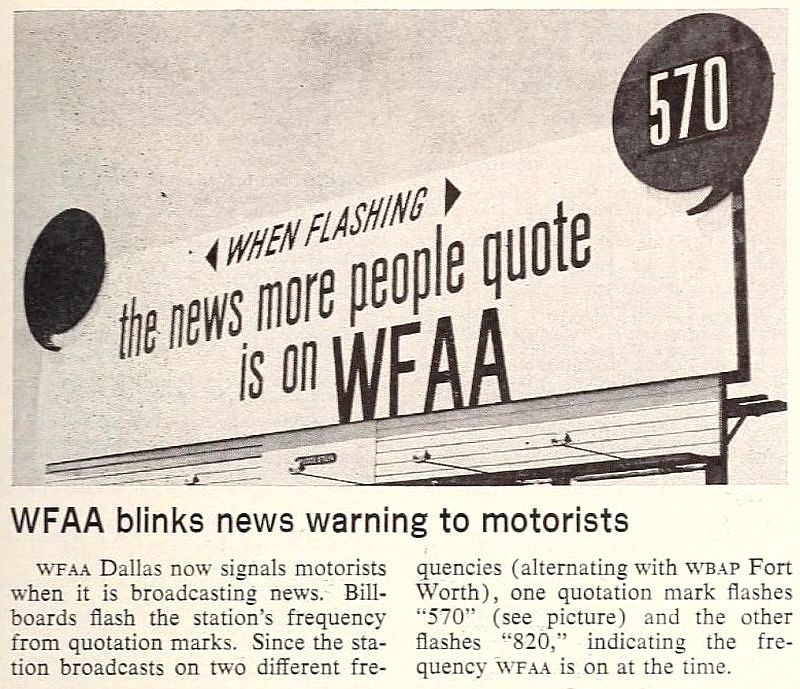
WFAA had billboards showing passing motorists which frequency to tune to:

wfaa-wbap_broadcasting_042263.jpg
 
I recently digitized some aircheck tapes I have of Chicago radio in 1997. Among those tapes is one where I recorded each of the handoffs between WSBC and WEDC (on 1240) on April 18, 1997. They passed the baton *10* times that day: at 6 am, 8:30 am, 10 am, 3:30 pm, 5 pm, 7 pm, 8 pm, 10 pm, 11 pm, and midnight. There were a couple of times when WSBC and WEDC, which had separate transmitter sites, were transmitting *simultaneously* for a few seconds. A couple of other times, there was a gap between the two stations, as WSBC tended to leave the air a little early and WEDC tended to linger a bit. I was recording off a GE Superradio III in wideband mode - living just a couple of miles from the transmitter sites, I could get away with that - and, during the gaps, WJOB at 1230 in Hammond, Indiana was audible and steady, if noisy. By June, WSBC had bought out WEDC, and started using WEDC's transmitter site on Milwaukee Avenue where it remains today.
And in earlier years, 1240 was shared three ways!


Back
Top Bottom