• Get involved.
    We want your input!
    Apply for Membership and join the conversations about everything related to broadcasting.

    After we receive your registration, a moderator will review it. After your registration is approved, you will be permitted to post.
    If you use a disposable or false email address, your registration will be rejected.

    After your membership is approved, please take a minute to tell us a little bit about yourself.
    https://www.radiodiscussions.com/forums/introduce-yourself.1088/

    Thanks in advance and have fun!
    RadioDiscussions Administrators

Another Attempt At Más Flo For San Diego/Tijuana

Chinese doesn’t have an alphabet per se. It has a series of initials and finals that make up its words. Several forms of romanization have been introduced to help those of us who natively speak a language with a Roman alphabet learn it, but the ultimate reason you learn romanization when learning Chinese is to get rid of it. A phonics-based system called BoPoMoFo is, or at least used to be, somewhat popular in Taiwan, but, as far as I know, it has never been widely used anywhere else. Plus, it doesn’t resemble our alphabet in any way, shape or form. I actually found learning it very difficult and frustrating and quickly ditched it in my junior high years. I replaced it with PinYin, which is a form of romanization, and a focus on learning a simple book of characters so I could expand from there.

I suppose you could try to use the initial and final sounds for some call letters as there are some call letter combinations that would correspond to exact initials and finals, but it would likely sound awkward or like gibberish to a native speaker. So, you might as well ID in English.
I know about Chinese phonetic alphabet system. It's only applies to Mandarin not Cantonese. As for the Chinese radio station, they will speak Mandarin or Cantonese depending on the program and have a recorded announcer in English such as "You're listening to KQEA-LP San Francisco" on the top of the hour and go back to Chinese language after that. When I learned Chinese, I didn't use the phonetic alphabet system Pinyin in Mainland China, BoPoMoFo/Zhuyin in Taiwan. I had to memorize Chinese Characters, I took Cantonese when I was a kid and we didn't use the pinyin system when we learned Chinese Characters.

As for pronouncing latin letters, they use the English pronunciation even in China when you have to spell out in pinyin. They don't use French, Italian, Spanish alphabet pronunciation. As for Hong Kong since English is co-official with Chinese (Cantonese) they use English pronunciation when it comes to roman letters.

As for Top of the hour ID call letters when it comes to language. FCC doesn't have a language requirement. Also, The United States doesn't have an official language.
 
Si no hablas el castellano ... FCCData.org has a friendlier frontend for border-area allotments data. For San Diego I just use the anchor bordertown of "San Ysidro" California as location.

Using the David Eduardo's link we find there is a station authorization (concesión) for XHRST 107.7 in Tijuana for GRUPO IMPULSOR DE MEDIOS, S.A. DE C.V. Some more details at :


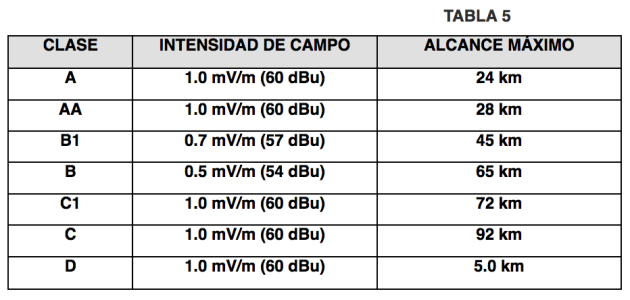
And here is the license , listed as a "B1" class : https://rpc.ift.org.mx/vrpc//pdfs/40946_190128184102_159.pdf

And the technical parameters here: https://rpc.ift.org.mx/vrpc//pdfs/0902526480028590.pdf

But this looks confusing - it's at Rosarito running 250 watts ERP at 341 to 90 degrees, and 1500 watts ERP in the 91 to 340 degree azimuth.

De todas maneras, muchas gracias compadre Eduardo .
 
Last edited:
FCCdata is fine, though it hasn't updated Mexico data in a bit.

The raw source for coverage data from the IFT is called CPCREL and can be found here. You can search by locality, by call sign (distintivo) or conduct an advanced search.

Simply select the band and it will autosuggest call signs as you type. Click "Consultar", check the leftmost checkbox, and then "Mostrar selección".

CPCREL spits out KMZs, with Longley-Rice coverage patterns for each station and a clickable pin. For instance, XHRST has an ERP (in Spanish, PRA — potencia radiada aparente) of 10 kW. Note that it does not quote HAAT (in Spanish, AATP) but rather the height of the antenna above ground—FCCdata does calculations to extract that for all stations, though if a station has a recent technical document in the RPC, you can probably get it. By the way, here's the stick.

Almost all of Mexico's station classes are equivalent to their US counterparts, except for A which is at 3 kW like in days of yore (there is a Class AA at 6 kW) and Class D which has a 50-watt limit.
 
Thank you' It looks like the tool spits out useful Longley-Rice scatter plots but the "station class contour" circles generated seem very "notional" (generic) unlike the FCC API plots.
 
There was always a belief among mainland US Spanish language stations that the ID had to be given in English, but that faded in the 90's as nobody could find reference in the rules to language. Now, many ID in Spanish.

Of course, in Puerto Rico, stations have IDed in Spanish "forever" going back the the predecessor of WKAQ around 1922. Of course, Puerto Rico is in the USA and has been for 122 years.

I'd be interested in knowing how the US stations in Farsi, Armenian, Russian and various Asian languages identify. I believe I have heard 670 in LA identify in Farsi, but that was about a decade ago.
I know the Punjabi / South Asian station in Ferndale, WA, KVRI 1600 has TOH announcements in clear English. I think one of the Punjabi stations in the Seattle area also IDs in clear English, but haven't listened to them in a while to say for certain.
 
Status
This thread has been closed due to inactivity. You can create a new thread to discuss this topic.


Back
Top Bottom