
• Get involved.
    We want your input!
    Apply for Membership and join the conversations about everything related to broadcasting.

    After we receive your registration, a moderator will review it. After your registration is approved, you will be permitted to post.
    If you use a disposable or false email address, your registration will be rejected.

    After your membership is approved, please take a minute to tell us a little bit about yourself.
    https://www.radiodiscussions.com/forums/introduce-yourself.1088/

    Thanks in advance and have fun!
    RadioDiscussions Administrators

Antenna question

Hello, probably a basic question, but my antenna knowledge is low...

I am trying to implement a basic BOG antenna, almost exclusively for AM DXing. 160' straight run to catch signals coming in from about 70 degrees (ENE) from Springfield, OH. Wanting to grab more New England states. If it works, I can try different directions in the future.

It is grounded (4' rebar) at the far end (not using a terminating resistor presently, don't care if it is bi-directional). At the shack end, I have it hooked up to one of those old 75 to 300 ohm adapters--I recall they were used on old TVs for UHF maybe? Local electronics shop guy thought it would work ok. So the antenna wire is hooked up to one of the 300 ohm sides, the other 300 ohm side is grounded to another piece of 4' rebar. I have about 150' of mostly spooled RG6 going from the adapter to my shack, and then a final adapter to hook the coax into the antenna port of an AN-200 passive loop. I have a CCrane Skywave 2, and an older CCradio SWP. I only bought the new one because the fine tuner broke on my old one.

I am not getting much in the way of results over just using the passive loop, hoping someone has some thoughts on how to improve my setup. Thoughts--is the 150' of coax too long, creating its own problems? Would a 300 or so ohm terminating resistor on the far end help any? Is my cheap 300 to 75 ohm adapter not really working as a transformer? Do I need a balun or choke-- whatever those do--have read a few comments on them?
 
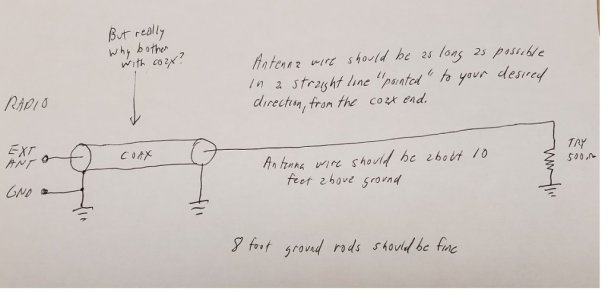
Hello Bouncer- It appears this antenna is a variation of the Beverage Antenna.
Suggestions-
1. Make a Beverage Antenna. Research it on the Internet.
2. The far end would be terminated to ground with a resistor that equals the characteristic impedance of the antenna.
3. Coax to the receiver should be have the same characteristic impedance as the antenna.
4. In my opinion ground rods will be fine for the connection at each end of the antenna. The ground rod at the receiver may not be necessary, but might as well do it.
5. For best AM band results the antenna should be longer than the 160 foot length you mentioned.
6. At the receiver side connect the coax directly to the screw terminals on the CCrane. As I understand it, the screw terminals are in parallel with the internal loop antenna, so it is already a compromise, and having a passive loop in the circuit seems like too much stuff.
7. To start with, I would not worry about the 300 to 75 ohm adapters.
8. I think you will get better results for your effort if you focus on making your own shielded loop antenna.
9. If you have the resources and scenario for it, consider a vertical antenna, which could be a wire going up to a high branch on a tree. Research the art of slinging a wire over a high branch.

Actually, why have so much coax? Can you start the antenna just outside your shack and run in in a straight line towards your desired direction? Is there a lot of electrical noise you are trying to get away from?
Since the radio is probably a portable, test the antenna with the radio outside connected directly to the antenna. Then see what happens when you connect a short run of coax, and test it from insider your shack. Also try different far end termination resistor values.

When I think about all of this, a four or six foot shielded loop antenna seems like a better choice, especially since you can rotate it.

Have fun!
 

Attachments

  • Beverage.jpg
    Beverage.jpg
    52.1 KB · Views: 8
Last edited:
A loop antenna may work better as you can use it to null out interfering stations. There are a number of YouTube videos about constructing it.
 
Hello Bouncer- It appears this antenna is a variation of the Beverage Antenna.
Suggestions-
1. Make a Beverage Antenna. Research it on the Internet.
2. The far end would be terminated to ground with a resistor that equals the characteristic impedance of the antenna.
3. Coax to the receiver should be have the same characteristic impedance as the antenna.
4. In my opinion ground rods will be fine for the connection at each end of the antenna. The ground rod at the receiver may not be necessary, but might as well do it.
5. For best AM band results the antenna should be longer than the 160 foot length you mentioned.
6. At the receiver side connect the coax directly to the screw terminals on the CCrane. As I understand it, the screw terminals are in parallel with the internal loop antenna, so it is already a compromise, and having a passive loop in the circuit seems like too much stuff.
7. To start with, I would not worry about the 300 to 75 ohm adapters.
8. I think you will get better results for your effort if you focus on making your own shielded loop antenna.
9. If you have the resources and scenario for it, consider a vertical antenna, which could be a wire going up to a high branch on a tree. Research the art of slinging a wire over a high branch.

Actually, why have so much coax? Can you start the antenna just outside your shack and run in in a straight line towards your desired direction? Is there a lot of electrical noise you are trying to get away from?
Since the radio is probably a portable, test the antenna with the radio outside connected directly to the antenna. Then see what happens when you connect a short run of coax, and test it from insider your shack. Also try different far end termination resistor values.

When I think about all of this, a four or six foot shielded loop antenna seems like a better choice, especially since you can rotate it.

Have fun!
Thanks for the detailed answer! Unfortunately I am limited by lot size and shape and my yard basically being a treeless field to a BOG with a max run of the 160', so I have to do the best with that. If this works it would be permanent and I don't want to have supports through the backyard. Also, neither CCrane radio I have has any screw terminals, or any way to hook up an external antenna, hence the use of a passive loop to get the external antenna signal to it. I may start checking ebay for a used console style with external hookup available.

I was wondering if that coax might be too long, I used a longer piece so we could try different directions of wire run, but direct connect and also using a short piece with the radio just out in the field is a great idea, takes one thing out of the equation anyway. Limitations (septic tank and propane tank/line) force the the end of the line nearest the shack to be at least 30' away.

Will look more into a shielded loop antenna, I like the concept of rotating it.

One question still--how do I match the impedance of coax to 18 gauge wire without using something like a 300 to 75 adapter? Can a multimeter be used to test this somehow or is there more specialized equipment?

Thanks again!
 
That 75 ohm to 300 ohm TV transformer bottoms out at about 5 MHz. You have a lot of signal attenuation and poor signal transfer below 5 MHz. Dump it and try to wind a balun on a ferrite core.

Bill
 
160 feet isn't long enough at MW wavelengths to be directional. But a 160 ft low wire can still work well with a good receiver. I used a 150 ft low wire with my Yaesu FRG-7 in 2011-2014 and it worked really well. Not really directional, but it definitely pulled in the MW stations.

I'd keep the 160 footer for SW and MW, but build a loop if you really want to increase your reception. A large loop is fairly easy to put together -- all you need is 110 ft of wire on a milk crate and a 365 pf tuner cap to make a good one -- and there are DXers who have made even bigger loops with good results. Loops, by nature, are pretty directional.
 
Hello Bouncer-

I suggest not spending too much time thinking about impedance. Experiment with different things and see how they work. Just be careful with electrical things like power lines and conduits, and don't work on this when an electrical storm is likely.

Ohio to New England is not a huge distance in the DX world. Good chance the CCrane radio has enough sensitivity/gain already to hear signals from New England. You might not need the extra stuff. However, you might consider getting the CCRadio 2E Enhanced AM/FM radio because it has antenna/ground terminals on the back.

Considerations are (1) radio signal propagation conditions, which vary, (2) interference from other radio stations, and (3) interference from electrical things within a few hundred feet of your radio.

Set yourself up a comfortable chair and umbrella in an outdoor location on your lot that has minimal electrical noise from the house, neighbors and power lines, bundle up and listen.

Here I have electrical noise from somewhere close, maybe in the kitchen or from a bug light operated by my neighbor. If necessary I walk out into the front yard where things are quiet, or to a nearby large wooded area that is a public park.

Don't overthink the theory. Just try out stuff. Have fun.
 
Last edited:
160 feet isn't long enough at MW wavelengths to be directional. But a 160 ft low wire can still work well with a good receiver. I used a 150 ft low wire with my Yaesu FRG-7 in 2011-2014 and it worked really well. Not really directional, but it definitely pulled in the MW stations.

I'd keep the 160 footer for SW and MW, but build a loop if you really want to increase your reception. A large loop is fairly easy to put together -- all you need is 110 ft of wire on a milk crate and a 365 pf tuner cap to make a good one -- and there are DXers who have made even bigger loops with good results. Loops, by nature, are pretty directional.
Greatly appreciate the feedback, will try a couple of the loops suggested. I wish I could exceed the 160' for sure.
 
Hello Bouncer-

I suggest not spending too much time thinking about impedance. Experiment with different things and see how they work. Just be careful with electrical things like power lines and conduits, and don't work on this when an electrical storm is likely.

Ohio to New England is not a huge distance in the DX world. Good chance the CCrane radio has enough sensitivity/gain already to hear signals from New England. You might not need the extra stuff. However, you might consider getting the CCRadio 2E Enhanced AM/FM radio because it has antenna/ground terminals on the back.

Considerations are (1) radio signal propagation conditions, which vary, (2) interference from other radio stations, and (3) interference from electrical things within a few hundred feet of your radio.

Set yourself up a comfortable chair and umbrella in an outdoor location on your lot that has minimal electrical noise from the house, neighbors and power lines, bundle up and listen.

Here I have electrical noise from somewhere close, maybe in the kitchen or from a bug light operated by my neighbor. If necessary I walk out into the front yard where things are quiet, or to a nearby large wooded area that is a public park.

Don't overthink the theory. Just try out stuff. Have fun.
Appreciate the have fun first advice. My Ccranes are sensitive, I have heard San Antonio, Cuba, and Denver already with just the built in ferrite core, but I need null functionality and some directionality to get specific wants like a 5k station in Vermont. :)

I like the tinker with a chair outside idea. Will give feedback on what seems to work in case others are in my situation too.

Thanks all!
 
I'm gonna share my real world 2 cents worth of opinion.

For AM or SW using a longwire.. get as long as you can get. Dont worry about length... the longer, the mroe directional, obviously.

If youre interested in HF, i suggest getting/making a big loop... 10 to 15 feet and get an antenna tuner. An antenna tuner isnt NEEDED with a broadband antenna, but it helps a good deal

I dont claim to be an electronics expert, but im a fairly accomplished Dxer, thanks to what others have taught me.... and what ive picked up on my own.
 
Hello, probably a basic question, but my antenna knowledge is low...

I am trying to implement a basic BOG antenna, almost exclusively for AM DXing. 160' straight run to catch signals coming in from about 70 degrees (ENE) from Springfield, OH. Wanting to grab more New England states. If it works, I can try different directions in the future.

It is grounded (4' rebar) at the far end (not using a terminating resistor presently, don't care if it is bi-directional). At the shack end, I have it hooked up to one of those old 75 to 300 ohm adapters--I recall they were used on old TVs for UHF maybe? Local electronics shop guy thought it would work ok. So the antenna wire is hooked up to one of the 300 ohm sides, the other 300 ohm side is grounded to another piece of 4' rebar. I have about 150' of mostly spooled RG6 going from the adapter to my shack, and then a final adapter to hook the coax into the antenna port of an AN-200 passive loop. I have a CCrane Skywave 2, and an older CCradio SWP. I only bought the new one because the fine tuner broke on my old one.

I am not getting much in the way of results over just using the passive loop, hoping someone has some thoughts on how to improve my setup. Thoughts--is the 150' of coax too long, creating its own problems? Would a 300 or so ohm terminating resistor on the far end help any? Is my cheap 300 to 75 ohm adapter not really working as a transformer? Do I need a balun or choke-- whatever those do--have read a few comments on them?
Lose the balun. As others have mentioned, TV-type 300-75 ohm baluns are extremely lossy at frequencies <5 Mhz. Connect your feedline directly to the antenna. The feedline shield can be connected to your ground rod at the feedpoint. At the station end, connect to your receiver and provide a good ground. If you're on city water and/or have metallic piping in your home a nearby cold water pipe would be good place to connect, and will likely perform better than your 4' ground rod. This connection is important, since it's effectively serving as the other "Half" of your antenna.

Make your antenna as long as possible and have fun. Receiving loops are a good option for AM (And below) DXing. At these frequencies, the noise floor is what will dictate how well your receiver performs. Compact loops and ferrite loopsticks aren't efficient, but they're great at rejecting noise, improving the effective sensitivity of your receiver.
 
Update: I think the lack of an antenna jack on either of my CCranes was quite a problem--though don't get me wrong, they rock as standalone portables! The Tecsun AN-200 passive loop never really seemed to work much with anything hooked up into its antenna 'out' jack (I read online it could be used as an input, but who knows). Worked well enough as a straight passive loop, but I wanted more.

So I broke down and bought an Airspy discovery plus SDR and an MLA-30 active loop antenna. Using SDR++ for now, will look at other software too. Also interested in setting up as a server on my home network (not the whole internet) to access it from my phone. That's down the road though.

Initial results are great, getting peaks on nearly every frequency, with the antenna just leaning against the house for now. Will consider some different configurations based upon where my shack will be. Its in the garage now, but that is not heated. Don't want to freeze every time I DX.

Question--I have it mounted on a PVC pipe now, does anyone know of a decent but cheap rotator I could control from the shack? It does null out pretty well, so I will need to rotate it a lot depending on what I am trying to get...hoping to spend less than $50 on a rotator...
 
Status
This thread has been closed due to inactivity. You can create a new thread to discuss this topic.


Back
Top Bottom