I'm playing with one of those vertical only cheap FM broadcast antennas made in China and sold on E Bay. While it seems to mirror the US versions I can't figure out how you tune it. Anybody have any experience with this? I'm guessing it's easier than I think. TIA

-
Get involved.
We want your input!
Apply for Membership and join the conversations about everything related to broadcasting.
After we receive your registration, a moderator will review it. After your registration is approved, you will be permitted to post.
If you use a disposable or false email address, your registration will be rejected.
After your membership is approved, please take a minute to tell us a little bit about yourself.
https://www.radiodiscussions.com/forums/introduce-yourself.1088/
Thanks in advance and have fun!
RadioDiscussions Administrators
You are using an out of date browser. It may not display this or other websites correctly.
You should upgrade or use an alternative browser.
You should upgrade or use an alternative browser.
Anyone tuned one of those E Bay vertical fm broadcast antennas?
- Thread starter Radio Bob
- Start date
Cold Coffee
Banned
What are you using it for?
Seeing how it might work on a repeater 98.1What are you using it for?
Cold Coffee
Banned
A quarter wave of 98.1 is 28.6 inches. Both elements should be that length.

Actually it a match of 1.3 or more near the middle that's why I ask how others have tuned itThose are supposed to be broadband antennas. Should be good across the entire FM broadcast band.
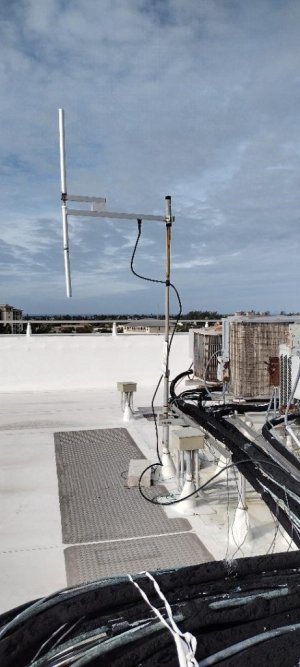
That type of antenna is not normally tunable. The only exception would be if the length of the vertical elements is adjustable. They usually are not, though I have not seen that particular type. If the photo is of your installation, you may get better results if the mounting pole is longer so that it extends well above the upper element of the antenna. Dipoles should not normally be mounted right at the top of a pole. You could also try to route the coaxial cable so that it is further from the lower element. And try to get it higher above the roof level. If you are putting any more than 1W into it, no one should be able to touch the lower element end.
I am afraid to say that you should not expect great results from a cheap antenna. It is also worth having a spare in the store.
I am afraid to say that you should not expect great results from a cheap antenna. It is also worth having a spare in the store.

When I built my first FM in Ecuador it was to be used as a low power (25 to 50 watts) STL for my 570 kHz AM Top 40 station. I had a CB antenna I had brought from my early teen years, and I trimmed the vertical radiator and the 4 slanting ground plane elements to the FM frequency by using a hacksaw and file. At the transmitter site, we put in a Hallicrafters FM radio that could be tuned to a fixed frequency. Another CB antenna was used; both were non-directional.That type of antenna is not normally tunable. The only exception would be if the length of the vertical elements is adjustable. They usually are not, though I have not seen that particular type. If the photo is of your installation, you may get better results if the mounting pole is longer so that it extends well above the upper element of the antenna. Dipoles should not normally be mounted right at the top of a pole. You could also try to route the coaxial cable so that it is further from the lower element. And try to get it higher above the roof level. If you are putting any more than 1W into it, no one should be able to touch the lower element end.
The two locations were about 12 miles apart, and the system worked fine. In fact, we discovered that a lot of listeners to the AM station had those big European units with record players and AM, Short wave and FM radio and they had discovered that the station sounded better on FM. That "discovery" led me to put on an independent FM later that year, using a home-built transmitter and four vertical element on a small tower on the studio building. We used plumbing supply copper tubing for the elements and feed lines between them. With 1 kw into the antenna, we covered the whole market of about a million people.
In both cases, the element or elements were mounted on a pipe extending from the top of the tower. We were at 10,000 feet AMSL and did not have lightening,but as a precaution we had "spikes" on the top of the pipe and the first element was about a meter below that point.
In both cases, the antenna elements were tunable by cutting the elements, but that only works if they are "too long" for the frequency.,
"Good" is a relative term. I would say that, except for the point that exactly corresponds with a wavelength fraction, that antenna will be, at best. mediocre.Those are supposed to be broadband antennas. Should be good across the entire FM broadcast band.
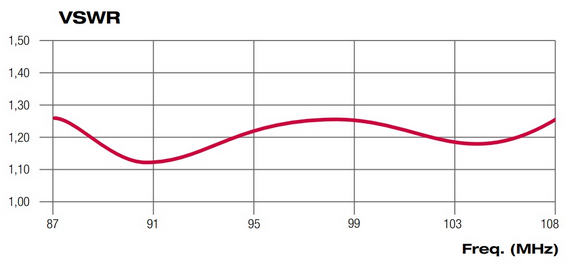
With a good antenna it is not quite like that. This is an example from Aldena (Italy). Because of the way it is matched they have two frequencies where the SWR is very good. Properly positioned this allows an acceptable SWR across the band. In my experience they are better than this graph shows."Good" is a relative term. I would say that, except for the point that exactly corresponds with a wavelength fraction, that antenna will be, at best. mediocre.
Home made antennas will usually be narrowband however. Sometimes too narrow for the modulation. Narrowband antennas are usually tuneable (sometimes using a hacksaw), wideband are not. To improve a wideband antenna you would use a fine matching transformer at the antenna input. The fine matching transformer would be more expensive than the antenna in this case.
What are you measuring VSWR with?Actually it a match of 1.3 or more near the middle that's why I ask how others have tuned it
Agreed. Using a broadband antenna has trade offs. The more expensive broadband antennas spec a VSWR of 1.2 across the band. I suspect a Chinese knock off selling at 1/3rd the price can't be better."Good" is a relative term. I would say that, except for the point that exactly corresponds with a wavelength fraction, that antenna will be, at best. mediocre.
The worst thing is that those Chinese transmitters that get connected to them tend to have "minimal"* harmonic and / or parasitic filtering and are quite capable of being heard at multiple frequencies.Agreed. Using a broadband antenna has trade offs. The more expensive broadband antennas spec a VSWR of 1.2 across the band. I suspect a Chinese knock off selling at 1/3rd the price can't be better.
* "Minimal" means "none" in most cases.
- Status
- This thread has been closed due to inactivity. You can create a new thread to discuss this topic.