
They weren't. As late as 2000, Mel Karmazin was refusing to try streaming on the CBS (then Infinity) stations. It looks like they may not have gotten involved until 2008, when they did a deal with AOL (!). By 2010, of course, they bought the "Radio-dot-com" platform and got serious.Correct, I'm aware of a lot of streaming radio stations around the world, including London and Ireland, in 1999. But the comment was about CBS stations streaming their broadcast signal. I'm not aware that CBS radio stations were streaming their local broadcast signals in 1999.

-
Get involved.
We want your input!
Apply for Membership and join the conversations about everything related to broadcasting.
After we receive your registration, a moderator will review it. After your registration is approved, you will be permitted to post.
If you use a disposable or false email address, your registration will be rejected.
After your membership is approved, please take a minute to tell us a little bit about yourself.
https://www.radiodiscussions.com/forums/introduce-yourself.1088/
Thanks in advance and have fun!
RadioDiscussions Administrators
You are using an out of date browser. It may not display this or other websites correctly.
You should upgrade or use an alternative browser.
You should upgrade or use an alternative browser.
Audacy discontinuing HD2 to save money?
- Thread starter rustyhodge
- Start date
They weren't. As late as 2000, Mel Karmazin was refusing to try streaming on the CBS (then Infinity) stations.
To be consistent he was opposed to streaming when he went to run Sirius in 2004. Only recently has Sirius allowed its stations to be streamed.

I still listen on a old school radio/stereo set. It's possible the HD thing could be fading away in a few years.OK, so everybody has a computer or smartphone..... and most of them are on YT, FB, Twitter, Spotify, Netflix, video gaming, etc.
How many people actually stream their local stations? Few seem to show up in the ratings anywhere. I know it happens, but it can't be in the millions per large metro.
Earbuds sound like crap, like playing music from a phone.I posted a study about that last month. The problem with streaming on phone is it's usually done using earbuds. That listening doesn't get picked up by PPM. There's a connection users are supposed to make when they use earbuds, but it likely gets overlooked. It may not show up in Nielsen, but it gets counted in the app, because the listenership gets reported to SoundExchange for royalty payment.
Depends on the earbuds, and what you've got them connected to.Earbuds sound like crap, like playing music from a phone.

This was at the height of the Dot Com bubble, and Yahoo's market cap was soon decimated when that burst, circa 2000-2001. I think Cuban, very wisely, diversified out of Yahoo! pretty quickly. (Personal experience on this one - I worked for a direct competitor in those days, which didn't survive the bursting of that bubble.)Wikipedia (and actually correct) says,
"In 1995, Cuban and fellow Indiana University alumnus Todd Wagner joined Audionet (founded in 1989 by Chris Jaeb, who retained 10% of the company), combining their mutual interest in Indiana Hoosier college basketball and webcasting.[36] With a single server and an ISDN line,[37] Audionet became Broadcast.com in 1998.[35] By 1999, Broadcast.com had grown to 330 employees and $13.5 million in revenue for the second quarter.[38] In 1999, Broadcast.com helped launch the first live-streamed Victoria's Secret Fashion Show.[39] That year, during the dot com boom, Broadcast.com was acquired by Yahoo! for $5.7 billion in Yahoo! stock."
Picking nits: Spain is on Central European Time, so it would have been 9 hours ahead of PST, not 8. (Hey, you do it to everyone else.One early memory I have of webcasting was on December 31 of 1999 when I captured the stream of Cadena COPE from Spain as they ushered in Y2K 8 hours before Los Angeles and rebroadcast it on KTNQ in Los Angeles.
 )
)I got into streaming radio in the early 2000s, listening to Australian rock and pop stations, mainly, along with a few other radio stations here and there.As I said, that's the retailers' and HD radio providers' problem. I love mine, but I know I'm in the minority and I won't be surprised if it goes away in the next decade. The market decides, and the HD folks shot themselves in the foot too many times.
As one of those "older demographics" (spelled "g-e-e-z-e-r-s"), I've been listening to streaming audio pretty much from the time I first signed onto Al Gore's Invention in 1997. On a 386 PC with a dial-up running Windows 95, RealPlayer didn't work very well most of the time. I've been streaming much longer than I've had an HD radio, which is about 6 years.
Then got out of it for a while (my computer at home was on a slow connection), then I got into TuneIn fairly heavy around 2013-2014 until half the stations on their listing were not available (you'd hear the necessary minute-long commercial before you got the 404 error message as more stations were geofenced).
Haven't gotten back into it recently. Sometimes I'll tune in a distant station's stream on my phone or laptop computer.
Otherwise, I just don't care.
Agreed that HD radio's days may be numbered, unless the stations can figure out a way to monetize it.
Best earbuds I have are dollar store specials. Unfortunately the right channel is louder than the left. Another set I got were tinny. Then I bought a $20+ set of Sony earbuds and they're shrill, with no bass response whatsoever.Depends on the earbuds, and what you've got them connected to.
True, radio isn't necessarily a music distribution scheme, but the biggest formats are music.Radio isn't in music distribution. Those music videos are owned by the labels and they make money from those views. Some of those views are being driven by fans who just want to see their favorites get a billion views. So they put it on repeat and go to sleep.

And there are "radio stations" (music live radio streams) that get 20-30k CONCURRENT listeners. ( I think that translates to AQH-Persons?)Fair enough, but some YT vids can get more listeners/viewers in just a few days.
It is really amazing how many younger people get all their audio from a video service (YT).
Except in the car, where most cars come with HD radios now.But to the average listener, HD radio is a non-thing, unfortunately.
I worked for KPIX-TV (CBS) in 95-96, and we were experimenting with Real Audio a bit. We had some on-demand stories but they were mostly TV stories audio only. There was KPIX-FM in the building, and we tried to do some stuff with them, but they didn't care much about the internet. (We did have an early webcam in the radio studio but the talent liked to put a coffee cup over it, that's another story)They weren't. As late as 2000, Mel Karmazin was refusing to try streaming on the CBS (then Infinity) stations.
There was also the whole AFTRA thing where most commercials couldn't be webcast without the commercial creators paying extra; not to mention some issues with production music libraries at first. The production music got handled easily enough but why be on streaming if you were blanking out all your commercials? Eventually commercial replacement / ad insertion became a thing and solved that. But I wonder how much different things would have been if they could have aired those audio ads on the webcasts as well as over the air?
I think part of that was because of the good deal that Sat Radio had (still has many feel) on royalties compared to streaming.To be consistent he was opposed to streaming when he went to run Sirius in 2004. Only recently has Sirius allowed its stations to be streamed.

Care to name one or two? I have only rarely seen a Shoutcast-type stream exceed 50 concurrents!And there are "radio stations" (music live radio streams) that get 20-30k CONCURRENT listeners. ( I think that translates to AQH-Persons?)
Wasn't that about the time when Mel Karmazin took over CBS and order all of their station's streams to be turned off? He was as farsighted as Mr. Magoo.
He wasn't a fan of the internet, and saw it as competition. But I'm not aware that US radio stations were streaming in 1999. It wasn't until 2002 that the music industry figured out how to collect streaming royalties.
This looks like Infinity's secondary dip in to the streaming pool:They weren't. As late as 2000, Mel Karmazin was refusing to try streaming on the CBS (then Infinity) stations. It looks like they may not have gotten involved until 2008, when they did a deal with AOL (!). By 2010, of course, they bought the "Radio-dot-com" platform and got serious.
March 2005 Infinity Broadcasting announces streaming to start with 11 News + News/talk stations -
Link: TechMonitor: Infinity To Launch Streams of Radio Stations - March 2005
Earlier entry in to the streaming realm is mentioned in the article:
"Infinity attempted to exploit the advantages of the internet in 2003 through a deal with America Online to broadcast five name-brand music stations online in Chicago, New York and Los Angeles. In February (2005), the company launched WHFS-FM online, and the previous success of WCBS-AM (New York) all-news outlet online, which began in December last year (2004)..."
WHFS-FM Annapolis had been Alternative "99.1 HFS" which changed format to "El Zol 99.1 FM" in January 2005.
The stream was a replacement for the displaced format.
Similarly in June 2005 when WCBS-FM NY switched from (what was then) Oldies to Jack-FM, it was promoted on-air and via their website that the Oldies format would be available by streaming. I briefly listened to the stream while at work; I recall it was a Windows Media-type stream at approximately 35 kbps.
Sports radio WFAN NY started their online stream on April 11, 2006.
Infinity Broadcasting became CBS Radio in December 2005 after Viacom split into CBS Corporation and a "new" Viacom.
That was a typo on my part---about the AOL deal. It was 2003, but I typed 2008.This looks like Infinity's secondary dip in to the streaming pool:
March 2005 Infinity Broadcasting announces streaming to start with 11 News + News/talk stations -
Link: TechMonitor: Infinity To Launch Streams of Radio Stations - March 2005
Earlier entry in to the streaming realm is mentioned in the article:
"Infinity attempted to exploit the advantages of the internet in 2003 through a deal with America Online to broadcast five name-brand music stations online in Chicago, New York and Los Angeles. In February (2005), the company launched WHFS-FM online, and the previous success of WCBS-AM (New York) all-news outlet online, which began in December last year (2004)..."
"lofi hip hop radio - beats to relax/study to"Care to name one or two? I have only rarely seen a Shoutcast-type stream exceed 50 concurrents!
Depending on the day of the week, it can get way more listeners than that.
Here are a few other popular ones. They're often a similar format. These ones only showing about 1000 concurrents currently, but they're not really "Friday Night" formats:
This one is "Relaxing Jazz Piano Radio - Slow Jazz Music - 24/7 Live Stream - Music For Work & Study"
Or "The Good Life Radio • 24/7 Live Radio | Best Relax House, Chillout, Study, Running, Gym, Happy Music"
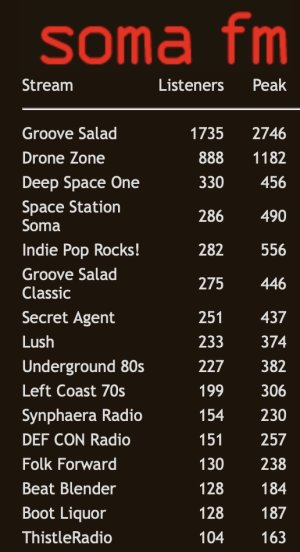
Just FYI, SomaFM's stats for right now (5:30pm Friday) with the peak being concurrents in the last 24 hours. Normally Tue/Wed are our biggest audience days. (We have a bunch of less popular channels too, our total aggregate tuning hours per month is in the 5.5-6m range. We are a "Shoutcast-type" stream
....and that ends 14 and a half years of a mostly-unattended computer running a jockless version of the previous KFRC 106.9 Classic Hits format.
I just went to Audacy-dot-com, and while Classic Hits KFRC is still shown, pushing the "play" button now starts Audacy's 60s stream.
So, one more time for the hourly ID that ran from 2008 until now, unchanged (KFRC.com ceased to exist years ago):
I just learned that I had something wrong about the now-departed KFRC-FM HD-2 and wanted to correct the record. This wasn't as hands-off a thing as I had been told. In fact, Audacy Ops Manager Tim Jordan scheduled the music for it daily and IT/Engineering Director Chuck Bullett made sure it kept running---this according to Chuck himself.
My apologies for getting it wrong for so long.
But most people are still driving older cars that don't have HD-capable radios.Except in the car, where most cars come with HD radios now.
But most people are still driving older cars that don't have HD-capable radios.
As of last year, 290 million vehicles were registered in the USA. 50 million have HD-capable radios. So that's---what?---a shade under 17 and a half percent.
Not only is it older cars, but some manufacturers save HD for their audio system upgrades in higher trim levels---so there's a certain percentage of new cars that are not HD-capable, either.

Many are monetizing HD by using an HD channel to allow the licensing of a translator. In smaller markets... even some of the top 50... a translator can be highly viable.Agreed that HD radio's days may be numbered, unless the stations can figure out a way to monetize it.
- Status
- This thread has been closed due to inactivity. You can create a new thread to discuss this topic.