• Get involved.
    We want your input!
    Apply for Membership and join the conversations about everything related to broadcasting.

    After we receive your registration, a moderator will review it. After your registration is approved, you will be permitted to post.
    If you use a disposable or false email address, your registration will be rejected.

    After your membership is approved, please take a minute to tell us a little bit about yourself.
    https://www.radiodiscussions.com/forums/introduce-yourself.1088/

    Thanks in advance and have fun!
    RadioDiscussions Administrators

Audio processing on a budget

It can be a challenge to get today’s big sound on a budget however not impossible.
An Aphex Dominator 720 and a Compellor 320 are available used pretty cheaply. If you put a decent comp/limiter and an old school sonic maximizer if front of them and an Alesis microverb behind them I think you’ll be surprised at what dynamic range these old school analog devices will produce.

The order being: comp/limiter+ Sonic Maximizer+ Compellor+ Dominator+ microverb to your transmitters limiters.

Proper adjustment of all of these devices is challenging but possible.

Try Reverb.com for these amazing old school processors! …..you’re welcome!
 
The Compellor (or any AGC) should always be placed first in the chain, except when other processors are used for special purposes, like a microphone compressor. Then the reverb unit (if you really must), then all other processors afterwards.
 
The Compellor (or any AGC) should always be placed first in the chain, except when other processors are used for special purposes, like a microphone compressor. Then the reverb unit (if you really must), then all other processors afterwards.
In most cases I would agree with you. However in this case the Compellor being third is the right place for this set up and overall effect. While the Compellor has minimal effect on dynamics it does prepare the now enhanced signal for the 720. In my humble opinion of course.
 
I can’t think of any station I’ve listened to that has had reverb.
Maybe not. However in this set up, remember we’re working on a very small budget, the microverb used correctly, gives our little set up an expanded dynamic voice. Not echoey, but wider. The microverb is basically a room simulator and if we use it sparingly, we obtain a bit of what would normally be considered dynamic expansion.
 
Since the word "Budget" is in the title I looked and found a tread Stereo tool vs Breakaway but it is closed. Does anyone have recent experiences with PC based audio chains?
 
If I remember correctly (and that is a challenge) the reverb was added in the better stations just to the jock's mic instead of all of the air chain. One of the main reasons for the reverb was to cover distortion generated by some pretty intense asymmetrical modulation. That was before the FCC limited positive modulation to 125%. (Physics limited negative peaks at 100%. You can have more than something but you can't have less than nothing.) I worked at a 250 W daytimer in my first job and they were banging better than 150% on peaks.
 
If I remember correctly (and that is a challenge) the reverb was added in the better stations just to the jock's mic instead of all of the air chain. One of the main reasons for the reverb was to cover distortion generated by some pretty intense asymmetrical modulation. That was before the FCC limited positive modulation to 125%. (Physics limited negative peaks at 100%. You can have more than something but you can't have less than nothing.) I worked at a 250 W daytimer in my first job and they were banging better than 150% on peaks.

Is that why the audio on those AM wideband off-air studio monitors always sounded so distorted?
 
Modulation monitors are often used as off-air monitors. Pre NRSC they had flat response to well past 15KHz, post NRSC they track that curve. As the NRSC pre-emphasis and de-emphasis curves are complimentary, the result is flat response up to the -3dB @10KHz filter required to meet the NRSC bandwidth specs. The idea is to simply demodulate the signal the transmitter sends to the antenna for mod measurement, then apply the NRSC de-emphasis to the audio output for monitoring.

Mod monitors are fed RF from a tap in the RF system (a couple of different ways), typically at the level of 5-10 volts RMS. You can get a decent RF burn from the signal going into the mod monitor. Because they are just demodulators, and do not include a tuned RF stage, they'll demodulate any signal from 200KHz to 160MHz that's hot enough. They'd be the absolute best off-air sound you could get, and sound nothing like a typical AM radio (with its low bandwidth RF and IF stages), then or now. Savvy stations will also use an actual radio receiver to verify what a listener would hear.

Reverb was traditionally added for a small increase in percieved loudness. In principle is that human perception of loudness includes integration over time. Reverb on speech increases that period of aural integration, and thus perceived loudness goes up. A bit. It's much less obvious on music, much of which already contains reverb of some type, leading to the perception that only mics are processed (though that is a possibility).

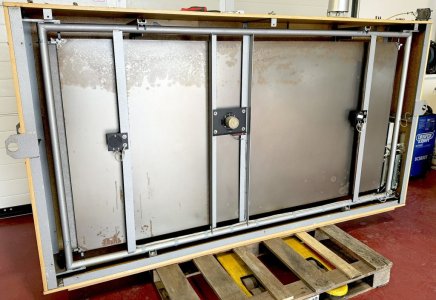
In the mid 1990s saw the original EMT Plate reverb at a mostly abandoned studio. It was a huge horizontal rectangular box in the hall outside of the air studio. A guy who used to engineer for the station said the staff was instructed to walk softly past the plate reverb. No such issues when it's done with digits.

Here's one with one side panel removed:
emt reverb.jpg

WGN uses (digital) reverb on air now.
 
In the mid 1990s saw the original EMT Plate reverb at a mostly abandoned studio. It was a huge horizontal rectangular box in the hall outside of the air studio. A guy who used to engineer for the station said the staff was instructed to walk softly past the plate reverb. No such issues when it's done with digits.

Here's one with one side panel removed:
emt reverb.jpg
Oh, that would be so much fun to play with!

I've wanted one off and on for years. I even found some plans to make my own. But they're so big and expensive, that I've settled for digital versions that are pretty good, but lack the wonderful character of the real thing, so I'm less enthused about them.

c
 
Oh, that would be so much fun to play with!

I've wanted one off and on for years. I even found some plans to make my own. But they're so big and expensive, that I've settled for digital versions that are pretty good, but lack the wonderful character of the real thing, so I'm less enthused about them.

c
Well, speaking as someone who has played with one, I can't say I'd use the term "fun". I'd use "microphonic", and "unnatural", but "fun" can be had in far better ways.

But you're compairing an entire catagory (digital reverb) to a specific device. No fair. There are many types of digital reverbs both in hardware and software, ranging from excellent to horrible. The EMT plate was what it was, and that specifically was smaller than a real chamber, better sounding than springs. The recording industry hasn't used real plates for decades, pretty much since Lexicon pioneered natural digital reverb in the early 1980s (with the exception of the analog fanatics who still think digital audio is made up of stairsteps, and tape is the worlds best medium). You can, for example, get the equivalent of what used to cost over 10K in hardware, today in software for next to nothing, and that will also simulate an EMT plate just fine. And with convolution, simulate pretty much any real room you like.

Yes, they're big and expensive, but also, they get you nothing you can't get another way that's even better. The days of the plate reverb are over, have been for a very long time. No loss.
 
@dc2bluelight Fair enough.

I'm sure there are better digital reverbs out there than what I've used, so perhaps that was a bit of an unfair over-generalization.

I don't consider myself an analog fanatic by any means (digital recording makes editing much simpler), but I do like the warm and sometimes crackly sound of analog vinyl records and tapes, even if the source material was digitally recorded and processed (in this context, the medium itself (vinyl and tape) is essentially an artistic effect).

Another quality of analog I like is tangibility and permanence. With no other tools or machines, one can directly touch and hold a vinyl record, and they can see the representations of audio in the grooves, plus they have the satisfaction of being able to hold onto it forever, since there's no DRM that enables a label to revoke one's rights to listen to it without warning.

c


Back
Top Bottom