WKTU here in NYC has the same one, it sounds like I'm almost listening to AM on FM. This just shows you the level of care the companies have of quality controlling their music. "Just get it on the air" is more appropriate for them seems like.For example, 106.1 Kiss FM in DFW plays a low bitrate version of one of the Rihanna songs (I think it’s S&M). It sounds like a 32 Kbps mp3. However, this isn’t limited to iHeart and I’m not trying to criticize any station or company.
I also hear horrible radio edits every now and then where the swear words are simply reversed and again, the goof radio edits aren’t difficult to find.

-
Get involved.
We want your input!
Apply for Membership and join the conversations about everything related to broadcasting.
After we receive your registration, a moderator will review it. After your registration is approved, you will be permitted to post.
If you use a disposable or false email address, your registration will be rejected.
After your membership is approved, please take a minute to tell us a little bit about yourself.
https://www.radiodiscussions.com/forums/introduce-yourself.1088/
Thanks in advance and have fun!
RadioDiscussions Administrators
You are using an out of date browser. It may not display this or other websites correctly.
You should upgrade or use an alternative browser.
You should upgrade or use an alternative browser.
I suppose I shouldn't be surprised that you of all people had figured out this trick as well.Also those record-label-bot channels will always have the channel name listed as "[artist name] - Topic".

Long ago, when Youtube still offered a stand-alone 256 kbit/s AAC-LC track option for every video (and even 192 kbit/s AAC-LC in their muxed format 22 legacy encodes), I considered lossless bot uploads the perfect backdoor means of mass-acquiring "first generation, keeper quality" lossy encodes of musical unobtanium. Alas, the Youtube forces that be removed the 256 kbit/s tracks eventually (and later changed even format 22 to only contain 128 kbit/s). The Opus tracks, when they were first introduced, ran at a tolerably tolerable 160 kbit/s too (~192 kbit/s in AAC-LC dog years). But they too got downgraded in the end to 128-130 kbit/s, and are still that way today. It appears with most people listening through iPhones, TV bezel speakers, and cheap earbuds these days, Youtube doesn't think anyone can hear better.
Yeah, I should have said more about this. They aren't guaranteed sources of highest-quality-available audio. They simply tend to be. I have even encountered some bot uploads now and then that were audibly sourced from lossy encodings. Even in cases where I don't clearly hear evidence of multi-generational lossy encoding, I always choose the Opus format and then inspect them using CoolEdit Pro's spectral view for insurance's sake. If I see the spectrum cutting off sharply at 16 kHz, that's a sure sign of the source having been an MP3. And since some MP3 encoders actually preserve audio above that limit, I also look for those characteristic MP3 encoder "spectral holes" -- little square-shaped (or even larger, gouge-sized) blocks of silence -- that many MP3 encoders' multiband gating functions tend to freckle throughout the highest frequencies during periods of bit starvation. The Opus codec doesn't leave those holes, so seeing them in an Opus encode is another dead giveaway that an MP3 was its source material. (Those holes are what's responsible for the "ringy" tonality of MP3 treble artifacting. They essentially consist of millisecond-length bandstops with skirts that are completely vertical and unsplined -- hence creating actual filter ringing that turns on and off at seemingly random frequencies with the speed and density of heavy rain plicking against a windshield. The designers of Opus ingeniously designed their encoder so that during any slices of time where it was starving for bits, it would leave meta instructions for the decoder to fill all the spectral holes it was creating with white noise matching the immediately adjacent spectrum's volume. This is why Opus spectral views look "solid to the top," like lossless audio spectral views -- and as a useful coincidence, it also means you can spot lossy MP3 source material, as with the Opus lossyness never adding a "layer" of its own spectral "holes," you always know that any that are visible are "showing through" from upstream.)But the audio being provided directly by the copyright owner isn't always a guarantee that they'll use the highest-quality copy available.
Yep. Although I have personally experienced the "needle drop digital" phenomenon since long before Youtube hit the scene. I still remember buying CD re-issues of two early 1970s albums (https://www.discogs.com/release/3914536 and https://www.discogs.com/release/2222790) in 1990 when I was just a naive kid, and being completely fascinated and perplexed by why I was hearing clicks, pops, and vinyl surface noise in every track on both CDs.Especially if it's an album that was never officially released in digital form. You excitedly click on the video, thinking "Wow, they finally found the master tape and did a new digital transfer of it!" -- but no, it's just a needledrop from a scratchy copy of the vinyl record, played on a not-very-good turntable. They don't care how good or bad it sounds; they just want to add it into YouTube's Content ID system so they can get the copyright revenue from it.
Finicky artists sometimes do the same thing simply "because." Didn't Enya famously try to memory hole the Gaelic version of "Book of Days" by covertly replacing it on all future album pressings with an english re-record? Also, Abby Travis' "Blythe," from her "Glitter Mouth" album, exists in a 5:29 version as well as in a 5:08 version. The 5:08 is the one you see everywhere today, on Youtube, at Bandcamp, and listed in Discogs. The 5:29 version, conversely, only showed up on Napster and on my local NPR station right before the album's official public release. Guess she decided to re-record it at the last second and scrub the original from existence -- or something.Or, worse yet, it could be a re-recording! I've seen that quite often, especially from one-hit-wonder artists, and groups which had a revolving door of members, like the Ink Spots and the Drifters.
Last edited:
Stations used to need audiophilic technology propellor heads to populate their unwieldy hardware-based automation with music. Now anyone with Windows skillz can populate a station's automation, and so you often have "the new intern in programming" using https://convert-itunes-m4a-to-mp3-fast.ru/ to do exactly that. Hey, the result sounds good through her Beats Pill buried under all the fast food wrappers on the desk ... so what could possibly go wrong?WKTU here in NYC has the same one, it sounds like I'm almost listening to AM on FM. This just shows you the level of care the companies have of quality controlling their music. "Just get it on the air" is more appropriate for them seems like.
Last edited:

There were companies that bought the unsalable vinyl records and used big heated punches to get the center punched out. This was very very common in less developed nations, where the vinyl was costly but also done in the US, often for small pressing plants that did indies or custom pressings.Back in final days of vinal, did anyone ever get a Motown record that had tiny pieces label inbeded the record. I was told it occasionally happened when they recycled vinyl from old returned records without removing all of the label.
But some of it got into the larger labels. During the oil crisis of the early 70's, vinyl was in shorter supply and the cost went up. I am guessing, but the idea of recycling returns was thought about everywhere.
Last edited:
I'm somehow pleased to see that I'm not the only one who's frustrated by the inconsistent and sometimes mediocre quality of supposedly "remastered, high quality" releases.
In my attempts at setting up the library for my Part 15 station, I've found that by and large, I can find good sounding recordings for most of the well known artists, but oftentimes for some of the lesser known or obscure stuff (easy listening is a big one), finding recordings that sound even tolerable is almost impossible. I want my library to sound good, because even on staticky AM with a lousy sounding radio and amateurish audio processing, the difference between a good quality lossless recording (or high bitrate MP3 one from a lossless source, even) and a low bitrate, badly encoded one is blatantly obvious, at least to me.
So, I've started collecting vinyl records, open reel tapes and cassettes, and if carefully copied using modest but decent sounding equipment, I've found that they sound better than most of the so-called HD stuff on Youtube and the like, even with all the noise and distortion of the old media and machines.
That said, I'm always looking for good quality recordings of older easy listening works, such as the many Reader's Digest box sets from the 60s and 70s, as well as some of the more obscure oldies (there's a surprising amount of stuff recorded as recently as the 80s for which decent quality versions aren't available) and if there's a place online where I can find them affordably (free would be nice of course, but I want to be fair, so if/when necessary, I'll gladly pay if I have the means), that would be excellent. I can copy it all myself (I do have a few of those box sets, found at various thrift stores over the years) but it's a hideously tedious process for one person. Especially documenting the metadata, much of which seems to be unknown and/or lost to time for the obscure stuff.
c
In my attempts at setting up the library for my Part 15 station, I've found that by and large, I can find good sounding recordings for most of the well known artists, but oftentimes for some of the lesser known or obscure stuff (easy listening is a big one), finding recordings that sound even tolerable is almost impossible. I want my library to sound good, because even on staticky AM with a lousy sounding radio and amateurish audio processing, the difference between a good quality lossless recording (or high bitrate MP3 one from a lossless source, even) and a low bitrate, badly encoded one is blatantly obvious, at least to me.
So, I've started collecting vinyl records, open reel tapes and cassettes, and if carefully copied using modest but decent sounding equipment, I've found that they sound better than most of the so-called HD stuff on Youtube and the like, even with all the noise and distortion of the old media and machines.
That said, I'm always looking for good quality recordings of older easy listening works, such as the many Reader's Digest box sets from the 60s and 70s, as well as some of the more obscure oldies (there's a surprising amount of stuff recorded as recently as the 80s for which decent quality versions aren't available) and if there's a place online where I can find them affordably (free would be nice of course, but I want to be fair, so if/when necessary, I'll gladly pay if I have the means), that would be excellent. I can copy it all myself (I do have a few of those box sets, found at various thrift stores over the years) but it's a hideously tedious process for one person. Especially documenting the metadata, much of which seems to be unknown and/or lost to time for the obscure stuff.
c
As for listening to the radio, I found that KISQ 98.1 (carrying iHeart's The Breeze format) sounds like they're simply broadcasting a low bitrate stream-like source, which to me is a huge turnoff. I noticed that it sounds marginally better in HD, but most of the time the signal isn't quite strong enough at my location to lock on, so I'm stuck with the analog signal.
c
c
D
Deleted member 76036
Guest
So beyond my original post about specific audio files sounding like low quality versions were put into the automation, I’ve also noticed that the iHeart stations here in DFW seem to have quality issues. It seems to come and go here, but I know exactly what you’re talking about. Sometimes 102.1 KDGE-HD2 sounds wayyy better than the HD1 and analog signal. It’s bizzare and only seems to be an iHeart issue. I know iHeart does traffic on HD, so I’m wondering if they’ve made some changes and that’s hogging all the bandwidth. I really don’t know, but it never used to be this way…As for listening to the radio, I found that KISQ 98.1 (carrying iHeart's The Breeze format) sounds like they're simply broadcasting a low bitrate stream-like source, which to me is a huge turnoff. I noticed that it sounds marginally better in HD, but most of the time the signal isn't quite strong enough at my location to lock on, so I'm stuck with the analog signal.
The data rate can be switched between the different HD channels.

We have a classic hits format, so every song we play is accessible from those GoldDiscs or I'll go through one of several broadcast libraries online. I've been buying promo records from Discogs or eBay, cleaning the records and slapping it on a turntable. After hours of manual removal of pops and clicks (automatic pop and click removal tools do not work well enough), I'll import that to WO. When I'm on-air, I'll mention the track as coming from a record once in a while when it comes up against a VT.Thanks for defending quality.
Our HD2 is a specialty format that I don't care that much about. I have enough with engineering. I fix the worst of the files, most of which were imported from the old MPEG2 files during the Scott Systems days and get to the rest when I'm done with the important stuff.
This did happen. Everyone always thinks of the OPEC oil issues of '73 to have only impacted cars. But the oil shortage also impacted the plastics industry (which LPs are definitely a part of). So a lot of labels either started using more reground vinyl (labels should have been removed, but weren't always). RCA introduced its Dynaflex (thin LPs).Back in final days of vinal, did anyone ever get a Motown record that had tiny pieces label inbeded the record. I was told it occasionally happened when they recycled vinyl from old returned records without removing all of the label.
So yes, this really did happen. I haven't run across it personally, though.
Thanks for the correction there. I do believe this was still a cost savings measure, as petroleum (PVC) was a big expense for the labels. Pressings overall got thinner in the early 70s around the time of OPEC....in 1969:
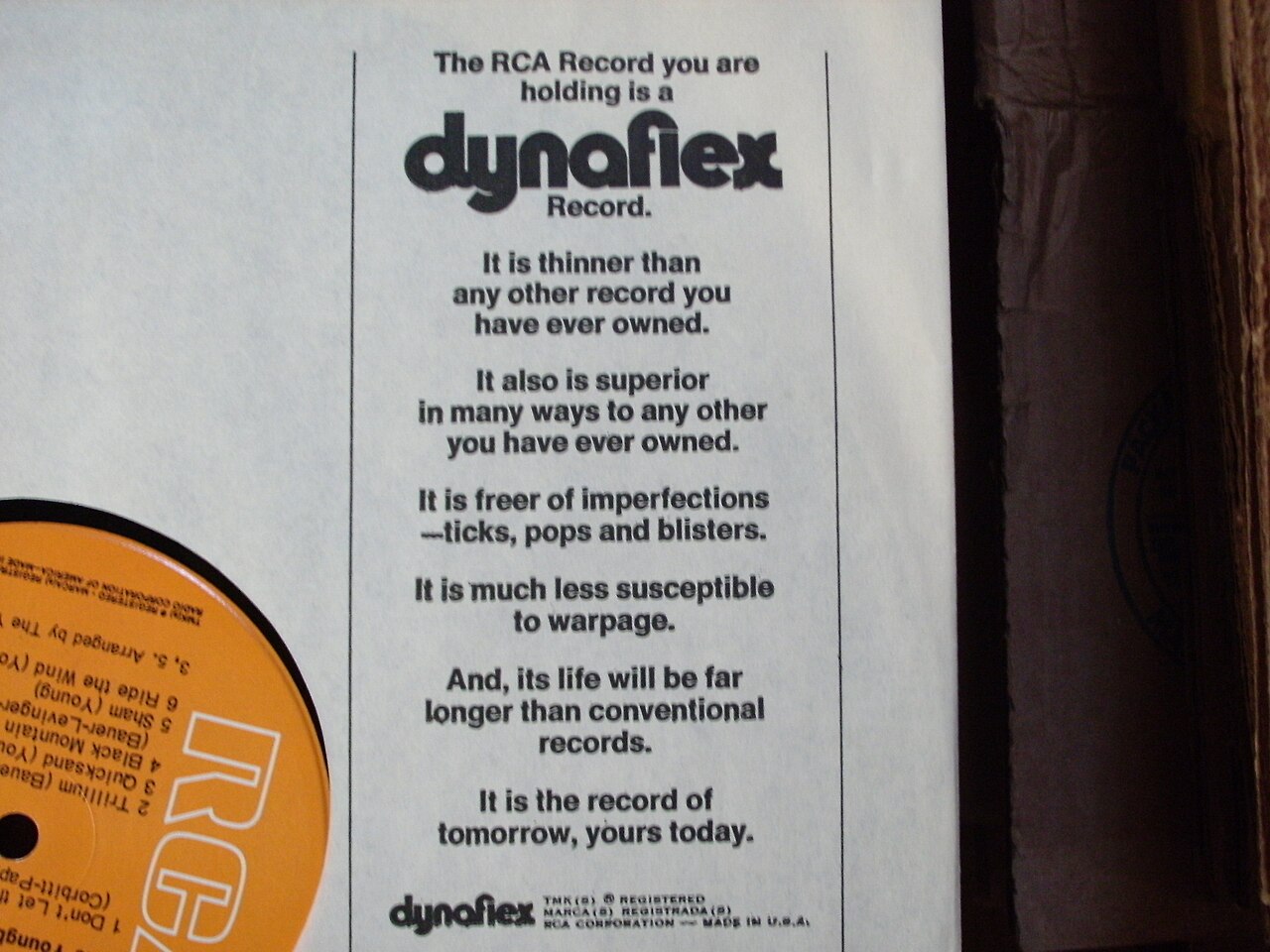
Dynaflex (RCA) - Wikipedia
en.wikipedia.org
And noisier, from what I've read and heard, perhaps as a result of, in part, embedded bits of old label roughening up the grooves.Pressings overall got thinner in the early 70s around the time of OPEC.
In my experience, though, most Dynaflex LPs I've played sound about as good as older, thicker pressings, but I have found that, obviously, they are more prone to warping because of their thinness.
c
Last edited:
I saw a number of record plants, and all had a machine that took the vinyl and stamped out the central label area and threw it away, plastic and all. None tried to remove the paper label and its adhesive.And noisier, from what I've read and heard, perhaps as a result of, in part, embedded bits of old label roughening up the grooves.
c
Plus Dynaflex LPs only used virgin vinyl, not reground vinyl that often had so much surface noise that it already sounded like a worn-out record the first time you played it.In my experience, though, most Dynaflex LPs I've played sound about as good as older, thicker pressings, but I have found that, obviously, they are more prone to warping because of their thinness.
Correct. Those Dynaflex LPs often sound pretty fantastic!Plus Dynaflex LPs only used virgin vinyl, not reground vinyl that often had so much surface noise that it already sounded like a worn-out record the first time you played it.
MCA, on the other hand... And don't even get me started on certain labels styrene 45s (Imperial, for example)...
- Status
- This thread has been closed due to inactivity. You can create a new thread to discuss this topic.