It's interesting that for the last few years KOLA ID's as "San Bernardino-Riverside" whereas for decades before it was always "San Bernardino-Riverside-Ontario". Is Ontario now totally within the LA Radio DMA rather than just supplemental to it?

-
Get involved.
We want your input!
Apply for Membership and join the conversations about everything related to broadcasting.
After we receive your registration, a moderator will review it. After your registration is approved, you will be permitted to post.
If you use a disposable or false email address, your registration will be rejected.
After your membership is approved, please take a minute to tell us a little bit about yourself.
https://www.radiodiscussions.com/forums/introduce-yourself.1088/
Thanks in advance and have fun!
RadioDiscussions Administrators
You are using an out of date browser. It may not display this or other websites correctly.
You should upgrade or use an alternative browser.
You should upgrade or use an alternative browser.
Baffling music selections on KOLA
- Thread starter victorres43
- Start date

Ontario is not in any rated market. It is in a corridor along the 210 Freeway from Ontario to Fontana that historically neither market wanted, going back to when many directional LA AMs did not reach, and the Riverside ones like 1440 and 1350 and the Class IV in San Berdoo didn't either.It's interesting that for the last few years KOLA ID's as "San Bernardino-Riverside" whereas for decades before it was always "San Bernardino-Riverside-Ontario". Is Ontario now totally within the LA Radio DMA rather than just supplemental to it?
There are no expanded TSA's in PPM markets. Just metros. And DMA's are TV markets.
Last edited:
Radio Ratings do not have a DMA. In the PPM system, there is not even a TSA. Just the Metro Survey Area. For LA, that is all of LA and Orange Counties, and no part of any other county.It's interesting that for the last few years KOLA ID's as "San Bernardino-Riverside" whereas for decades before it was always "San Bernardino-Riverside-Ontario". Is Ontario now totally within the LA Radio DMA rather than just supplemental to it?
Riverside County has a lot of no-survey-area territory, a piece of the Riverside/San Bernardino market and all of the Palm Springs Market. San Bernardino County has part of the Riverside/ San Berdoo market, all of the High Desert market and a lot of un-surveyed area, including the no-man's-land area from Pomona to Fontana that is in neither the IE nor the LA market.
Decades ago when lots of people listened to AM radio, it was proposed to unite the IE and LA to make a much bigger market. But most of the LA AMs voted against that, and all of the IE stations did. Both of those groups had limited or no coverage of the part of the proposed market that would be added in. So they remained separate.
Similarly, nobody wanted the Pomona to Fontana zone because it would dilute shares for all stations, not matter what.

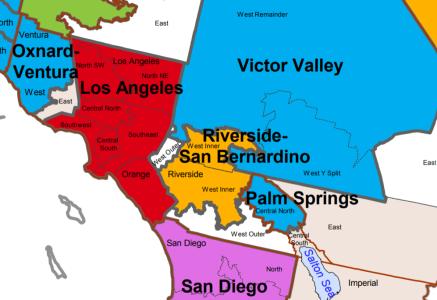
From looking at that map, does that mean that Temecula is not part of the Riverside - San Bernardino market and is part of “West Outer”?A visual aid to Mr. Gleason's post - a map of the Nielsen markets in southern California.
I know that a couple of San Diego radio stations, now and again, have "unofficially" claimed Temecula and environs as part of their market. In fact, one or two TV stations in SD treat that area as part of their market relative to their weather forecasts. Part of this is no doubt due to the fact that about 70% of the home owners in that area migrated north from SD in search of cheaper housing, and around 60-70% commute into SD County for their jobs. These figures were from about 20 or so years ago, what the reality today is I don't know. Perhaps David can help.From looking at that map, does that mean that Temecula is not part of the Riverside - San Bernardino market and is part of “West Outer”?
You bring up some very good points that I can definitely vouch for from personal experience. My wife is a nurse in North County San Diego and a lot of her co-workers commute from Temecula, Murrieta and Menifee on a daily basis because of the cheaper and more affordable housing available up there. A lot of these people grew up in San Diego County and have most of their friends in SD / North County so they are definitely more interested in San Diego radio stations and news than that coming from LA. My brother-in-law does the opposite: he lives in Oceanside and works in Temecula, but listens to San Diego radio stations while at work in Temecula.I know that a couple of San Diego radio stations, now and again, have "unofficially" claimed Temecula and environs as part of their market. In fact, one or two TV stations in SD treat that area as part of their market relative to their weather forecasts. Part of this is no doubt due to the fact that about 70% of the home owners in that area migrated north from SD in search of cheaper housing, and around 60-70% commute into SD County for their jobs. These figures were from about 20 or so years ago, what the reality today is I don't know. Perhaps David can help.
On the television side, I believe that KUSI, an independent television station in San Diego, has a translator up in Murrieta so that tells me that a lot of displaced San Diegoans live up there and prefer San Diego news on television and the radio since they do have a focus on Temecula news and traffic. KUSI has news stories about things going on in Temecula and KOGO AM 600 from San Diego gives traffic updates about the I-15 through Temecula and the I-15 / I-215 split in Murrieta. San Diego North County, southern Orange County and southern Riverside County are a lot alike, but they don’t really have their own media market. As such, you have three different radio markets: (1) Los Angeles, (2) San Diego and (3) the Inland Empire San Bernardino / Riverside market. If you are in these areas, you can pick up radio stations from all three radio markets and choose what you want to listen to. Television, though, is a little different since the Inland Empire does not have their own television market with local stations so if you are in Temecula, you will get LA stations on cable, but if you go a couple of miles south on the I-15 into Rainbow Valley in San Diego County, you will get all the San Diego television stations. Not sure if there is such a dichotomy of large television markets so close to each other like that where a couple of miles is the difference between receiving LA television stations or San Diego television stations!

There are areas between San Francisco and Sacramento where that’s the case. I would think Baltimore and Washington, D.C. would be one, too.Not sure if there is such a dichotomy of large television markets so close to each other like that where a couple of miles is the difference between receiving LA television stations or San Diego television stations!

Yes Solano County, CA is in two media markets Sacramento and Bay Area. Vallejo and Benicia are counted as being in the San Francisco-Oakland-San Jose Media Market while Dixon, Rio Vista and Vacaville are counted as part of the Sacramento Media market.There are areas between San Francisco and Sacramento where that’s the case. I would think Baltimore and Washington, D.C. would be one, too.
Fairfield and Suisun City are the cities where the boundary between Sacramento and San Francisco are factored here.
I think parts of New Jersey would count as being in two media markets due to New York getting the northern New Jersey and Southern New Jersey is counted as parts of the Philadelphia media market.
Remember, Nielsen works on a county basis, not a city one. In this case, you have a county divided in an eastern and western part with each allocated to a different market.Yes Solano County, CA is in two media markets Sacramento and Bay Area. Vallejo and Benicia are counted as being in the San Francisco-Oakland-San Jose Media Market while Dixon, Rio Vista and Vacaville are counted as part of the Sacramento Media market.
New Jersey has a "whole bunch" of radio markets. First, there are portions in the NYC and Philadelphia metros. Then there are the Atlantic City and Trenton markets. And then there are the suburban NYC markets that are subsets of the larger NYC market but issues separately to give local area stations a separate report.I think parts of New Jersey would count as being in two media markets due to New York getting the northern New Jersey and Southern New Jersey is counted as parts of the Philadelphia media market.
Yep. The "white areas" are orphans. The little one in the foothills from Fontana to Ontario in San Bernardino County is not in either the LA nor the Riverside/San Berdoo markets.From looking at that map, does that mean that Temecula is not part of the Riverside - San Bernardino market and is part of “West Outer”?
If you add up the cities that are in that area, it appears to have enough people to be, on its own, a Top 100 market!
These geographical issues are interesting, though. A few years ago, the cable provider in Truckee, California tried to switch the network affiliates on their system from Sacramento (100 miles away) to Reno (30 miles) away. But while Truckee has more in common with Reno in terms of weather and geography, the viewers there care about coverage of California and Placer County, which the Reno stations have no real incentive to cover. Eventually the outcry won out and the Sac stations stayed.
This has been an ongoing issue in the Lake Tahoe basin, where people live and work in both California and Nevada.
Up until the 1980s, Northern California and Northern Nevada cable systems covered all the bases---San Francisco cable had Sacramento stations and vice-versa....and Reno-Tahoe carried Sacramento and the independents from San Francisco in addition to the local Reno stations.
This has been an ongoing issue in the Lake Tahoe basin, where people live and work in both California and Nevada.
Up until the 1980s, Northern California and Northern Nevada cable systems covered all the bases---San Francisco cable had Sacramento stations and vice-versa....and Reno-Tahoe carried Sacramento and the independents from San Francisco in addition to the local Reno stations.
Although with digital xmission its probably not the case today but I was told by a friend of mine who used to live in the Temecula area that back in the analogue days many people had no trouble picking up CHs 8 and 10 with a rooftop antenna. I'm pretty sure that these two SD stations are carried on cable as "distant" stations, at the very least, meaning their network programming is switched over to LA.You bring up some very good points that I can definitely vouch for from personal experience. My wife is a nurse in North County San Diego and a lot of her co-workers commute from Temecula, Murrieta and Menifee on a daily basis because of the cheaper and more affordable housing available up there. A lot of these people grew up in San Diego County and have most of their friends in SD / North County so they are definitely more interested in San Diego radio stations and news than that coming from LA. My brother-in-law does the opposite: he lives in Oceanside and works in Temecula, but listens to San Diego radio stations while at work in Temecula.
On the television side, I believe that KUSI, an independent television station in San Diego, has a translator up in Murrieta so that tells me that a lot of displaced San Diegoans live up there and prefer San Diego news on television and the radio since they do have a focus on Temecula news and traffic. KUSI has news stories about things going on in Temecula and KOGO AM 600 from San Diego gives traffic updates about the I-15 through Temecula and the I-15 / I-215 split in Murrieta. San Diego North County, southern Orange County and southern Riverside County are a lot alike, but they don’t really have their own media market. As such, you have three different radio markets: (1) Los Angeles, (2) San Diego and (3) the Inland Empire San Bernardino / Riverside market. If you are in these areas, you can pick up radio stations from all three radio markets and choose what you want to listen to. Television, though, is a little different since the Inland Empire does not have their own television market with local stations so if you are in Temecula, you will get LA stations on cable, but if you go a couple of miles south on the I-15 into Rainbow Valley in San Diego County, you will get all the San Diego television stations. Not sure if there is such a dichotomy of large television markets so close to each other like that where a couple of miles is the difference between receiving LA television stations or San Diego television stations!
Last edited:
There are areas between San Francisco and Sacramento where that’s the case. I would think Baltimore and Washington, D.C. would be one, too.
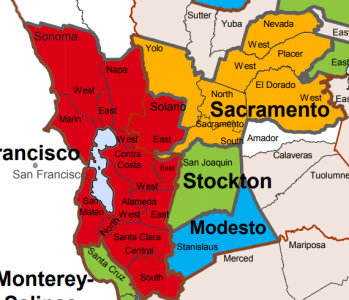 Interesting on the radio side Solano-E which is where Vacaville, Dixon and Rio Vista are counted as part of the San Francisco Radio Market. But once TV is involved then Solano-E is counted as part of the Sacramento TV market. Parts of the explanation why Solano ended up in two media markets involves KOVR-TV CBS 13 in its early history https://en.wikipedia.org/wiki/KOVR Originally KOVR TV was supposed to include the Bay Area in its OTA coverage until ABC ordered KOVR to not be in the Bay Area due to its ABC affiliation contract at the time and so it does not remove viewers away from ABC O&O KGO-TV in San Francisco proper.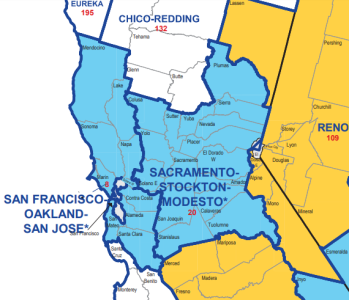

K.M. Richards
Program Director, The Eighties Channel™
True, but not exactly.Originally KOVR TV was supposed to include the Bay Area in its OTA coverage until ABC ordered KOVR to not be in the Bay Area due to its ABC affiliation contract at the time and so it does not remove viewers away from ABC O&O KGO-TV in San Francisco proper.
KOVR originally went on the air from Mt. Diablo, which allowed it to be received in both the Bay Area and the northern San Joaquin Valley. In fact, the call letters KOVR were intended to evoke channel 13 "covering" a wide area.
ABC's original Sacramento affiliate was KCCC-TV/40, which operated from September 30, 1953 to May 31, 1957 and its demise was KOVR-related. Channel 13 wanted the ABC affiliation for Sacramento and the network was amenable ... except that they didn't want to potentially split viewership with KGO-TV. But KCCC-TV fought KOVR's move from Diablo to Butte Mountain, just east of Sacramento and the move didn't happen until channel 40's owners bought a part-interest in channel 13 and went dark, transferring the ABC affiliation in the process.
So it wasn't case of ABC "ordering" them not to cover the Bay Area ... they just refused to let them affiliate until they moved away.
Incidentally, KCCC-TV ran into its own problems with ABC when it bought the other Stockton station, KTVU/36 (dark after operating as an independent for about 18 months in 1953-55) with the intent of operating it as a satellite, but it also had signal overlap with KGO-TV, and the network threatened to pull the affiliation if they went through with it. Even though the sale got FCC approval, they never put it back on the air for that reason.
And yeah, this is all in my article on KCCC-TV on the still temporarily offline UHF History site.
I wonder if the definitions would ever be revisited. It’s funny, many of the LA stations cover the IE better than the SF stations cover San Jose, East Solano and Santa Rosa.Radio Ratings do not have a DMA. In the PPM system, there is not even a TSA. Just the Metro Survey Area. For LA, that is all of LA and Orange Counties, and no part of any other county.
Riverside County has a lot of no-survey-area territory, a piece of the Riverside/San Bernardino market and all of the Palm Springs Market. San Bernardino County has part of the Riverside/ San Berdoo market, all of the High Desert market and a lot of un-surveyed area, including the no-man's-land area from Pomona to Fontana that is in neither the IE nor the LA market.
Decades ago when lots of people listened to AM radio, it was proposed to unite the IE and LA to make a much bigger market. But most of the LA AMs voted against that, and all of the IE stations did. Both of those groups had limited or no coverage of the part of the proposed market that would be added in. So they remained separate.
Similarly, nobody wanted the Pomona to Fontana zone because it would dilute shares for all stations, not matter what.
I guess the market rank of number 4 is more important to the SF stations. LA would still be number 2 even if the ie and Ontario were to be added.
One of you historian type people certainly would know better than me...I remember reading that apparently sometime after the FCC modified the TV table of assignments and Channel 12 was taken away from Fresno and given to Santa Barbara County and before a new agreement was made with Mexico, A CP was issued for a TV station on Ch 12 in Riverside and the call letters KORA were granted but the station was never built...does anyone have any info on this??
K.M. Richards
Program Director, The Eighties Channel™
One of you historian type people certainly would know better than me...I remember reading that apparently sometime after the FCC modified the TV table of assignments and Channel 12 was taken away from Fresno and given to Santa Barbara County and before a new agreement was made with Mexico, A CP was issued for a TV station on Ch 12 in Riverside and the call letters KORA were granted but the station was never built...does anyone have any info on this??
Of course I do. Short version: KFRE-TV originally operated on channel 12 but by the time they went on the air in 1956 the FCC was already planning to make Fresno an all-UHF market, which they did by moving them to channel 30. The channel 12 allocation was originally proposed to be moved to Santa Barbara but that created a problem in the negotiations for the agreement you referenced for 14 VHF assignments within 200 miles of the shared border along California, Arizona, New Mexico and Texas. (The problem, as most people already know by now, is that a channel 12 signal from Santa Barbara would have an impeded path across the Pacific Ocean to interfere co-channel with Tijuana.) Allocating it on the other side of the Santa Ynez Mountains, in Santa Maria, solved that problem.
I believe you are 100% mistaken on all counts about "KORA" ... those calls belonged to an AM radio station in Bryan TX in from 1947 to 1973, and still exist (since 1966) on a still co-owned FM, and channel 12 was never allocated to Riverside. I think you mean KARO, which was assigned channel 1 before that channel was reallocated to land mobile services nationwide in 1947; the CP holder tried unsuccessfully to have channel 13 moved there from Los Angeles and also tried to get a STA to use channel 6 while that request was in process, but the pre-1952 freeze prevented both from being considered (and the CP itself was cancelled in 1949). But it was never a channel 12 allocation.
Thank you! I have a bit of dyslexia. This was many years ago, and the Calls were no doubt KARO, I simply remembered them wrong. Speaking of Ch 12 in Santa Maria, besides terrain shielding, I think they were also required to operate with about half the power for which they would ordinarily be authorized.Of course I do. Short version: KFRE-TV originally operated on channel 12 but by the time they went on the air in 1956 the FCC was already planning to make Fresno an all-UHF market, which they did by moving them to channel 30. The channel 12 allocation was originally proposed to be moved to Santa Barbara but that created a problem in the negotiations for the agreement you referenced for 14 VHF assignments within 200 miles of the shared border along California, Arizona, New Mexico and Texas. (The problem, as most people already know by now, is that a channel 12 signal from Santa Barbara would have an impeded path across the Pacific Ocean to interfere co-channel with Tijuana.) Allocating it on the other side of the Santa Ynez Mountains, in Santa Maria, solved that problem.
I believe you are 100% mistaken on all counts about "KORA" ... those calls belonged to an AM radio station in Bryan TX in from 1947 to 1973, and still exist (since 1966) on a still co-owned FM, and channel 12 was never allocated to Riverside. I think you mean KARO, which was assigned channel 1 before that channel was reallocated to land mobile services nationwide in 1947; the CP holder tried unsuccessfully to have channel 13 moved there from Los Angeles and also tried to get a STA to use channel 6 while that request was in process, but the pre-1952 freeze prevented both from being considered (and the CP itself was cancelled in 1949). But it was never a channel 12 allocation.
It's so interesting that Riverside/San Bernardino never became a separate TV market, because simply based on distance almost anywhere else in the country they would be. I assume it's because most other markets don't have a 5280 ft. mountain!
on
Example… the maximum HAAT for the old 7-13 at 316 kw visual was just under 2000 here, but in NY and Chicago it was under 1000 ft at that power.
You can find this info on David’s wonderful site.
West of the Rockies, TV stations were allowed higher HAAT relative the ERP. The DMAs are all quite large.Thank you! I have a bit of dyslexia. This was many years ago, and the Calls were no doubt KARO, I simply remembered them wrong. Speaking of Ch 12 in Santa Maria, besides terrain shielding, I think they were also required to operate with about half the power for which they would ordinarily be authorized.
It's so interesting that Riverside/San Bernardino never became a separate TV market, because simply based on distance almost anywhere else in the country they would be. I assume it's because most other markets don't have a 5280 ft. mountain! , 60 miles is not far when it comes to DMA.
Example… the maximum HAAT for the old 7-13 at 316 kw visual was just under 2000 here, but in NY and Chicago it was under 1000 ft at that power.
You can find this info on David’s wonderful site.
- Status
- This thread has been closed due to inactivity. You can create a new thread to discuss this topic.