• Get involved.
    We want your input!
    Apply for Membership and join the conversations about everything related to broadcasting.

    After we receive your registration, a moderator will review it. After your registration is approved, you will be permitted to post.
    If you use a disposable or false email address, your registration will be rejected.

    After your membership is approved, please take a minute to tell us a little bit about yourself.
    https://www.radiodiscussions.com/forums/introduce-yourself.1088/

    Thanks in advance and have fun!
    RadioDiscussions Administrators

Baffling music selections on KOLA

I just found an unintended typo to my last post.

Channel 12, if allocated to Santa Barbara, would have an unimpeded path to Tijuana.
 
Her recording career started in 2008. Thirteen-year-old songs don't fit the standard definition of "classic hits," but I hear them a lot on local stations nonetheless, referred to as "throwbacks" -- too old to be recurrents, not old enough to be gold. Maybe KOLA (and, I assume, similar stations elsewhere) are expanding the definition as a way to find more songs that click with their target audience, regardless of year of release. Since fewer songs became hits in the '90s and '00s compared to the '70s and '80s, as new methodology turned the pop chart to sludge, and the rock/rhythmic divide became a chasm, I can see this as something a lot of classic hits stations will be doing to chase that always-moving demographic target.
Pre-2005 approximately is my cutoff date for classic hits. Basically when DSL and Wifi internet were then luxuries and Geocities was the place for personal web pages.
 
Pre-2005 approximately is my cutoff date for classic hits. Basically when DSL and Wifi internet were then luxuries and Geocities was the place for personal web pages.
I personally had 2007 as the firm cutoff date for Classic Hits. Before YouTube supplanted MTV as the source for music videos, and before the millennial "pure pop" wave. Though 2004 could work too as a cutoff date since Casey Kasem had his last AT40 show in January 2004, and Carson Daly stepped down as TRL host in 2003.
 
Well, let's see what the stations themselves think, shall we?

Using the airplay monitoring service I subscribe to ... For the period covering the past seven days, there were 4987 songs from 1954 to present day that received at least one play on one station.

2390 of those are on at least five of the 75 stations in the nationwide Classic Hits monitor. Slightly under half of the total.

730 of those 2390 had at least 50 spins total nationwide (just under one-third). That's pretty much what we'd consider a core group of titles based on airplay.

By decade:
1950s: None.
1960s: 66.
1970s: 218.
1980s: 388.
1990s: 55.
2000s: Three.

And the year with the most titles in the core group? 1984, with 66. Runners-up: 1983 (56), 1982 (43), 1985 (39), and 1987 (38). 1988 and 1989 together only had 51.

In context, trying to decide whether the "correct" cutoff year was 2005 or 2007 is essentially a mind exercise with no real world correlation.
 
You bring up some very good points that I can definitely vouch for from personal experience. My wife is a nurse in North County San Diego and a lot of her co-workers commute from Temecula, Murrieta and Menifee on a daily basis because of the cheaper and more affordable housing available up there. A lot of these people grew up in San Diego County and have most of their friends in SD / North County so they are definitely more interested in San Diego radio stations and news than that coming from LA. My brother-in-law does the opposite: he lives in Oceanside and works in Temecula, but listens to San Diego radio stations while at work in Temecula.

On the television side, I believe that KUSI, an independent television station in San Diego, has a translator up in Murrieta so that tells me that a lot of displaced San Diegoans live up there and prefer San Diego news on television and the radio since they do have a focus on Temecula news and traffic. KUSI has news stories about things going on in Temecula and KOGO AM 600 from San Diego gives traffic updates about the I-15 through Temecula and the I-15 / I-215 split in Murrieta. San Diego North County, southern Orange County and southern Riverside County are a lot alike, but they don’t really have their own media market. As such, you have three different radio markets: (1) Los Angeles, (2) San Diego and (3) the Inland Empire San Bernardino / Riverside market. If you are in these areas, you can pick up radio stations from all three radio markets and choose what you want to listen to. Television, though, is a little different since the Inland Empire does not have their own television market with local stations so if you are in Temecula, you will get LA stations on cable, but if you go a couple of miles south on the I-15 into Rainbow Valley in San Diego County, you will get all the San Diego television stations. Not sure if there is such a dichotomy of large television markets so close to each other like that where a couple of miles is the difference between receiving LA television stations or San Diego telev

Not to be too off topic...but I don't see the point of having KUSI translator in Murrietta area. No cable company really carries it and of course, services like YouTubeTV and Hulu Live, which are becoming increasingly popular don't carry it. This means they probably have just a few viewers who happen to catch it by antenna. It would be nice if it was more widely available in the Temecula Valley given it's proximity to San Diego. Even SD radio stations are hard to pick up in this area (I've done the drive a few times on the I-15).
 
Not to be too off topic...but I don't see the point of having KUSI translator in Murrietta area. No cable company really carries it and of course, services like YouTubeTV and Hulu Live, which are becoming increasingly popular don't carry it. This means they probably have just a few viewers who happen to catch it by antenna. It would be nice if it was more widely available in the Temecula Valley given it's proximity to San Diego. Even SD radio stations are hard to pick up in this area (I've done the drive a few times on the I-15).
There is still nearly 30% of TV viewing in SoCal that is OTA, not cable or stream originated. Even if this were only 105 to 15%, that is enogh to warrant the small cost of a translator.
 
There is still nearly 30% of TV viewing in SoCal that is OTA, not cable or stream originated. Even if this were only 105 to 15%, that is enogh to warrant the small cost of a translator.
But will an antenna even pick up any major affiliates from LA or SD given the distance?
 
But will an antenna even pick up any major affiliates from LA or SD given the distance?
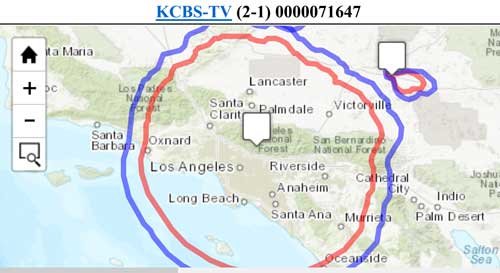
LA, yes. Remember, the major LA TVs are 5000 feet up on Mt Wilson. Murrieta is about the same distance as Hemet, and a little farther than Perris and all have pretty clear line of site from Wilson. Look at it on a topographical map.
 
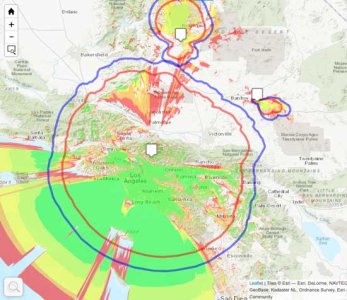
Here are some coverage contours of KCBS-TV.
Looks like the signal gets to the area.

Screenshot-2022-01-20-164736-.jpg
 
Status
This thread has been closed due to inactivity. You can create a new thread to discuss this topic.


Back
Top Bottom