• Get involved.
    We want your input!
    Apply for Membership and join the conversations about everything related to broadcasting.

    After we receive your registration, a moderator will review it. After your registration is approved, you will be permitted to post.
    If you use a disposable or false email address, your registration will be rejected.

    After your membership is approved, please take a minute to tell us a little bit about yourself.
    https://www.radiodiscussions.com/forums/introduce-yourself.1088/

    Thanks in advance and have fun!
    RadioDiscussions Administrators

BBC preparing to close 198 kHz longwave

As I recall the BBC broadcast from Okeechobee was around 4 PM my time (PDT).

And indeed the last evening BBC broadcast I remember hearing was the one targeted to the Caribbean from Ascension Island on 25 Meters in the late afternoon Pacific Time.

The last morning broadcast (Pacific Time) I remember hearing was from Singapore on 9740.
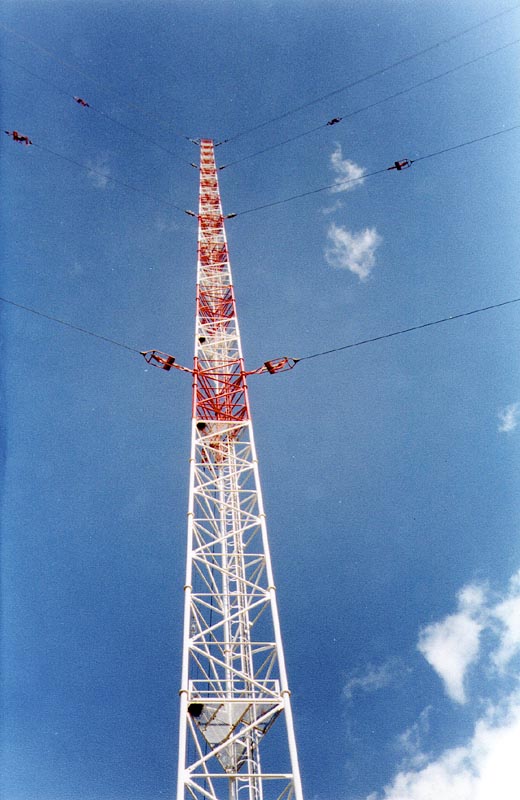
 
And the Roumoules station is the old Radio Monte Carlo, formerly on 1466 which was a full commercial station, doing Top 40 part of the day in French and part in Italian.
The other monster signal at Roumoules, namely the 216 kHz longwave outlet, has been off the air since 2020. It had been running 1400kw, but once ran 2000kw with two 1000kw transmitters in parallel. There was a third megawatt backup unit that could be combined with the other two to acheive 3000kw😵‍💫🤯but AFAIK that power level was never used.

 
Radio 4 mediumwave transmitters that will close are on 603, 720, 756, 774, 1449 and 1485 kHz.
Update: The BBC Radio 4 mediumwave outlets have now discontinued programming, and announcements are airing redirecting listeners to FM, DAB, and various online platforms. Interestingly no mention of the 198 kHz longwave service, which will probably shut down mid-2025.
 
So anyone know why the U.S. didn't adopt long wave? And for those who did listen to long wave, how did its reach and signal quality compare to AM/medium wave, shortwave, etc.?
 
So anyone know why the U.S. didn't adopt long wave? And for those who did listen to long wave, how did its reach and signal quality compare to AM/medium wave, shortwave, etc.?
One of the reasons why longwave was not developed was that the US system was always based on private investment while in Europe it was controlled almost totally by government broadcasters until well after WW II. Longwave has immense coverage due to the low frequencies and government operators like the ability to use just a few transmitters to cover the whole nation.

In the US, under the FRC and FCC, the politicians in Washington did not want high power wide coverage stations as their owners could have immense influence and power. That is why our AMs were limited to the low 50 kw maximum power, too.

And... if 1000 watts on 550 covers as well as 50,000 watts on 1500, think of how a few hundred thousand watts below the U.S. AM band would have covered!

There are other factors, such as technical considerations on antenna height and such that also limited the appeal of longwave in the US, but much of this is related to politics.
 
One of the reasons why longwave was not developed was that the US system was always based on private investment while in Europe it was controlled almost totally by government broadcasters until well after WW II. Longwave has immense coverage due to the low frequencies and government operators like the ability to use just a few transmitters to cover the whole nation.

In the US, under the FRC and FCC, the politicians in Washington did not want high power wide coverage stations as their owners could have immense influence and power. That is why our AMs were limited to the low 50 kw maximum power, too.

And... if 1000 watts on 550 covers as well as 50,000 watts on 1500, think of how a few hundred thousand watts below the U.S. AM band would have covered!

There are other factors, such as technical considerations on antenna height and such that also limited the appeal of longwave in the US, but much of this is related to politics.
I think one other reason was that adding commercial Longwave, and Short Wave for that matter, would have created additional competition and domestic AM/MW broadcasters wouldn't have wanted that.
 
Longwave has immense coverage due to the low frequencies and government operators like the ability to use just a few transmitters to cover the whole nation.
LW groundwave coverage is awesome. When the Irish RTE outlet on 252 kHz was shut down, I was able to hear the co-channel Algerian station on an Irish online SDR in the middle of the day!
 
Back in the day the Irish RTE outlet was called "Atlantic 252". A top-40 station which acted as a "British" national station covering both the UK and Ireland. Due to the relatively late adoption of FM over there, its heyday was in the mid 1990s.
 
Status
This thread has been closed due to inactivity. You can create a new thread to discuss this topic.


Back
Top Bottom