• Get involved.
    We want your input!
    Apply for Membership and join the conversations about everything related to broadcasting.

    After we receive your registration, a moderator will review it. After your registration is approved, you will be permitted to post.
    If you use a disposable or false email address, your registration will be rejected.

    After your membership is approved, please take a minute to tell us a little bit about yourself.
    https://www.radiodiscussions.com/forums/introduce-yourself.1088/

    Thanks in advance and have fun!
    RadioDiscussions Administrators

Big Signals

A

ALRocker

Guest
Which AM station claims to have the largest coverage area? {a} Daytime {b} Nightime.

 
More than likely WLW. Low dial position, some areas of good ground conductivity, and relatively few other stations on 700.


> Which AM station claims to have the largest coverage area?
> {a} Daytime {b} Nightime.
>
<P ID="signature">______________
"You can't say 'moron' on the radio, you can only say 'moron' on television"...FCC official on an episode of "The Fairly Oddparents" which my son watches</P>
 
> More than likely WLW. Low dial position, some areas of good
> ground conductivity, and relatively few other stations on
> 700.
>
>
> > Which AM station claims to have the largest coverage area?
>
> > {a} Daytime {b} Nightime.
> >
>
I'm sure WABC does, too. There aren't a ton of other stations on 770, at least where WABC is concerned, no?<P ID="signature">______________
Cary from Cherry Hill, NJ</P>
 
Seem to be quite a few on 770 these days.

> > More than likely WLW. Low dial position, some areas of
> good
> > ground conductivity, and relatively few other stations on
> > 700.
> >
> >
> > > Which AM station claims to have the largest coverage
> area?
> >
> > > {a} Daytime {b} Nightime.
> > >
> >
> I'm sure WABC does, too. There aren't a ton of other
> stations on 770, at least where WABC is concerned, no?
>
<P ID="signature">______________
"You can't say 'moron' on the radio, you can only say 'moron' on television"...FCC official on an episode of "The Fairly Oddparents" which my son watches</P>
 
I would nominate WBAP 820. 50 kW with good ground conductivity. I can hear it 450 miles daytime in the car in just about every direction except over the gulf, of course!

KFI and WSB would be good, except for poor ground conductivity. KOA is pretty decent - I can hear it 400 miles away daytime. Must be good ground conductivity as well, but I don't know what the Rockies do to it West.

The New York stations just don't seem to get out on the ground wave, I have had trouble as little as 200 miles away daytime. Nighttime they are GONE in TX.

Chicago stations are decent - I heard them almost as strong as locals in Jackson, MI, about 200 miles. I don't know about daytime range down south, but they are not receivable in the UP of Michigan, which is less than 300 miles.

There are not a whole lot of 50 kW low band stations in the central US. WWL, WBAP, WMAQ, WGN, KOA, WLS come to mind. All do pretty well in the daytime. There are some 50kW low band daytime stations in San Antonio that go 300 miles. KTRH, KRMG do very well. Something happened to KKOB 770 - I don't know what, but it is very poor in range. It didn't used to be, I had to null it in Houston to get WABC at night. KRVN 880 used to be stronger at night, now hardly there at all. There is some high power stuff in Kansas City, but it lowers power at night. WCCO does very well at night, I suspect it might have a good daytime range. I probably am forgetting one or two 50W's in the 600-900 kHz range in the central US.
 
> Which AM station claims to have the largest coverage area?
> {a} Daytime {b} Nightime.
>
Based on my travels, I would say that KSL, WOAI and WLW have the best nighttime signals because those channels are still relatively clear. During the day, the 5000 watt stations between 550 and 590 in the Central US, where the ground conductivity is excellant, probably cover more ground than the 50,000 watt clears. I'll bet CBK at 540 in Watrous Saskatchewan covers the most ground in North America during the daytime with their 50,000 signal, but I may be wrong.
 
> Which AM station claims to have the largest coverage area?
> {a} Daytime {b} Nightime.

During the day 570 WNAX Yankton, SD does a nice job punching into seven fairly large states. Nothing like a low dial position and high ground conductivity...
 
> Which AM station claims to have the largest coverage area?
> {a} Daytime {b} Nightime.
>

The best US daytime signals are a group of 4, KWMT-540, KFYR-550, WMT-600 and WNAX-570. All are 5 kw on very low frequencies with very high ground conductivity.

The low frequency clear channel stations do not fare as well. 640 is lost to the ocean, 650 is on awful ground conductivity, 660 is on poorer conductivity, 670 is in only fair conductivity, 700 is in bad conductivity in much of the area, etc.

AMs basically have no interest in night coverage any more. I doubt more than a dozen or so make any money based on non-groundwave coverage.

Those on the clearest channels would be on the channels not duplicated close by by Mexico or Cuba or Canada or a Latin American nation. 820, 850 and 700 stand out in my excperience, but each location will have different issues, including adjacent channel problems.

Internationally, where the silly 50 kw limit was never imposed, stations have much bigger coverage areas when they run 250,000 to 2,000,000 watts.
 
I guess at night WABC isn't as strong then. During the day, however, seems to be a different story in certain places. I've received them pretty strong on the Outer Banks of North Carolina, as well as WFAN and WCBS. I'm sure it has something to do with the water, but even so, it's amazing how well they all come in during the daytime.<P ID="signature">______________
Cary from Cherry Hill, NJ</P>
 
> Something happened to KKOB 770 - I
> don't know what, but it is very poor in range. It didn't
> used to be, I had to null it in Houston to get WABC at
> night.

More stations on 770 and KKOB has had a null towards WABC @ night since 1978.
 
Re: KKOB 770. Also: KSL, CKW, KGO.

Bruce Carter wrote:

Something happened to KKOB 770 - I
> don't know what, but it is very poor in range. It didn't
> used to be, I had to null it in Houston to get WABC at
> night.

Tom responds:

Bruce: Interesting observation...There was a post several months ago about one of the KKOB 770 (Citadel) towers getting hit by a hot air balloon during the Albuquerque Hot Air Balloon Festival which I think takes places in October (?).
I don't know if the tower(s) were damaged. I am not on an internet connnection/browser combo right now that has the capacity to check the PDF files on the FCC web site. KKOB now has "experimental synchronous operation" at low power (ND1) in Santa Fe. Right now I do not live in an area that can receive the station so I can't add anything except this possible factor for decreased power...perhaps they are temporarily operating at a differnt pattern or at reduced power...I don't know...

On the subject of tower collisions, KFI 640 L.A. - are they at 5kW, 25kW or 50kW???

Someone mentioned 1160 KSL, the station can be heard in Seattle during the mid-winter beginning about 3pm. I am still trying to track down the origin of bizarre "harmonic tones" on 1160 and when I do I may post it here to see if others have heard this.

540 CKW / Saskatchewan comes in loud in clear with classical music and BBC news an other programming in the Pacific NW at night.

810 KGO is highly directional and can be heard all the way to Alaska and Hawaii according to Bill Wattenburg. I would say that at least 20% of the nighttime calls to this local talk station from San Francisco are outside the service area. KGO can be heard at NOON on some winter days in Seattle with a loop antenna. From Seattle I even recall hearing what Bob Brinker was actually saying (vs. someone in the distance) on KGO in the winter. I placed the signal on an FM microtransmitter with good results. Anyway...

How far east does KGO go? I know that when I have been in Vegas I had problems with reception...although I did not have the best equipment at the time...
 
> I'm sure it has
> something to do with the water, but even so, it's amazing
> how well they all come in during the daytime.

I had virtually every 50kW east of the Mississippi come in during the day when I lived in Daytona Beach Shores. The soil was essentially salty damp sand so the ground conductivity there was huge. I am sure your experience on the outer banks of NC is the same phenomenon.

I have had the same thing happen in Galveston, TX at the beach. I am going to take an SR-3 down there some day soon and give daytime DX a try.
 
Re: KKOB 770. Also: KSL, CKW, KGO.

>
> How far east does KGO go? I know that when I have been in
> Vegas I had problems with reception...although I did not
> have the best equipment at the time...
>
KGO beams up and down the coast, but nulls to the east. There's a really nasty null over Livermore, which is pretty much due east from the Xmtr site...but in LA and Seattle at night, well, it's a local!!!!
 
Re: KKOB 770. Also: KSL, CKW, KGO.

> >
> > How far east does KGO go? I know that when I have been in
>
> > Vegas I had problems with reception...although I did not
> > have the best equipment at the time...
> >
> KGO beams up and down the coast, but nulls to the east.
> There's a really nasty null over Livermore, which is pretty
> much due east from the Xmtr site...but in LA and Seattle at
> night, well, it's a local!!!!
>

KOGO is occasionally possible in the daytime with a good antenna & tuner in the San Diego area.

I can hear KKOB just fine in San Diego at night on my walkman, and KFMB (760, 50kW at night) is about 7 or 8 miles away from me.
 
> Which AM station claims to have the largest coverage area?
> {a} Daytime {b} Nightime.
>

I suppose my daytime vote would be for 700 WLW Cincinnati. It can be heard in the northern Atlanta suburbs and through the southern half of Michigan during the daytime. 850 KOA Denver has a good signal too, at least halfway through Kansas heading east in the daytime, but the mountains kill it going west within 90 miles.

At night, here in Michigan, the farthest stations are usually:
850 KOA Denver (fighting with WKNR Cleveland's night signal)
870 WWL New Orleans
820 WBAP Fort Worth

Strongest nighttime skywave signal here would have to be 1030 WBZ Boston - sounds like a local many nights. I suppose it must go much farther west than Michigan...
 
I suppose my daytime vote would be for 700 WLW Cincinnati. It can be heard in the northern Atlanta suburbs and through the southern half of Michigan during the daytime. 850 KOA Denver has a good signal too, at least halfway through Kansas heading east in the daytime, but the mountains kill it going west within 90 miles.
At night, here in Michigan, the farthest stations are usually:
850 KOA Denver (fighting with WKNR Cleveland's night signal)
870 WWL New Orleans
820 WBAP Fort Worth

Strongest nighttime skywave signal here would have to be 1030 WBZ Boston - sounds like a local many nights. I suppose it must go much farther west than Michigan...
KOA just touches central Kansas during the day.
I've heard it in Hays, KS, during the day, but it was very difficult to listen to.
 
I read somewhere that KFYR 550 in North Dakota has a very large coverage area.

And those of us in the Western US and Western Canada know about CBK 540 -- it seems to cover everything from Winnipeg to Calgary, if one has a good radio. And at night I usually hear it with good signals, although there was a period of maybe two years I rarely heard it at all, and that was unusual, because I used to even hear it on my Superadio III at work during the 1990s and early 2000s.
 
More than likely WLW. Low dial position, some areas of good ground conductivity, and relatively few other stations on 700.


> Which AM station claims to have the largest coverage area?
> {a} Daytime {b} Nightime.
>
<P ID="signature">______________
"You can't say 'moron' on the radio, you can only say 'moron' on television"...FCC official on an episode of "The Fairly Oddparents" which my son watches</P>
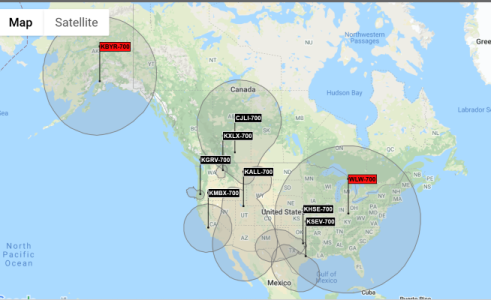
WLW's nighttime signal is amazing. The Eastern half of the U.S.

Screenshot 2021-12-30 190919----.png
 
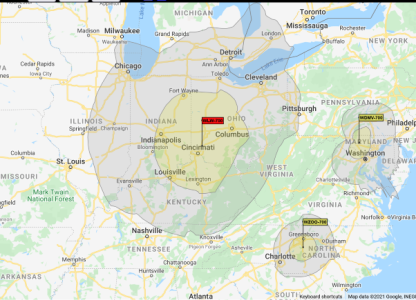
WLW's daytime signal is a strong Midwesterner.

Screenshot 2021-12-30 191816-.png
 
I read somewhere that KFYR 550 in North Dakota has a very large coverage area.

And those of us in the Western US and Western Canada know about CBK 540 -- it seems to cover everything from Winnipeg to Calgary, if one has a good radio. And at night I usually hear it with good signals, although there was a period of maybe two years I rarely heard it at all, and that was unusual, because I used to even hear it on my Superadio III at work during the 1990s and early 2000s.
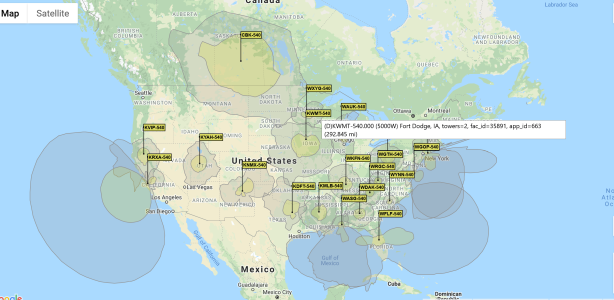
CBK is tremendous.
Days:

Screenshot 2021-12-30 190729.png
 
Status
This thread has been closed due to inactivity. You can create a new thread to discuss this topic.


Back
Top Bottom