
-
Get involved.
We want your input!
Apply for Membership and join the conversations about everything related to broadcasting.
After we receive your registration, a moderator will review it. After your registration is approved, you will be permitted to post.
If you use a disposable or false email address, your registration will be rejected.
After your membership is approved, please take a minute to tell us a little bit about yourself.
https://www.radiodiscussions.com/forums/introduce-yourself.1088/
Thanks in advance and have fun!
RadioDiscussions Administrators
You are using an out of date browser. It may not display this or other websites correctly.
You should upgrade or use an alternative browser.
You should upgrade or use an alternative browser.
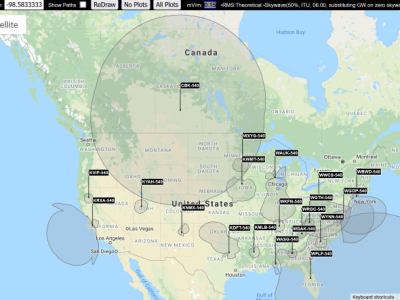

Those maps are unduly optimistic. WLW has a usable night signal in the Tri-State area, and is a DX signal elsewhere. The average person is not going to separate a weak WLW from closer stations on 690 and 710, and atmospherics make for less than optimum reception each night.
Those are not really coverage maps... they are intended to show the pattern, not the usability of the signals. And, for example, they don't show the extreme interference to WLW by stations in Cuba and the Caribbean Basin.
Again, those maps are unduly optimistic. WLW's signal is usable by the average listener in places like Dayton and, maybe, Lexington and the other nearby areas...
In recent years, the only markets outside of Cincy that they have shown up in ratings-wise are Dayton and Lima .
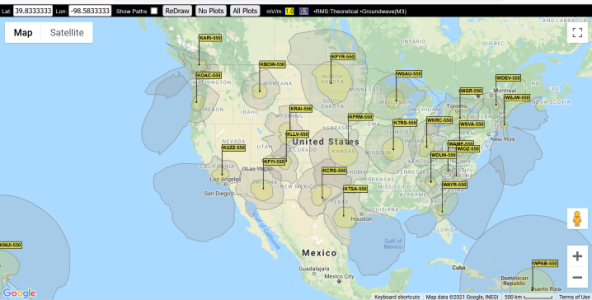
Very large, according to the (optimistically drawn) maps.I read somewhere that KFYR 550 in North Dakota has a very large coverage area.
Again, those maps are unduly optimistic. WLW's signal is usable by the average listener in places like Dayton and, maybe, Lexington and the other nearby areas...
In recent years, the only markets outside of Cincy that they have shown up in ratings-wise are Dayton and Lima .
The maps likely represent how far a signal can be heard weakly, perhaps only in a car radio or better.
I recall talking with a farm broadcaster who stated his station's signal goes out maybe 30-40 miles where it's receivable on a clock radio. The rest of the area is in a car.
But... this map of 550 seems accurate, in terms of car reception.
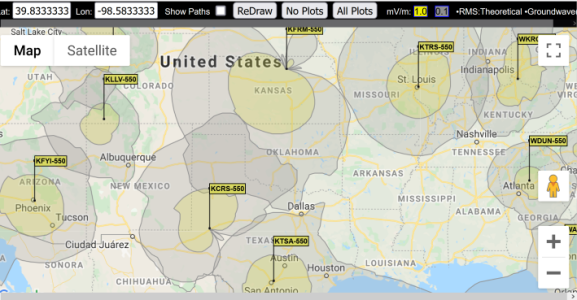
Take KFRM, in western Kansas. I recall picking it up in eastern Colorado and in Oklahoma.
KTRS, St. Louis, seems right.
There are reports of Chicago DXers picking up that signal.
I think the FCC spaced the Texas 550s too close to each other, nullifying both.
Take KFRM, in western Kansas. I recall picking it up in eastern Colorado and in Oklahoma.
KTRS, St. Louis, seems right.
There are reports of Chicago DXers picking up that signal.
I think the FCC spaced the Texas 550s too close to each other, nullifying both.
I've caught WLW at night in Tampa.Those maps are unduly optimistic. WLW has a usable night signal in the Tri-State area, and is a DX signal elsewhere. The average person is not going to separate a weak WLW from closer stations on 690 and 710, and atmospherics make for less than optimum reception each night.
Those are not really coverage maps... they are intended to show the pattern, not the usability of the signals. And, for example, they don't show the extreme interference to WLW by stations in Cuba and the Caribbean Basin.
Granted, few skywave stations enter Fla., but I did on occasion receive that signal.
But... I agree... the skywave pattern isn't the station's commercial marketing region.
Skywave stations wouldn't show up in many other markets.
And I got 250 watt KIKI from Honolulu in Cleveland, Ohio. That's called DX reception and is not normal, protected or expected.I've caught WLW at night in Tampa.
Granted, few skywave stations enter Fla., but I did on occasion receive that signal.
One of my 1 kw stations in Ecuador, which operated on 805 kHz, got regular reports from New Zealand, Australia, Scandinavia and all over the US.
They used to, when there was no TV and night reception of the radio networks was king. But that was 70 years or more ago.But... I agree... the skywave pattern isn't the station's commercial marketing region.
Skywave stations wouldn't show up in many other markets.
Today, in the top 100 markets, there are fewer than 180 stations that even have decent usable reception in 80% or more of their home market.

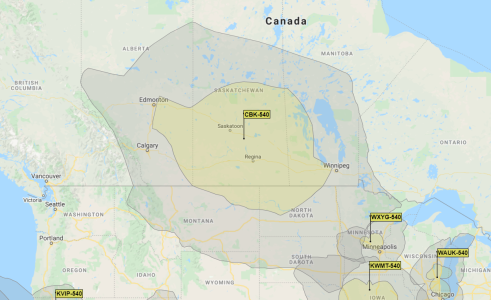
North America Daytime
I have been a regular daily listener of WLW in Lafayette, Logansport and Fort Wayne.Again, those maps are unduly optimistic. WLW's signal is usable by the average listener in places like Dayton and, maybe, Lexington and the other nearby areas...
In recent years, the only markets outside of Cincy that they have shown up in ratings-wise are Dayton and Lima .
700 is still fairly clear in the east at night. Per MWList, there are no Cubans and only a 10kW Costa Rican and a 1KW Dominican. Here in East Tennessee, if I hear anything else along with or in place of WLW, it's KHSE, in Texas, running day power at night
6 states, 4 provinces.....
Where I live – conveniently just far enough from neighbors to not be affected by their electronic gadgetry – the maps appear accurate for stations I can receive, and often unoptimistic. Of course, they don't take into effect adjacent-channel interference (or the Cubans, at night especially), but otherwise they're good.Those maps are unduly optimistic. WLW has a usable night signal in the Tri-State area, and is a DX signal elsewhere. The average person is not going to separate a weak WLW from closer stations on 690 and 710, and atmospherics make for less than optimum reception each night.
Those are not really coverage maps... they are intended to show the pattern, not the usability of the signals. And, for example, they don't show the extreme interference to WLW by stations in Cuba and the Caribbean Basin.
For instance, daytime here in the southwest suburbs of Chicago I get these stations easily that I probably shouldn't get easily:
590 WKZO
600 WMT
700 WLW (barely in the house, easily in the car)
760 WJR (car only)
980 WITY
1020 WPEO (not that easily, but it's there)
That's just off the top of my head. Plus the semi-locals like 540 WAUK, 580 WILL, 620 WTMJ, 1060 WHFB, 1130 WISN and, most of the day, 1530 WCKY, much to the annoyance of local WCKG Elmhurst. After that comes DX-type signals (550 KTRS, for instance). All this is with a CC Crane portable, a Sony ICF-2010, and a ho-hum Radio Shack pocket radio that has to be 30 years old (which doesn't get WITY or WPEO unless I put the Tecsun AN-200 loop by it; everything else is barefoot on all receivers).
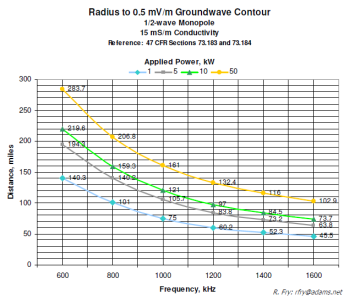
For those not familiar with this sort of chart and data, it means thatt 50kw on 1600 kHz covers about 30% less than 1 kw on 600 kHz, given that the transmitter sites are the same.Below is a clip on this topic from a paper I wrote for Radio World years ago ...
View attachment 2455
And a 30 kw Colombian and a 50 kw Ecuadorian.I have been a regular daily listener of WLW in Lafayette, Logansport and Fort Wayne.
700 is still fairly clear in the east at night. Per MWList, there are no Cubans and only a 10kW Costa Rican and a 1KW Dominican. Here in East Tennessee, if I hear anything else along with or in place of WLW, it's KHSE, in Texas, running day power at night

And the ITU thinks that today, AM needs 15 mV/m to be useful.And given the ever-increasing levels of terrestrial noise, including the 10mV/m field strength for average listening, these circles can be reduced by 50%.
Nearly no metro survey area today has an AM that puts a 15 mV/m over the entire market day and night. Offhand, I can't think of a single one in the topp 50 markets.... maybe in the top 100.
And a lot of those old coverage maps shown here were created back in the day were drawn assuming a 1mV/M coverage area.And the ITU thinks that today, AM needs 15 mV/m to be useful.
Nearly no metro survey area today has an AM that puts a 15 mV/m over the entire market day and night. Offhand, I can't think of a single one in the topp 50 markets.... maybe in the top 100.

Columbus gets a very good signal from WLW as well. It isn't DX around here, as its transmitter is only 70 miles from the southwest portion of the metro area. Cleveland and Youngstown, that is a DX catch although it's simple a catch as there is.
As far as the original topic, WBAP and WNAX always jump to mind immediately in terms of daytime coverage and nighttime for the former.
As far as the original topic, WBAP and WNAX always jump to mind immediately in terms of daytime coverage and nighttime for the former.

I may have missed KMOX and / or WHO mentioned. Do they get out well? It seems to me that both stations could've been heard coast to coast at one point decades ago.
(For the record: KMOX signed on in 1925. The year earlier, 1924, was when WHO was on first.
(For the record: KMOX signed on in 1925. The year earlier, 1924, was when WHO was on first.
- Status
- This thread has been closed due to inactivity. You can create a new thread to discuss this topic.