
-
Get involved.
We want your input!
Apply for Membership and join the conversations about everything related to broadcasting.
After we receive your registration, a moderator will review it. After your registration is approved, you will be permitted to post.
If you use a disposable or false email address, your registration will be rejected.
After your membership is approved, please take a minute to tell us a little bit about yourself.
https://www.radiodiscussions.com/forums/introduce-yourself.1088/
Thanks in advance and have fun!
RadioDiscussions Administrators
You are using an out of date browser. It may not display this or other websites correctly.
You should upgrade or use an alternative browser.
You should upgrade or use an alternative browser.
Boston Globe Editorial - 1/2/20 on radio pirates
- Thread starter Fenway1912
- Start date

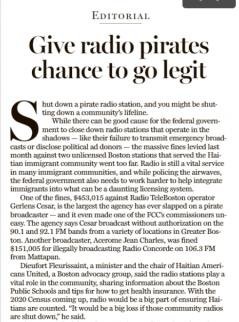
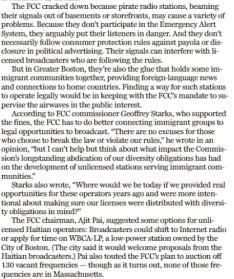
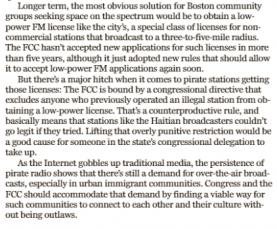

Those graphics are not readable. How about a link instead.
The Globe is behind a paywall
https://www.bostonglobe.com/2020/01/02/opinion/give-radio-pirates-chance-go-legit/
[FONT="]Longer term, the most obvious solution for Boston community groups seeking space on the spectrum would be to obtain a low-power FM license like the city’s, a special class of licenses for noncommercial stations that broadcast to a three-to-five-mile radius. The FCC hasn’t accepted new applications for such licenses in more than five years, although it just adopted new rules that should allow it to accept low-power FM applications again soon.
But there’s a major hitch when it comes to pirate stations getting those licenses: The FCC is bound by a congressional directive that excludes anyone who previously operated an illegal station from obtaining a low-power license. That’s a counterproductive rule, and basically means that stations like the Haitian broadcasters couldn’t go legit if they tried. Lifting that overly punitive restriction would be a good cause for someone in the state’s congressional delegation to take up.
As the internet gobbles up traditional media, the persistence of pirate radio shows that there’s still a demand for over-the-air broadcasts, especially in urban immigrant communities. Congress and the FCC should accommodate that demand by finding a viable way for such communities to connect to each other and their culture without being outlaws.
[/FONT]
[FONT="]
[/FONT]
https://www.bostonglobe.com/2020/01/02/opinion/give-radio-pirates-chance-go-legit/
[FONT="]Longer term, the most obvious solution for Boston community groups seeking space on the spectrum would be to obtain a low-power FM license like the city’s, a special class of licenses for noncommercial stations that broadcast to a three-to-five-mile radius. The FCC hasn’t accepted new applications for such licenses in more than five years, although it just adopted new rules that should allow it to accept low-power FM applications again soon.
But there’s a major hitch when it comes to pirate stations getting those licenses: The FCC is bound by a congressional directive that excludes anyone who previously operated an illegal station from obtaining a low-power license. That’s a counterproductive rule, and basically means that stations like the Haitian broadcasters couldn’t go legit if they tried. Lifting that overly punitive restriction would be a good cause for someone in the state’s congressional delegation to take up.
As the internet gobbles up traditional media, the persistence of pirate radio shows that there’s still a demand for over-the-air broadcasts, especially in urban immigrant communities. Congress and the FCC should accommodate that demand by finding a viable way for such communities to connect to each other and their culture without being outlaws.
[/FONT]
[FONT="]
[/FONT]

Those graphics are not readable. How about a link instead.
Click on the graphics and they open in a separate mini-window, with the entire editorial in three readable (if small) pages.
That’s a counterproductive rule, and basically means that stations like the Haitian broadcasters couldn’t go legit if they tried. Lifting that overly punitive restriction would be a good cause for someone in the state’s congressional delegation to take up.
That's not the only impediment for immigrant radio operators. Another is the licensee must be an American citizen. There are the legal and technical requirements. Then there's the cost. A bigger problem in Boston is finding an available frequency. Not sure if any exist right now.

The Globe's opinion is based on a flawed assumption - that these pirates only broke the law, risking fines, or even jail time, and adversely affected other broadcasters and listeners - solely because of their selfless desire to help their fellow man - and not because of the thrill of pirate broadcasting, and possibly making some serious $$...
If a few more frequencies could be opened up for this - AM in the expanded band, or FM in the top end of TV ch 6 - there would be many more applicants who never ran a pirate station. So, who decides, and using what criteria, on who will get the few possible licenses? Perhaps favor the former pirates because they have experience?
If a few more frequencies could be opened up for this - AM in the expanded band, or FM in the top end of TV ch 6 - there would be many more applicants who never ran a pirate station. So, who decides, and using what criteria, on who will get the few possible licenses? Perhaps favor the former pirates because they have experience?
So, who decides, and using what criteria, on who will get the few possible licenses? Perhaps favor the former pirates because they have experience?
That's easy. It's up to the FCC, and ultimately Congress.
There is no right to radio. Commercial broadcast radio is big business. Radio stations even small ones are worth millions of dollars and cost lots and lots of money to operate with real expenses in a regulated marketplace. That means the few that get to operate have to have licenses and follow the rules. The FCC has already tried to use every scrap of room to fit in as many licenses as possible without folks interfering with one or another. When the FCC says licensed stations must serve the public or their licensed city it has nothing to do with what they play music or news. It has to do with EAS, Public Service announcements and Public Affairs. These pirates are blatant criminals that have figured out they don't need to pay fines, royalties or anything. If the Marshall's come along and confiscate all their equipment they are usually back in a month. They have no interest in low power FM or a small AM's. They operate where they want in the mode they choose at what ever power level they want with complete disregard to interference or Hazardous radiation to others. The FCC has basically closed all the local enforcement and just visits from time to time with a fine, a newspaper story and they move on. It's the least expensive way for them to play the whack a mole game and keep the licensed broadcasters off their backs.

Exactly.
If the paper is so concerned about a lifeline for these communities maybe they can put out a newspaper covering their concerns and culture and perhaps distribute it free to the residents. Or advertiser supported like some of the weeklies around here.All this would cost a tiny fraction of the salaries their ball team gets paid to pitch, hit, and catch baseballs.
If the paper is so concerned about a lifeline for these communities maybe they can put out a newspaper covering their concerns and culture and perhaps distribute it free to the residents. Or advertiser supported like some of the weeklies around here.All this would cost a tiny fraction of the salaries their ball team gets paid to pitch, hit, and catch baseballs.
If the paper is so concerned about a lifeline for these communities maybe they can put out a newspaper covering their concerns and culture and perhaps distribute it free to the residents.
Ha! Newspapers never offer to do such a thing, just criticize radio. It's OK to criticize, but as we've all said, there's more to the story than the one small issue they mentioned.
The Globe's opinion is based on a flawed assumption - that these pirates only broke the law, risking fines, or even jail time, and adversely affected other broadcasters and listeners - solely because of their selfless desire to help their fellow man - and not because of the thrill of pirate broadcasting, and possibly making some serious $$...
If a few more frequencies could be opened up for this - AM in the expanded band, or FM in the top end of TV ch 6 - there would be many more applicants who never ran a pirate station. So, who decides, and using what criteria, on who will get the few possible licenses? Perhaps favor the former pirates because they have experience?
The experience of the pirates includes failure to observe public safety rules (such as no EAS compliance), failure to pay taxes, permits and fees that legal businesses pay, non-payment of music licensing fees, a likely scenario of under-payment or non-payment of wages and benefits (FICA), endangerment of vital services due to use of non-Type Accepted gear, abusive language on many occasions, interference with other stations and likely many more things.
Their "experience" is in breaking the law and ignoring the rules other businesses must comply with.
These guys don't have a frequency of their own because the technical standards imposed to regulate radio don't allow any more channels in congested markets.
Some years back a pirate was found right across the street from a fire station
(Brockton?) throwing off spur signals that interfered with fire frequencies.A pirate called Datz Hitz 99.7 not only interfered with WCRB but also Logan
aircraft radio.
One South Shore pirate, WHDL ("We Hate Dumb Listeners" or "We had Hot Dogs for Lunch") increased its power to reach North Shore as well.They'd give out their phone number for requests etc.
WMWM has had a long running Spanish language Christian show.I'm glad they're on a legit station and not running a pirate interfering with other stations.As it is there's also a Spanish language Christian FM in nearby Lynn (89.3).
(Brockton?) throwing off spur signals that interfered with fire frequencies.A pirate called Datz Hitz 99.7 not only interfered with WCRB but also Logan
aircraft radio.
One South Shore pirate, WHDL ("We Hate Dumb Listeners" or "We had Hot Dogs for Lunch") increased its power to reach North Shore as well.They'd give out their phone number for requests etc.
WMWM has had a long running Spanish language Christian show.I'm glad they're on a legit station and not running a pirate interfering with other stations.As it is there's also a Spanish language Christian FM in nearby Lynn (89.3).
The experience of the pirates includes failure to observe public safety rules (such as no EAS compliance), failure to pay taxes, permits and fees that legal businesses pay, non-payment of music licensing fees, a likely scenario of under-payment or non-payment of wages and benefits (FICA), endangerment of vital services due to use of non-Type Accepted gear, abusive language on many occasions, interference with other stations and likely many more things.
Their "experience" is in breaking the law and ignoring the rules other businesses must comply with.
These guys don't have a frequency of their own because the technical standards imposed to regulate radio don't allow any more channels in congested markets.
Of course I was being sarcastic about favoring them, although the Globe may think that a good idea. Actually nearly all pirates, if they did have the chance to get a legitimate license - would probably not be interested in buying approved equipment, filling out the required paperwork and reports, or following any other rules. Almost by definition they have already shown doing it legally is not what they want.
Almost by definition they have already shown doing it legally is not what they want.
Which is partly why the FCC disqualifies them for legal ownership.
- Status
- This thread has been closed due to inactivity. You can create a new thread to discuss this topic.