
• Get involved.
    We want your input!
    Apply for Membership and join the conversations about everything related to broadcasting.

    After we receive your registration, a moderator will review it. After your registration is approved, you will be permitted to post.
    If you use a disposable or false email address, your registration will be rejected.

    After your membership is approved, please take a minute to tell us a little bit about yourself.
    https://www.radiodiscussions.com/forums/introduce-yourself.1088/

    Thanks in advance and have fun!
    RadioDiscussions Administrators

Building your own shorted stub

Have leftover 7/8 ridge line and hardware, and intend to build a shorted stub as a secondary protector (transmitter is a Nautel VX-150, primary protector at the entry panel is a Polyphaser VHF50D-PGR)

Before I start cutting, anyone know the velocity factor for 7/8 ridge line?

SP
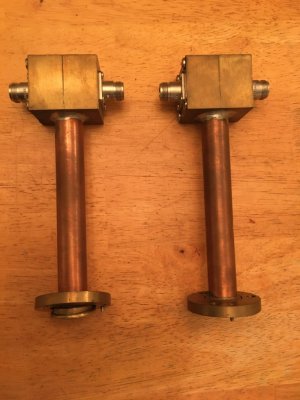
 

Attachments

  • IMG_4005.JPG
    IMG_4005.JPG
    123.9 KB · Views: 3
Have leftover 7/8 ridge line and hardware, and intend to build a shorted stub as a secondary protector (transmitter is a Nautel VX-150, primary protector at the entry panel is a Polyphaser VHF50D-PGR)

Before I start cutting, anyone know the velocity factor for 7/8 ridge line?

SP
All I know is that you can get "pretty damn close" on the antenna with a pretty good tape measure! My first FMs, which were also the first FMs in the Bolivarian nations of South America, went on the air with trimmed vertical only CB antennas. Widely available in the mid-60's were CB antennas that were rated at "up to 1000 watts" and they had a vertical element with three inclining horizontal ones. Trimming to wavelength got us reasonably low SWR. No gain, but the band was empty for about 800 to 1000 miles in any direction.

My point is that when you are improvising, "precision" has a different meaning than the usual one.
 
Have leftover 7/8 ridge line and hardware, and intend to build a shorted stub as a secondary protector (transmitter is a Nautel VX-150, primary protector at the entry panel is a Polyphaser VHF50D-PGR)

Before I start cutting, anyone know the velocity factor for 7/8 ridge line?

SP
I take it you're wanting to use a shorting stub for lightening protection. Shorting stubs are also used to kill harmonics. The velocity factor for LDFS -50A is 89 percent.

I usually use a more flexible coax like RG 213 to make quarter wave shorting stubs. which has a velocity factor of 66 percent.

What frequency do you need this for?
 
One of the local makerspace members (PhD and amateur extra class) suggested using a VF of 1.0 for the EIA line, so that's what I am going to start with.

Another makerspace member is turning a shorting plug to slip inside the 7/8 EIA line, once it's tuned, we will lock it in place with bronze or stainless hardware.

BTW, here's a source for the same type of hardware I am using: 7/8" EIA - 2 Way Divider, Type N (x5) | eBay

SP
 
Status
This thread has been closed due to inactivity. You can create a new thread to discuss this topic.


Back
Top Bottom