• Get involved.
    We want your input!
    Apply for Membership and join the conversations about everything related to broadcasting.

    After we receive your registration, a moderator will review it. After your registration is approved, you will be permitted to post.
    If you use a disposable or false email address, your registration will be rejected.

    After your membership is approved, please take a minute to tell us a little bit about yourself.
    https://www.radiodiscussions.com/forums/introduce-yourself.1088/

    Thanks in advance and have fun!
    RadioDiscussions Administrators

Byron Allen gets the Colbert timeslot

It wasn't rare. Comedians made political jokes all the time. Ever hear of George Carlin? How about Mort Sahl? How about Vaughn Meader. He recorded an album called The First Family lampooning John F. Kennedy.
But none of those posted a daily hour long late night national television show. I am just comparing the frequency of comedy or, at least, attempts at comedy “back in the day“ and today
The point is it happened before, and the president didn't go after Johnny Carson or Dick Cavett. Did he? Try to at least acknowledge that this president is responding in ways even Nixon didn't. Late night hosts didn't ignore political issues.
But the frequency of politically based humor, whether full bets or one liners or remarks by guests, back, then was definitely and vastly less than it is today on the current or former ABC, CBS, or NBC versions of the late night show.
Meanwhile on the radio, almost every talk show is political, and every political show isn't just conservative, but rabidly anti-democrat.
That is a separate subject as most radio talk, shows our principally about politics and time has proven that any other type of talk programming does not generate profitable audience sizes. Again, our subject has been the late night talk shows that follow immediately after the classic late news wrap up done by each local station.
It's not that blue is bad, but that blue is illegal, needs to be arrested, and prevented from voting.
That is an overly broad statement that would be impossible to prove. And that is not a radio subject.
That was not the case in the 60s or 70s. None of those radio stations are being investigated by the FCC. There are no concerns about the public interest or equal time.
This is totally irrelevant. We have no idea what might have happened in the 60s and 70s if the FCC regulations had not required equal opportunity and balance in that kind of programming. All talk formats were essentially rare or nonexistent in those two decades in all, but a few very large markets. In fact, news and current event talk content was generally found on stations that also included music. And even early talk shows like Bill Ballance, played music as part of their original concept

If we look at the origins of radio talk programming, we can also see examples of the sexual content late night Show on KROQ in Los Angeles, where the rest of the day was predominantly filled with an all music format. In many cases, all talk formats evolved from depart specific talk shows or music shows with lots of phones and commentary.

It would certainly be an interesting project to write a book about the evolution of talk radio and the relationship of such formats with FCC rules.
 
I just checked some recent guest lists for Jimmy Kimmel:
And don’t you think, whether good or bad, that the current controversies have made the people who book guests and the people who write or supervise monologue content to be a little more focused on balance? Or, at least, aware of what may be too much or gone too far?
 
But none of those posted a daily hour long late night national television show. I am just comparing the frequency of comedy or, at least, attempts at comedy “back in the day“ and today

I've already pointed out that those nightly shows aren't political shows. They're not even comedy shows. They are primarily promotion vehicles for movies, music, books, and other casual fare. Compared to conservative talk radio shows which are 100% political and 100% conservative.

But the frequency of politically based humor, whether full bets or one liners or remarks by guests, back, then was definitely and vastly less than it is today on the current or former ABC, CBS, or NBC versions of the late night show.

No it wasn't. It was very topical especially during the Vietnam War. But the president in power was far less sensitive, and politics itself was less divisive, primarily because the politicians recognized they HAD to appeal to voters of both parties. The current president doesn't. He has caused the situation he frequently complains about.

That is a separate subject as most radio talk, shows our principally about politics and time has proven that any other type of talk programming does not generate profitable audience sizes. Again, our subject has been the late night talk shows that follow immediately after the classic late news wrap up done by each local station.

I'm simply comparing then with now, which is what we've been doing.

That is an overly broad statement that would be impossible to prove. And that is not a radio subject.

All I have to do is post links to any of the popular talk hosts to prove my point. They are specific with who should be arrested and for what crimes.

This is totally irrelevant. We have no idea what might have happened in the 60s and 70s if the FCC regulations had not required equal opportunity and balance in that kind of programming.

But that's exactly why talk radio was less divisive and more balanced than it is today. What you want is for TV talk to be balanced, while allowing radio to remain a cesspool of conservative hate. The FCC is trying to force a fairness doctrine on TV, while leaving radio alone.

It would certainly be an interesting project to write a book about the evolution of talk radio and the relationship of such formats with FCC rules.

There have been quite a few. Most have been written by sociologists who know nothing about radio.
 
So to TL;DR it for those that are just joining us:

Conservative television news and conservative talk shows (both on TV and radio): Low reach, broadcast on dying mediums, simply presenting an opinion, they have the right to say and do as they please.

Mainstream late night talk shows: Out of line, divisive, money losers, pitting Americans against each other, intentionally alienating half of the country.
 
I've already pointed out that those nightly shows aren't political shows. They're not even comedy shows. They are primarily promotion vehicles for movies, music, books, and other casual fare. Compared to conservative talk radio shows which are 100% political and 100% conservative.
Yes, traditionally and dating back to Steve Allen, those shows have been sustained by the star power of music, film, and sports celebrities. My only point is to say that the shows were much lighter on heavy sociopolitical subjects and more casual in the chat parts of the show.
No it wasn't. It was very topical especially during the Vietnam War.
You have perhaps hit on an important point, which is that the Vietnam war was generally criticized by most and totally opposed by many… it was not a divisive, subject for mass market television and unless the commentary took the political aspect and involved personal remarks about certain politicians.
But the president in power was far less sensitive, and politics itself was less divisive, primarily because the politicians recognized they HAD to appeal to voters of both parties. The current president doesn't. He has caused the situation he frequently complains about.
But that was not a societal trend begun by the current president as it dates back nearly 20 years in the general rise of more extreme polarization.
All I have to do is post links to any of the popular talk hosts to prove my point. They are specific with who should be arrested and for what crimes.
Beyond that even the definition of what is a crime and what isn’t have become subject to debate.
But that's exactly why talk radio was less divisive and more balanced than it is today. What you want is for TV talk to be balanced, while allowing radio to remain a cesspool of conservative hate. So instead the FCC is trying to force a fairness doctrine on TV, while leaving radio alone.
My only point is that in Radio efforts to create liberal talk networks or shows have not been successful and that raises the question of why conservative talk is very successful and radio yet none of the three major English language over the air TV networks has focused on the conservative portion of the electorate.
There have been quite a few. Most have been written by sociologists who know nothing about radio.
That is why I bring up the point. I have…. And have scanned… everything in that area and find, as you suggest, a total lack of understanding of commercial radio. Because of that not only the suggested political reasons brought up by the authors, but the misunderstanding of the economics of commercial radio produce absurd, if not, totally silly conclusions
 
Yes, traditionally and dating back to Steve Allen, those shows have been sustained by the star power of music, film, and sports celebrities. My only point is to say that the shows were much lighter on heavy sociopolitical subjects and more casual in the chat parts of the show.

You've already told us you don't watch anymore because you feel those shows have alienated you. So you really don't know.

You have perhaps hit on an important point, which is that the Vietnam war was generally criticized by most and totally opposed by many… it was not a divisive, subject for mass market television and unless the commentary took the political aspect and involved personal remarks about certain politicians.

It depends on whose side you were on. Spiro Agnew said the silent majority supported the war. He continued to say so until he was forced to resign.

But that was not a societal trend begun by the current president as it dates back nearly 20 years in the general rise of more extreme polarization.

The current president began the polarization by attacking Obama.

According to the BBC, in March 2011, Trump publicly raised what he described as “serious questions” about whether President Obama possessed a legitimate U.S. birth certificate. In the days that followed, he escalated those claims, announcing that he had dispatched private investigators to Hawaii to uncover what he framed as the “real story.” He later offered a $5 million charitable donation to anyone who could prove that Obama had, in fact, been born in the United States.
As I said, the current president has created the environment that he complains about.

My only point is that in Radio efforts to create liberal talk networks or shows have not been successful and that raises the question of why conservative talk is very successful and radio yet none of the three major English language over the air TV networks has focused on the conservative portion of the electorate.

Nobody is saying that talk radio should become liberal. But if the FCC wants to require equal time on TV, it should require the same on talk radio.
 
So to TL;DR it for those that are just joining us:

Conservative television news and conservative talk shows (both on TV and radio): Low reach, broadcast on dying mediums, simply presenting an opinion, they have the right to say and do as they please.

Mainstream late night talk shows: Out of line, divisive, money losers, pitting Americans against each other, intentionally alienating half of the country.
Do you really believe an entertainment program can "create" division that wasn't already there?

If they were all money losers they would gone.
 
Receiving a few nasty e-mails is in no way comparable to minorities, immigrants, and LGBTQ+ people in red states literally being in fear of their lives and physical freedom at the hands of white Christian nationalists and ICE agents.
Like Blue dots in red states NEVER have any of that happen? MAGAs stealing opposite candidate signs, leaving nasty letters in your mailbox "how DARE you be a leftist Communist, now get the hell out of my neighborhood" and worse. There are female Democratic candidates challenging established Republicans, and they get misogynistic death threats daily. In supposedly ruby red Tennessee, 48% chose independent/3rd party/other...a higher percentage than Republican (33.7%) or Democratic (18.2%). So take the idea that the American people overwhelmingly support Trump to the trash can. The GOP has a fit when the rest of us oppose him and don't surrender pop culture (how DARE that Spanish speaking guy do the half time show instead of Kid Rock). Ridiculous
 
You have perhaps hit on an important point, which is that the Vietnam war was generally criticized by most and totally opposed by many… it was not a divisive, subject for mass market television and unless the commentary took the political aspect and involved personal remarks about certain politicians.
This is categorically not true. Please see


and


(Note that the second link leads to a downloadable .pdf file.)

Finally, one can view the statistical charts at


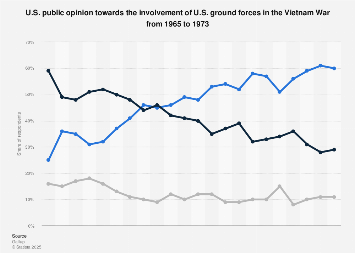
The U.S. public mostly supported the Vietnam War until 1) body bags began returning to the U.S. in large numbers; 2) Walter Cronkite began showing what was happening on the ground during the CBS Nightly News; and 3) the Tet offensive and the U.S. troops response to it. (I'm specifically thinking of the incident regarding Lt. William Calley.)
 
So much horseshit.

Look—-you wanna know why late night talks more about Trump than previous presidents?

Because the others went out of their way not to do stupid, illegal, unconstitutional crap that would make them objects of ridicule.

When they occasionally f***ed up (Nixon, Ford, Carter, Reagan, either Bush, Clinton, Obama, Biden), late night took its shots.

If the current occupant of the White House and the modern GOP want the jokes to end, all they have to do is stop providing so damn much raw material every single day.
 
You've already told us you don't watch anymore because you feel those shows have alienated you. So you really don't know.
While I do not watch for entertainment, I do watch a lot at random to see what is going on. This is no different than being the program director of a country station regularly monitoring the classic hits station in the market because we know that each option to be had by listeners and viewers is an option for them not to listen to you and your station.
It depends on whose side you were on. Spiro Agnew said the silent majority supported the war. He continued to say so until he was forced to resign.
“Truth“ and “politician“ do not frequently find themselves attached in the same thought. Agno, in that kind of statement was simply reinforcing the Administration position at the time.
The current president began the polarization by attacking Obama.
And with his followers, he was reflecting the perspective of, if not all, the vast majority.
As I said, the current president has created the environment that he complains about.
I suggest you go back and read “Advise and Consent” from 1959 that, in a work of fiction that is over 60 years old the author describes negotiations transactions and even backstabbing between the parties and the politicians of America. This is nothing new. We just have more sources of information and more people throwing gasoline on the fires.
Nobody is saying that talk radio should become liberal. But if the FCC wants to require equal time on TV, it should require the same on talk radio.
I think the point is… and it is one that I believe to be unsustainable… that there is a lack of fairness when of the three over the air television networks that cover news in English, there is not a single one that has a conservative perspective. The element seems to be about balance, but I agree with you that this is a magnificent example of fighting windmills.
 
The U.S. public mostly supported the Vietnam War until 1) body bags began returning to the U.S. in large numbers; 2) Walter Cronkite began showing what was happening on the ground during the CBS Nightly News; and 3) the Tet offensive and the U.S. troops response to it. (I'm specifically thinking of the incident regarding Lt. William Calley.)
The period of support was relatively short-lived as the body count began to rise very early after the American forces took over when the French abandoned their supposed colony of Vietnam. Support was strongest at the time of the Gulf of Tonkin incident and had severely declined less than 3 full years later around the time of the My Lai affair. It took about 6 years to reach the full withdrawal.
 
I think the point is… and it is one that I believe to be unsustainable… that there is a lack of fairness when of the three over the air television networks that cover news in English, there is not a single one that has a conservative perspective. The element seems to be about balance, but I agree with you that this is a magnificent example of fighting windmills.
Do the big three networks have a liberal perspective? Or do they simply not blindly agree with the messages coming out of The White House?
 
The period of support was relatively short-lived as the body count began to rise very early after the American forces took over when the French abandoned their supposed colony of Vietnam. Support was strongest at the time of the Gulf of Tonkin incident and had severely declined less than 3 full years later around the time of the My Lai affair. It took about 6 years to reach the full withdrawal.
It took less than three years from the 1965 start of the draft for Vietnam protest songs to make their way on to Top 40 playlists, which would certainly jibe with your timeline of American popular opinion. We went from Sgt. Barry Sadler's big hit "Ballad of The Green Berets" and Pat Boone's lesser-known, but pro-war (or at least anti-draft dodger) "Wish You Were Here, Little Buddy" in 1966 to the Animals' "Sky Pilot" and Donovan's "Hurdy Gurdy Man." By 1969, just four years in, Top 40 radio was very much anti-war in its sound -- "Sweet Cherry Wine" and "Bad Moon Rising" -- followed in 1970 by Edwin Starr's snarling "War." None of these songs would have been the AM hits they were if the war was receiving anything close to majority support.
 
And with his followers, he was reflecting the perspective of, if not all, the vast majority.

"Vast majority" of who? Certainly not the majority of Americans. Birtherism was a fringe conspiracy theory that even republicans distanced themselves from.

I suggest you go back and read “Advise and Consent” from 1959 that, in a work of fiction that is over 60 years old the author describes negotiations transactions and even backstabbing between the parties and the politicians of America. This is nothing new. We just have more sources of information and more people throwing gasoline on the fires.

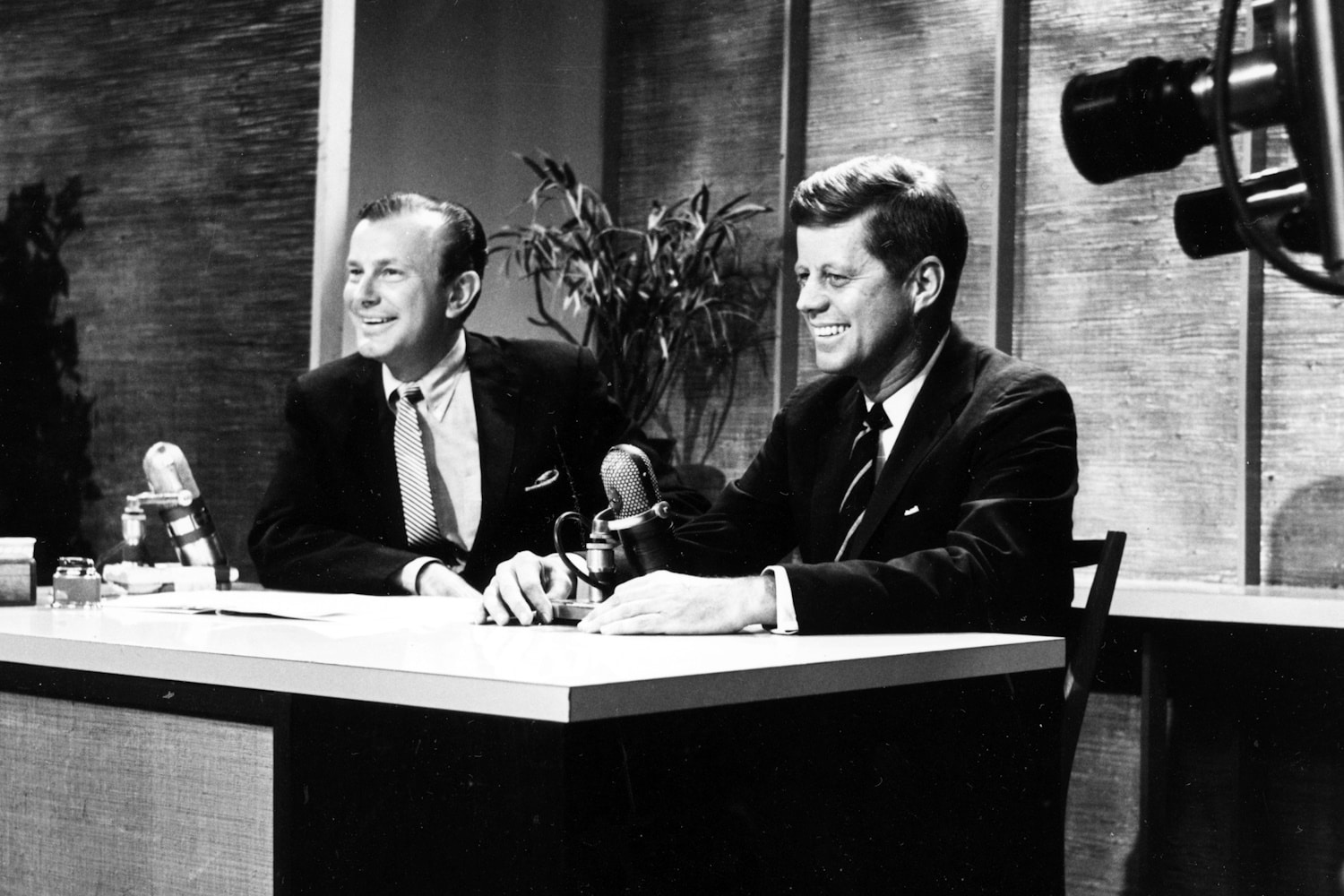
If it's "nothing new" and is core to the American system, then the criticism of government should be an accepted practice by everyone, including the FCC. There's nothing wrong with late night TV hosts telling jokes about the president, because it's been done for over 50 years. Including Jack Paar:


I think the point is… and it is one that I believe to be unsustainable… that there is a lack of fairness when of the three over the air television networks

Because, as I have tried to point out, there is no fairness doctrine in this country. It was determined that such a thing is unconstitutional.

If it's such a problem in TV, why isn't fairness a problem in talk radio? The reason is obvious. You don't really want fairness.

there is a lack of fairness when of the three over the air television networks that cover news in English, there is not a single one that has a conservative perspective.

That ignores what the new owner of CBS has been doing. The reason he hired Bari Weiss was to enforce a conservative perspective at CBS News. She has already tried to get 60 Minutes to "make the protesters appear more violent." He signed an agreement with the FCC that promised a form of fairness. By doing so, he did something that no other broadcaster has done. Because he did, they approved his purchase of Warner Brothers. That's not fair either. But it happened.
 
Last edited:
It took less than three years from the 1965 start of the draft for Vietnam protest songs to make their way on to Top 40 playlists, which would certainly jibe with your timeline of American popular opinion. We went from Sgt. Barry Sadler's big hit "Ballad of The Green Berets" and Pat Boone's lesser-known, but pro-war (or at least anti-draft dodger) "Wish You Were Here, Little Buddy" in 1966 to the Animals' "Sky Pilot" and Donovan's "Hurdy Gurdy Man." By 1969, just four years in, Top 40 radio was very much anti-war in its sound -- "Sweet Cherry Wine" and "Bad Moon Rising" -- followed in 1970 by Edwin Starr's snarling "War." None of these songs would have been the AM hits they were if the war was receiving anything close to majority support.

It's WAY more complicated than that.

First, Top 40 radio was aimed squarely at the demographic most likely to get a draft notice and their girlfriends. Want to balance that out? Check out what Country stations were playing and what MOR stations studiously avoided.

Second, if you go back to the polling Ted posted, specifically the last link from Statista, the question was phrased as "was it a mistake?"

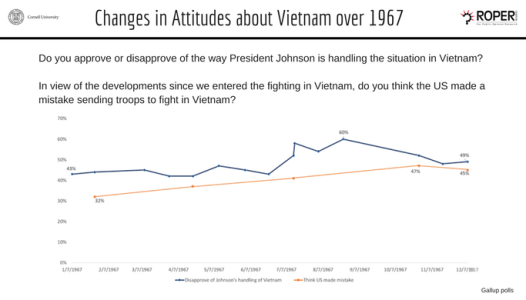
I'm old enough to remember a lot of people at the time who had the opinion of "It's not our business, but if we're there, let's do the job." They may not have supported the concept, but that was not the same as being anti-war. Have a look at polling in 1967, with much more enlightening questions and responses:

attitudes-about-vietnam-1967.png

Johnson's handling of the war was viewed more critically than the war itself. While the number of people who thought the U.S. made a mistake grew over that year, but it never hit 50%.


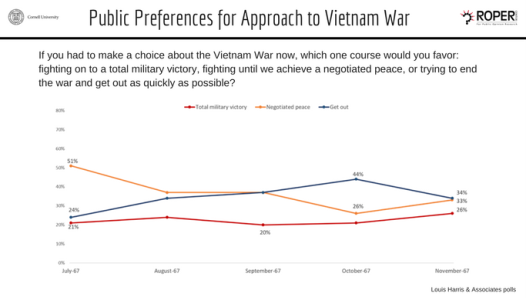
public-preferences-vietnam.png

More to the point---at its peak in that year, only 44% of Americans supported a total troop pullout, and within three months, that had dropped to 34%---only eight percent more than those who wanted a "total military victory".

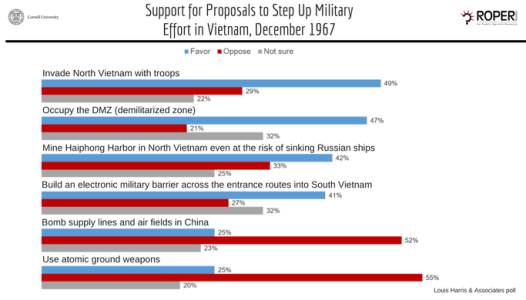
But dig deeper and even that number has some serious nuance:


military-proposals-vietnam.png

Invade North Vietnam with troops? 49% in favor. 29% opposed. 22% unsure.

The only massively unpopular options are bombing China and using nukes. (Link to full analysis: A Creeping Doubt: Public Support for Vietnam in 1967 | Roper Center for Public Opinion Research)

Over time, opposition to the Vietnam war became a majority thing, but even My Lai wasn't the inflection point a lot of people remember it as:


Back
Top Bottom