
-
Get involved.
We want your input!
Apply for Membership and join the conversations about everything related to broadcasting.
After we receive your registration, a moderator will review it. After your registration is approved, you will be permitted to post.
If you use a disposable or false email address, your registration will be rejected.
After your membership is approved, please take a minute to tell us a little bit about yourself.
https://www.radiodiscussions.com/forums/introduce-yourself.1088/
Thanks in advance and have fun!
RadioDiscussions Administrators
You are using an out of date browser. It may not display this or other websites correctly.
You should upgrade or use an alternative browser.
You should upgrade or use an alternative browser.
Calculating the Radiation Efficiencies of Vertical Monopole Antenna Systems
- Thread starter rfry
- Start date
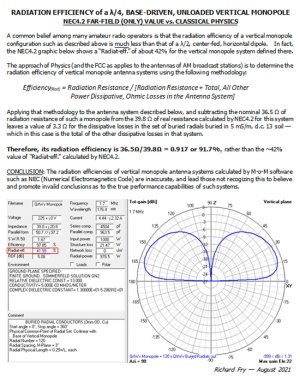

So, given this, vs. the cost of additional land for a λ/2 wave, the difficulties in zoning a taller tower and the cost of the tower and ground, why would a station not prefer a λ/4 wave tower(s)? In fact, with the elimination of the .25,. 5, 1 kw, 5 kw, 10 kw and 50 kw fixed power steps, one could theoretically calculate a compensatory power increase and achieve with (for example) the same coverage as 1 kw with a λ/2 wave.
Even the increased power bills over many years would still not be greater than things like higher property taxes, higher maintenance costs on the land and the tower and insurance expenses. That, and the considerable savings on construction would seem to make the quarter wave a better choice.
So, given this, vs. the cost of additional land for a λ/2 wave, the difficulties in zoning a taller tower and the cost of the tower and ground, why would a station not prefer a λ/4 wave tower(s)? In fact, with the elimination of the .25,. 5, 1 kw, 5 kw, 10 kw and 50 kw fixed power steps, one could theoretically calculate a compensatory power increase and achieve with (for example) the same coverage as 1 kw with a λ/2 wave. ...
One consideration is that increasing the applied power so that the maximum field radiated by a 1/4-wave tower could match that from a 1/2-wave tower is that the radiation patterns of those two heights are different in the vertical plane, and doing so would affect (increase) nighttime skywave interference in the AM broadcast band.

Geez, this debate has been around since the 1940's. I've read correspondence between engineers at Westinghouse, General Electric, and Blaw-Knox discussing this same thing. Ultimately the answer from a pure-performance standpoint is pretty simple: If you have approval, money and enough land, half wave is the best antenna. Debate over. Although, anymore I can't see where someone would invest that kind of coin into a new or replacement AM facility.So, given this, vs. the cost of additional land for a λ/2 wave, the difficulties in zoning a taller tower and the cost of the tower and ground, why would a station not prefer a λ/4 wave tower(s)? In fact, with the elimination of the .25,. 5, 1 kw, 5 kw, 10 kw and 50 kw fixed power steps, one could theoretically calculate a compensatory power increase and achieve with (for example) the same coverage as 1 kw with a λ/2 wave.
True, and who's putting up new AM sites anymore? May have to replace an existing aging tower, but certainly nothing from scratch.Even the increased power bills over many years would still not be greater than things like higher property taxes, higher maintenance costs on the land and the tower and insurance expenses. That, and the considerable savings on construction would seem to make the quarter wave a better choice.
The vertical radiation characteristic as it affects skywave groundwave interference is certainly another consideration. When WWJ and WXYT went from 5 kW DA-N to 50 kW DA-2 with shorter and much shorter towers respectively, and a broadside array design component which exacerbates fading over endfire arrays, it was not an unqualified improvement. Besides having weaker signals outside Wayne County, in Oakland and Macomb and other neighboring counties, where half or more of the population of the Market resides, the fading was much worse than the taller closer towers with just 5 kW near the center of the Market. WWJ's 186 degree tower (the other one 139 degrees) was near the optimum theoretical and empirical height, and WXYT's 165 degree towers weren't far behind. WXYT's nine 82 degree towers are far shorter than ideal. Now in places like Sault Ste. Marie, Sudbury, Stockholm, and Helsinki, the signals are like a slow fading powerful international shortwave stations. They are regarded some of the biggest DX pests in Northern Europe. WLQV 1500 with 10 kW Night with its 132 degree towers and an endfire array component which balances the broadside component, fades a lot less.
Last edited:
WWV and CHU use 1/2-wave vertical dipoles for their HF time signal transmissions.
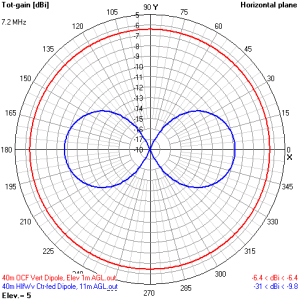
Probably because, for other things equal, v-pol transmission/reception results in greater and more uniform (omnidirectional) fields at lower elevation angles than when using h-pol (see attachment).
- Status
- This thread has been closed due to inactivity. You can create a new thread to discuss this topic.