It looks like WIND put up a dogleg three tower array in 1937 similar to the WHK array, when they went to 5 kW Night. This allowed them to increase the IDF to the NNW toward Chicago, while suppressing the IDF to the SSE. Eventually, they went to a 4 tower parallelogram with top loaded towers, and then replaced them with taller monopoles and moved the array slightly in the mid 1970s.

-
Get involved.
We want your input!
Apply for Membership and join the conversations about everything related to broadcasting.
After we receive your registration, a moderator will review it. After your registration is approved, you will be permitted to post.
If you use a disposable or false email address, your registration will be rejected.
After your membership is approved, please take a minute to tell us a little bit about yourself.
https://www.radiodiscussions.com/forums/introduce-yourself.1088/
Thanks in advance and have fun!
RadioDiscussions Administrators
You are using an out of date browser. It may not display this or other websites correctly.
You should upgrade or use an alternative browser.
You should upgrade or use an alternative browser.
Calculation Of The WIND Field Strength At WOR's Jean Shepherd's Childhood Home In Indiana
- Thread starter Schroedingers Cat
- Start date
I grew up listening to the Jean Shepherd radio show from about 1960 till 1966 when I went into the service. His show was carried by WOR-710 in New York. It was on every night, Monday to Friday, from 10 PM till 11. I was a kid and lived in the Philadelphia area, only 90 miles from NYC. I would lie in bed cuddled up to a 5 tube superhet and then later a transistor radio. In between I would DX. Wolfman Jack would boom in from the Texas/Mexico border.
I got my ham license in 1963, and Jean's previous night's monolog was always the talk of the high school radio club every day. He was idolized among the young ham radio crowd because Jean was also a ham. His call was K2ORS.
I had the privilege of working Jean on 15 meter SSB one day in the early 1980s. I was out of the service and married and lived in the Denver, Colorado area. My call was W0OHF at the time. The band was seemingly dead. I called CQ and this voice came back: "W0OHF, this is K2ORS". It took a few seconds to register. I hadn't thought of Jean in quite a few years. Could it be??
It indeed was. He was in Ft. Lauderdale, Florida, enjoying a respite of sorts. He was operating portable from the top floor of a condo building with a short stick vertical clamped to the porch railing. We chatted for 45 minutes.
I related the story of my youth to him and how much his radio shows meant to me as a teenager. And I thanked him for that. It was one of the greatest thrills of my radio-life.
His stories of early radio and Army life set the stage for my own life. He was one of my heroes.
If you remember the "brass figlagee with bronze oak-leaf palm" and "watch out for live wires", you will know what I'm talking about.
"Excelsior".
Bill, WE7W
I got my ham license in 1963, and Jean's previous night's monolog was always the talk of the high school radio club every day. He was idolized among the young ham radio crowd because Jean was also a ham. His call was K2ORS.
I had the privilege of working Jean on 15 meter SSB one day in the early 1980s. I was out of the service and married and lived in the Denver, Colorado area. My call was W0OHF at the time. The band was seemingly dead. I called CQ and this voice came back: "W0OHF, this is K2ORS". It took a few seconds to register. I hadn't thought of Jean in quite a few years. Could it be??
It indeed was. He was in Ft. Lauderdale, Florida, enjoying a respite of sorts. He was operating portable from the top floor of a condo building with a short stick vertical clamped to the porch railing. We chatted for 45 minutes.
I related the story of my youth to him and how much his radio shows meant to me as a teenager. And I thanked him for that. It was one of the greatest thrills of my radio-life.
His stories of early radio and Army life set the stage for my own life. He was one of my heroes.
If you remember the "brass figlagee with bronze oak-leaf palm" and "watch out for live wires", you will know what I'm talking about.
"Excelsior".
Bill, WE7W
It had been stated the Rocketman was partially fictionalized from the outset.Apparently that happens with real people, or at least their estates, as well.
In Elton John's movie "Rocketman," he is asked to come up with a new name. Per the movie, he got Elton from his band's sax player Elton Dean, and his last name from John Lennon. This is a blatant error, even more amazing because Sir Elton was the Executive Producer of the film.
"John" came from blues singer Long John Baldry, who was the leader/vocalist in Bluesology, the band he was with at the time, and who convinced him to come out of the closet. In fact, the song "Someone Saved My Life Tonight" is about Baldry convincing John to come out. Why Baldry was never mentioned in the movie, I have no idea. Maybe his estate wanted some extra money for it (he died in 2005) or they had a falling out over the years.
As for Frankie Valli in Detroit, they probably could have made up call letters to replace CKLW and only radio geeks would notice. Stodgy WJR was not in the business of breaking hits in 1967.
Broadway shows, movies, and autobiographical books are usually somewhat fictionalized, whether it's "Mamma Mia", "Jersey Boys", "Rocketman" or whatever. Autobiographical songs are often sanitized for air play. Words that rhyme or sound better are often substituted for a more factual lyric. In "Down On Main Street", by Bob Seger, the "club downtown" was actually on Ann St. in Ann Arbor, NEAR Main St. There really is a "Janey" from "Against The Wind", but her name is actually Jan or Janet. My wife grew up in "Janey's" neighborhood, but she didn't know "Janey", but she went to school with her brother. Bob was at my wife's HS Graduation Ceremony. I think Bob told "Janey's" brother he'd come to his graduation if he finished high school.It had been stated the Rocketman was partially fictionalized from the outset.
As for Frankie Valli in Detroit, they probably could have made up call letters to replace CKLW and only radio geeks would notice. Stodgy WJR was not in the business of breaking hits in 1967.
Last edited:
I've heard it stated that Shepherd may have been much more popular and well-known had he and his radio program come at an earlier or later time period. As it was, his show went on the air after the "Golden Age of Radio" was through, but also wasn't around long enough to experience the real resurgence of AM talk, either. If it weren't for the somewhat unexpected popularity of A Christmas Story (the movie wasn't particularly popular when it was first released..It was only when TBS and/or TNT began broadcasting their "24 hours of a Christmas Story" that it gained wide popularity) far fewer would be familiar with Jean and his work.I grew up listening to the Jean Shepherd radio show from about 1960 till 1966 when I went into the service. His show was carried by WOR-710 in New York. It was on every night, Monday to Friday, from 10 PM till 11. I was a kid and lived in the Philadelphia area, only 90 miles from NYC. I would lie in bed cuddled up to a 5 tube superhet and then later a transistor radio. In between I would DX. Wolfman Jack would boom in from the Texas/Mexico border.
I got my ham license in 1963, and Jean's previous night's monolog was always the talk of the high school radio club every day. He was idolized among the young ham radio crowd because Jean was also a ham. His call was K2ORS.
His stories of early radio and Army life set the stage for my own life. He was one of my heroes.
As an interesting aside, I've heard that the engineers producing Jean's program weren't allowed to do other work or leave the studio during his show, as he needed to be able to look at "someone" and have an audience to speak to. It was easier for him to use his engineer for that purpose rather than trying to visualize in his mind the folks at home listening to their radios.
Last edited:
This is an interesting thread, but are we saying that "Little Orphan Annie" was on WIND in 1939, the more-or-less agreed on time frame for the movie? Looking up the radio series indicated it at least started being originated on WGN.I've heard it stated that Shepherd may have been much more popular and well-known had he and his radio program come at an earlier or later time period. As it was, his show went on the air after the "Golden Age of Radio" was through, but also wasn't around long enough to experience the real resurgence of AM talk, either. If it weren't for the somewhat unexpected popularity of A Christmas Story (the movie wasn't particularly popular when it was first released..It was only when TBS and/or TNT began broadcasting their "24 hours of a Christmas Story" that it gained wide popularity) far fewer would be familiar with Jean and his work.
As an interesting aside, I've heard that the engineers producing Jean's program weren't allowed to do other work or leave the studio during his show, as he needed to be able to look at "someone" and have an audience to speak to. It was easier for him to use his engineer for that purpose rather than trying to visualize in his mind the folks at home listening to their radios.
I read this earlier in the Washington Post and appreciated the information and details about Jean Shepherd and some of his stories and books. Also some details about the movie "A Christmas Story" and how it was received when first released. Since the WaPo is behind a paywall for some, the link below is to the version appearing on Yahoo.

 www.yahoo.com
Do you know the stories behind 'A Christmas Story'?
Do you know the stories behind 'A Christmas Story'?
Late on a weekday afternoon in November 1983, I sat amid the scattered handful of moviegoers in a multiplex on Manhattan's Upper West Side, awaiting the opening frames of the new film "A Christmas Sto...
Shepherd's on-air style anticipated the spoken-word narratives of Garrison Keillor and Spalding Gray and inspired Jack Nicholson's portrayal of an overnight disc jockey in the film "The King of Marvin Gardens." No less a scholar of mass media than Marshall McLuhan praised Shepherd for utilizing "radio as a new medium for a new kind of novel that he writes nightly."
By the mid-1960s, Shepherd began adapting his autobiographical monologues into stories, initially for Playboy magazine and then for his books. The plot of "A Christmas Story" - the misadventures of stand-ins for a youthful Shepherd, here named Ralph, and his parents and younger brother - was assembled from pieces of a half-dozen different stories in "In God We Trust" and "Wanda Hickey."
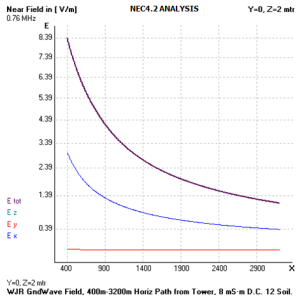
Below for consideration is a plot of the calculated groundwave fields of WJR that people living and working near their tower, plus their electronic equipment need to deal with.... I just calculated the field strength at the address on Cleveland St. The Night pattern field strength, which exceeds the Day field strength, is 280 mV/m, based on M-3 conductivity. That's definitely a crystal radio grade signal.
Nowadays there are multi-dozens of homes located in that area. In the 1960s and before, it was about 100% farmland.
- Status
- This thread has been closed due to inactivity. You can create a new thread to discuss this topic.