
• Get involved.
    We want your input!
    Apply for Membership and join the conversations about everything related to broadcasting.

    After we receive your registration, a moderator will review it. After your registration is approved, you will be permitted to post.
    If you use a disposable or false email address, your registration will be rejected.

    After your membership is approved, please take a minute to tell us a little bit about yourself.
    https://www.radiodiscussions.com/forums/introduce-yourself.1088/

    Thanks in advance and have fun!
    RadioDiscussions Administrators

Campus Broadcasting Under FCC §15.221

There seems to be an expectation that FCC §15.221 will be quite useful in setting up an unlicensed AM band transmitter for a campus operation that will permit higher legal fields on campus than permitted by FCC §15.209.

Below is an analysis of such a system based on an elevated Part 15 "Class E" AM transmitter with 100 mW input power using a 20 foot conductor to an earth ground, for the other parameters shown.

If this system was placed at the center of a campus, that campus would need to have a minimum width of over 11 miles in order for §15.221(b)(2) to be met.

For small campuses, the power that could be radiated to meet the limit under §15.221(b)(2) might be much less than could be radiated by a system strictly meeting §15.219.

Campus_AM.jpg
 
LPB lobbied for the 15.221 campus rules, but they eventually realized that they were worthless, except possibly on a LARGE campus. After John Devecka, a sales and marketing manager at LPB, left the company, he ran a Part 15 station on a small college campus in Baltimore, and he used 15.219, not 15.221. He had five synchronized Rangemasters for his station.
 
There's something I've been wondering about the campus rules, as it concerns the shape of the campus boundary.

For example, let's say your campus boundaries are 300 meters west, 800 meters north, 250 meters east, and 700 meters south of your transmitter. And, the campus isn't rectangular either, so that, for example, the boundary comes as close as 100 meters to the southwest, but extends 1.2 km to the northeast.

The rule specifies a certain field as measured at the boundary of the campus. What boundary are you allowed to go by, assuming an omni-directional operation? Are you required to rein it in at the closest boundary, or are you allowed to maintain that signal at the farthest boundary?
 
Taken literally, FCC 15.221 requires the field at all locations along the campus perimeter to meet the limits defined in FCC 15.209. This could mean that the fields at the perimeter with the longer paths to reach it from the transmitter would be less than permitted by 15.209.

A practical issue here is that the 15.209 legal fields in the AM broadcast band usually are below the radio noise level in most locations, and cannot accurately be measured even by calibrated, professional-quality field intensity meters.
 
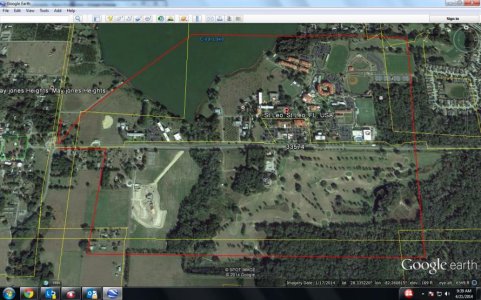
Saint Leo University Campus

This would be one to try to measure. One has to ask just how vigorous the FCC's enforcement of 15.221 would be?
 

Attachments

  • SLU.jpg
    SLU.jpg
    102.2 KB · Views: 10
Last edited:
St. Leo Campus Scenario

The St Leo campus situation is interesting to consider with respect to FCC §15.221.

Assumptions:

  • The field intensity of the 1640 kHz r-f noise in that area is 100 µV/m
  • A 10 dB signal-to-noise ratio is needed for the FCC to consider their measurement to be reliable

Given the above, then fields exceeding 316 µV/m any place along the perimeter of the St Leo campus might be considered as a basis for an NOUO under §15.221.

If the goal was to provide the best signal to the student housing buildings, and the unlicensed transmit system described in my NEC model above was installed at the north end of the plant operations building (about midway between those two housing areas), then the 316 µV/m contour is ~tangent to the closest point on the campus perimeter about 0.16 miles to the north.

That 316 µV/m contour also encloses the two student housing areas, although the fields inside those buildings could be reduced due to shielding, and r-f noise levels inside those buildings could be greater than 100 µV/m.

The system described in my NEC model (86 mW of applied power) would produce a field of about 1730 µV/m at a distance of 0.16 miles -- which the FCC would have no difficulty measuring quite accurately, even with 100 µV/m ambient noise.

The power applied to that antenna system would need to be reduced to about 3 mW in order to limit the field to 316 µV/m at a distance of 0.16 miles.

St_Leo_Campus_Bdcst.jpg
 
John, re:
... sensitivity of an AM radio would have to be to easily detect 3 millivolts?

My post showed 0.316 millivolts/m (mV/m) at that yellow circle on the map -- not 3.16 millivolts/m. The distance from that NEC model I posted would be 100 feet or less for the field to exceed 3 mV/m.

But to answer your question, an AM broadcast band signal having a field intensity of 3 mV/m is rather strong. It would give good reception on average consumer-level AM receivers inside typical suburban homes, but probably not to receivers in the inside rooms of a multi-story, steel framed building (all of this assumes the local r-f noise at the receiver location is not greater than 100 µV/m).

Radio-Locator shows 2.5 mV/m contours as providing "local" coverage.

I have a cheap clock radio that can pick up WHO from Des Moines, IA in the daytime here in west central Illinois. The field from WHO at this location is about 0.4 mV/m, and the r-f noise here is rather low -- although I haven't measured it.

My earlier statement about the FCC needing 10 dB S/N when measuring AM fields is just a guess, though. It might take a lot less, for example if they could see any meter indication of a signal above the noise floor, and could identify its source by program audio or direction finding techniques. If that signal+noise exceeded the level permitted by §15.221 at that location, it might be cause for an NOUO if the operator considered the source to be covered by 15.221.

OTOH a strictly compliant system operating under §15.219 with the base of its 3-m antenna a few inches above the earth could produce about a 0.36 mV/m field at the campus perimeter point I showed above, other conditions the same as in the model. And it would not be subject to any limit on the field it produced at the campus perimeter.
 
Thanks Rich. I meant 0.3 millivolts. However, the information you provided is useful. I am extracting myself out of the AM transmitter challenge debate. It reminds me of a comment: "Never argue with a pig because you both get dirty and the pig likes it."
 
They were flat out running a pirate FM that seemed to be condoned by the administration at the University of Missouri St. Louis until it was displaced by a new translator... It could easily be heard 7 or 8 miles off of campus on a car radio, and was going several years; UMSL is also the licensee to NPR KWMU, and a relay station in Quincy, IL. They have since went to an AM that still seems to considerably exceed Part 15 at 1620AM. I wonder how many college stations are running far in excess of Part 15?
 
USF in Tampa is/was running a free radiate on 1620. It could in some spots be heard well over 2 miles away. This is interesting since the Tampa Enforcement guys are just a few miles from the campus.
 
Status
This thread has been closed due to inactivity. You can create a new thread to discuss this topic.


Back
Top Bottom