• Get involved.
    We want your input!
    Apply for Membership and join the conversations about everything related to broadcasting.

    After we receive your registration, a moderator will review it. After your registration is approved, you will be permitted to post.
    If you use a disposable or false email address, your registration will be rejected.

    After your membership is approved, please take a minute to tell us a little bit about yourself.
    https://www.radiodiscussions.com/forums/introduce-yourself.1088/

    Thanks in advance and have fun!
    RadioDiscussions Administrators

Car Makes & Models with No AM Band.

I don't think we have that rule, and it's a pet hate. Too many ads start with a siren only to go "don't get stopped by the police, get new tires from Mike's Tires" or whatever.

There's another one that really gets to me - the sound of a car breaking down and clunking, followed by a VO along the lines of "don't you hate that sound? When it happens to you, call XYZ Breakdown Service". It's a needless distraction while driving, because the driver is trying to figure out if the grinding and clunking is their vehicle or the damn radio.
The drivers here are notoriously bad, and there's a station that's a got sounder leading into their traffic reports which is a bunch of blaring car horns. That has caught me off guard a few times and caused me to tap the brakes and look around, before realizing it's the radio.
 
I think you're referring to the ice storm where people died while all the radio stations in Houston were running syndicated talk or playing music.

Keep in mind the crisis lasted two weeks. The characterization that all radio stations didn't do anything about the storm for two weeks is an exaggeration. The main part of the crisis was the failure of the state's power grid, which meant home radio usage was out. It was also a state-wide problem, not just Houston. But since you mentioned Houston, there was quite a bit of coverage on KTRH and Houston Public Media. The obligation of the radio stations is to remain on the air and available for emergency officials to inform the public. They did that. Some radio stations won awards for their storm coverage that year.
 
Keep in mind the crisis lasted two weeks. The characterization that all radio stations didn't do anything about the storm for two weeks is an exaggeration. The main part of the crisis was the failure of the state's power grid, which meant home radio usage was out.
One of the key advantages of radio as a medium is the low cost and long battery life of portable radios. If something as simple as a power outage renders the medium unusable to a significant proportion of the populace, we've got problems.
 
One of the key advantages of radio as a medium is the low cost and long battery life of portable radios. If something as simple as a power outage renders the medium unusable to a significant proportion of the populace, we've got problems.

The availability of portable radios has been seriously diminished. I don't own a battery-operated radio, and I work in the radio business. I've seen surveys that say I am fairly typical of the general population. Which is why it's imperative to keep radios available in cars.
 
Last edited:
The availability of portable radios has been seriously diminished. I don't own a battery-operated radio, and I work in the radio business. I've seen surveys that say I am fairly typical of the general population. Which is why it's imperative to keep radios available in cars.
Agreed.

During the pandemic, my wife and I realized that we had no battery operated radio. Amazon came to the rescue with a variety of units, some of which I found that other members of the National Radio Club were actually using as DX radios.... so I bought a nice Tecsun PL 880 about 6 months ago, and keep it with several boxes of 24 long storage life batteries in a place in the home where we can easily find it even after a horrible earthquake.

How many people would do that (or have done it)? It borders on either geek behaviour or insanity, and ended up costing about $200 in total including a "crush-proof" waterproof box to store it in.

Only car radios would be available to a huge portion of the population, and even then not for very long unless used very sparingly.
 
The availability of portable radios has been seriously diminished. I don't own a battery-operated radio, and I work in the radio business. I've seen surveys that say I am fairly typical of the general population. Which is why it's imperative to keep radios available in cars.
I feel so old, as we have several battery-powered radios in our house, including a 10-transistor GE radio I got for my 10th birthday.
 
Agreed.

During the pandemic, my wife and I realized that we had no battery operated radio. Amazon came to the rescue with a variety of units, some of which I found that other members of the National Radio Club were actually using as DX radios.... so I bought a nice Tecsun PL 880 about 6 months ago, and keep it with several boxes of 24 long storage life batteries in a place in the home where we can easily find it even after a horrible earthquake.

How many people would do that (or have done it)? It borders on either geek behaviour or insanity, and ended up costing about $200 in total including a "crush-proof" waterproof box to store it in.

Only car radios would be available to a huge portion of the population, and even then not for very long unless used very sparingly.
I feel so old, as we have several battery-powered radios in our house, including a 10-transistor GE radio I got for my 10th birthday.
As I've mentioned before, I only have 2 "radios" in my home and rarely use either. One happens to be built into my 3.1 "entertainment system", and the other is an Eton wind-up AM/FM/weather radio that also has an LED flashlight and cell phone charger built in. While it's been nearly useless in shorter-term major storms and weather events as none of the stations has broken programming or usual format to give news or information, during incidents where there was a lot of long-lasting damage or widespread power outages and other impacts, the wind-up radio has been helpful when our power was out, as a few stations did break programming and I didn't need to go to the bother or expense of keeping batteries in stock for it, or trying to drive around and find batteries once a storm hit and shelves were empty. As a bonus, it kept my cell phone charged during the day or two we were without power. I got my wind-up radio as a "gift" during an NPR station pledge drive, but I appreciated it so much that I bought a few to give family members as gifts.
 
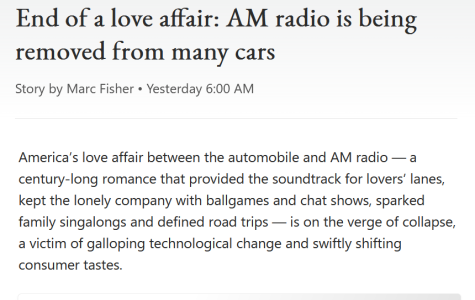
Here is the (horribly researched) Washington Post article dated Saturday:

1684130022343.png
This article is a free read at End of a love affair: AM radio is being removed from many cars

The headline is, of course, totally inaccurate in using the term "many". It's still a smaller percentage o new cars and a tiny percentage of all cars on the road. It also, very inaccurately, blames consolidation for the reduction in radio news sources; the real cause is double or triple... huge increase in stations due to Docket 80-90, deregulation that no longer forced music stations to do news when they did not want to and the general decline of over 2/3 of radio's revenue base in the last 25 years.
 
Last edited:
Perhaps AM radios in vehicles (intended to be sold in the US market) could be part of the baseline of safety equip. - seat belts, air bags, window glass that breaks "safely", AM (& FM) radios.

All of these things can be life saving in certain situations.


Kirk Bayne
 
There is a case for conventional radios to remain available in cars, but whether they have to be AM is another matter. A lot of major tunnels have FM repeaters running through them, which is convenient as listeners don't lose the station they were listening to while driving, but also allows the tunnel operator to break into the FM signal to provide emergency information if something happens. Many tunnels have signs advising drivers to switch on their radio when entering the tunnel, even if they weren't previously listening to an FM program.

Last time I took the Channel Tunnel was a few years ago, but they also had two FM signals running the length of the tunnel, playing music and information, one in English and the other French, again largely so that the signal can be used in an emergency. On there, you sit in your car inside a rail carriage as it takes you through. (There used to be a bilingual on-land FM station on the approach to the tunnel as well, but it was deemed unnecessary and closed over 20 years ago. The recordings on the page are a memory of a better era, when travel between the UK and mainland Europe was routine and straightforward.)
 
Last edited:
Perhaps AM radios in vehicles (intended to be sold in the US market) could be part of the baseline of safety equip. - seat belts, air bags, window glass that breaks "safely", AM (& FM) radios.

All of these things can be life saving in certain situations.
Not if few people listen, or stations aren't staffed to broadcast such actual life-safety information...
As we've all said several times Kirk; we don't live in the 1970's anymore. In natural or man-made disasters, people don't even exercise one brain neuron cell thinking to turn on AM radio. They whip out their smatphone and check an app or their chosen social media site.
 
Perhaps AM radios in vehicles (intended to be sold in the US market) could be part of the baseline of safety equip. - seat belts, air bags, window glass that breaks "safely", AM (& FM) radios.

All of these things can be life saving in certain situations.


Kirk Bayne
Seriously, this is becoming absurd. No one buying a car who’s under 50 is going to listen to AM radio. It’s not a safety feature. It isn’t going to save lives. Learn to live in the 21st century.
 
Sigh... Please, PLEASE, don't let this become yet another discussion thread that winds up getting locked due to it becoming an extended, absurd debate around 1 person's insistence than an old, antiquated, substandard band be brought back to life or kept alive for a purpose it hasn't served in years and is not well suited for! :rolleyes:
 
There are some AM stations that are planning to sue the FCC over this, claiming that the FCC can "make" car manufacturers keep the AM band as part of the entertainment options in cars. I'm guessing that's going nowhere.

They're talking about it on KCJJ right now and hypothesizing that the FM band could be next.

As for emergency communications, even when I lived in Iowa City and KCJJ was the only local station doing live storm coverage, I listened to the stream online rather than on AM, because it was a lot clearer.
 
There are some AM stations that are planning to sue the FCC over this, claiming that the FCC can "make" car manufacturers keep the AM band as part of the entertainment options in cars. I'm guessing that's going nowhere.

They're talking about it on KCJJ right now and hypothesizing that the FM band could be next.
It'll probably go about as far as the proposed lawsuits that would've forced cell manufacturers to include OTA radio receivers in their phones, or the suits against SiriusXM merging for fear it would hurt terrestrial broadcast stations, or the suits against those satellite companies giving local weather forecasts, for much the same argument. None were effective.
 
I do not believe that the FCC has the statutory authority to require auto manufacturers to include AM radios. This would have to come from Congress. I do feel though that there would be bipartisan support for an "All Channel Receiver Act"-type bill, however, it must be written in a way that prevents auto manufacturers from removing broadcast radio completely (AM and FM) from the dashboard. Otherwise, the legislation would backfire, horribly. While it is a stretch, Congress should also look into the "sweetheart" deals between the auto manufacturers and Sirius/XM. The legislation would probably not necessarily be directed at the FCC as much as it would be directed towards the DOT to require AM/FM presence without a subscription requirement for the purpose of safety. Of course, I would extend it to (1) require HD reception and (2) to require tuning capability for 76~108 MHz on FM, but again.. that's just forward thinking me with another one of my usual pie-in-the-sky ideas. For wide coverage facilities (Class A and B AM), there will always be a need for AM radio to reach areas where FM is under-served, but for smaller stations, they could benefit better from an extended FM band. Too many small AMs are turning in their licenses and there is simply no room in our existing FM band. We need to follow Japan as well as Brazil and other South American nations and seriously weigh the public interest of 60 channels of extended FM that could be used nationwide or the handful of TV stations remaining on Channels 5 and 6.
 
Status
This thread has been closed due to inactivity. You can create a new thread to discuss this topic.


Back
Top Bottom