
Exactly. If you go back and look at the..say last twenty years; how many broadcast stations have been knocked off for extended periods during natural or man-made disasters, verses entire cell phone systems? The argument that somehow broadcast is more reliable than a modern "cellular" infrastructure, is a red herring argument.What happens if AM towers are toppled?

-
Get involved.
We want your input!
Apply for Membership and join the conversations about everything related to broadcasting.
After we receive your registration, a moderator will review it. After your registration is approved, you will be permitted to post.
If you use a disposable or false email address, your registration will be rejected.
After your membership is approved, please take a minute to tell us a little bit about yourself.
https://www.radiodiscussions.com/forums/introduce-yourself.1088/
Thanks in advance and have fun!
RadioDiscussions Administrators
You are using an out of date browser. It may not display this or other websites correctly.
You should upgrade or use an alternative browser.
You should upgrade or use an alternative browser.
Car Makes & Models with No AM Band.
- Thread starter davideduardo
- Start date
Most AM stations aren't staffed after hours to save money, so who would be broadcasting this information?
Emergency officials, as required by the DHS act. There is no requirement that radio stations staff emergencies. In fact, if a station is in an evacuation area, the staff must evacuate. There is no exemption in the law for radio people.
There's no reason that people of color or that speak other languages need to put up with crappy quality of AM mono. Most have smartphones now.
The government can't make that assumption. There was money appropriated to help get broadband to everyone, regardless of income or situation. But as I posted earlier, if the government is responsible for public safety, then the government should do what it can to get its safety information to the public.
But history has shown Kirk, the local municipality must know-how, practice, and appreciate the use of EAS over stations and other services. The reality is; most don't. When weather or man made disasters hit, local EMS services don't give a s*it about activating EAS. They're going on-site, reacting and evaluating from the ground, not over some AM station that most of them don't even know exists. Amber alerts are different. They can be activated when buildings aren't being blown down, blown-up, or floods and fires aren't ravaging the community.If an EAS alert goes out, first responders would provide statements about the emergency over the radio (years ago, I happened to hear an Amber Alert go out - the audio on the cable TV program was replaced with a police officer stating the specifics of the Amber Alert - then back to the program audio).
I've been saying this for years, starting when the Commission started auctioning-off spectrum to Cell/PCS companies. Go ahead and allow broadcasters to buy their channel, and with that, do away with 'obscenity rules', payola, plugola, public files, EAS, and ownership rules.
I'll go a step further, and say if they did this, then radio companies would hire security to deal with pirates. They would be treated as trespassers and subject to arrest.
Exactly. For some reason, radio nerds seem to thing Les Nessman is sitting around waiting to jump into action at all hours of the day or night.Emergency officials, as required by the DHS act. There is no requirement that radio stations staff emergencies. In fact, if a station is in an evacuation area, the staff must evacuate. There is no exemption in the law for radio people.
And most Federal and local government officials already know, the way to reach the public is via smartphones or on the ground with bullhorns.The government can't make that assumption. There was money appropriated to help get broadband to everyone, regardless of income or situation. But as I posted earlier, if the government is responsible for public safety, then the government should do what it can to get its safety information to the public.

Spanish speakers only listen to AM if there is no FM available or a format they like is only on FM. In general, Hispanics listen to AM less than non-Hispanic whites.You mean Caucasian non-Hispanic consumers? I ask this, because in California, Spanish speaking, Korean speaking, and Chinese speaking people listen to AM radio, as there are stations which broadcast specifically to those communities.
But many who are statistically seen to be in lower income groups can't afford a variety of paid services. So they generally use "free" AM and FM more.There's no reason that people of color or that speak other languages need to put up with crappy quality of AM mono. Most have smartphones now.
And make LPFM "broadcasters" buy their channel too. That in itself would clean up a lot of noise and clutter.I'll go a step further, and say if they did this, then radio companies would hire security to deal with pirates. They would be treated as trespassers and subject to arrest.
But many of the streams are ad-supported, so there is no cost, other than standard cell/data rates.But many who are statistically seen to be in lower income groups can't afford a variety of paid services. So they generally use "free" AM and FM more.
Remember, many lower income users are on pay-as-you-go plans and use the cheap semi-disposable phones.But many of the streams are ad-supported, so there is no cost, other than standard cell/data rates.
On this subject, I can't find details on the manufacturing cost of those phones you buy on a cardboard card hanging in a rack in the 7-11. I wonder why an iPhone is in the $600 to $1300 range and this one costs just a little more than a pack of Marlboros in California:
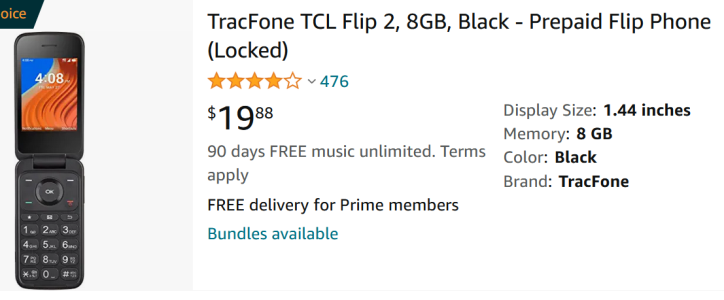

It is absolutely a free market issue when you tell a particular industry what they must do, based on the tenuous assumption that because the government has its hands in one area that it must have the unfettered authority to have it in another.That's sort of up to them, isn't it? If it was up to me, I'd wipe out lots of laws, starting with payola.
As long as the government mandates radio stations must be on the air, the government should have a say in if that signal can be received. A station required to be on the air without the ability to be received is useless. This is not a free market issue.
They need to be backing out of antiquated mandates, not doubling down on them. But perhaps we should expect no better.
It is absolutely a free market issue when you tell a particular industry what they must do,
The government is telling the radio industry what it must do. Why is that OK, but everyone else gets an exemption?
Spotify has no ownership regulations, indecency rules or payola rules. Radio does. You can't ignore the second part of the deal.
There is no 'tenuous assumption.' The government controls the entire food chain, from the studio to the receiver. If you look at the back of radio receivers, there is an FCC logo on them. It's there for a reason. Even if they haven't done a thing to improve the quality of receivers.

FCC Launches Proceeding on Promoting Receiver Performance
The Commission takes a fresh look at the role of receiver performance in our spectrum management responsibilities, with the goal of facilitating new opportunities for use of our nation's spectrum resources.
So yes, the government has authority over receivers.
Last edited:

FM was not listed as an option for the 1970 Dart.Actually was a bigger difference than that. The one and only new car I've ever owned was a '70 Dart Swinger, bought the year I graduated college (nice car...318 V8 with stick shift. If you kept your foot out of it gas mileage was in the 22-23 mpg range). Don't recall what an AM only radio cost, but an AM-FM radio was an almost $300 option. On a car with a list price of around $2500!
Needless to say, I skipped the FM (not much worth listening to on FM in 1970 anyway). Turns out it was a good decision. Several years later I got a factory AM-FM radio at a junkyard for $10 or so. FM section was deaf as a stump, and didn't have very good AFC so it drifted. A lot.
👍Exactly. For some reason, radio nerds seem to thing Les Nessman is sitting around waiting to jump into action at all hours of the day or night.
A good and current example is the distribution of dedicated phones to registered immigrants as they cross the Mexican border into the US; these are intended to keep the immigrant in contact with the immigration authorities for hearing appointments.The government can't make that assumption. There was money appropriated to help get broadband to everyone, regardless of income or situation.
Streets and trash receptacles in places like Nogales, Yuma, Calexico, El Paso and others are full of those devices. Migrants receiving them have been heard saying "¡ch---nga tu madre! No voy a cargar con esta mi---da" (Screw it, I ain't carrying this piece of crap).
Or, as I heard a comedian say in a stand-up routine, "If the government mandated that married women all wear obligatory diamond rings, the price of diamonds would collapse overnight".

Clearly you've never worked with a government or municipality when coordinating EAS use with broadcasters, as I have. There is no "requirement" for a local municipality in the use of EAS, yet most have them. One needs to look no further than an errant nuclear missile alert being sent via EAS in Hawaii. Most local governments have EAS, but few know how to use them, nor understand their value.EAS use requires training as does all the other things first responders do - once they assess the situation in a large scale disaster - activate EAS and broadcast info periodically.
I've worked in nations where payola is legal. It results in horrible radio programming.That's sort of up to them, isn't it? If it was up to me, I'd wipe out lots of laws, starting with payola.
At one time, before FM expanded competition and a few group owners controlled radio in the major cities of Mexico, paid play of stiffs along with over 20 minutes of ads an hour caused radio to reach under 75% of all people weekly; at the same time in the U.S., radio reached about 95% of the population each week.
Remember, payola does not prevent the station owner from taking money to play songs. It prevents employees, unbeknown to the owner or management, from taking bribes to play songs. In a sense, "payola" is the act of stealing something of value from one's employer.
Exactly what happened in Minot.Most local governments have EAS, but few know how to use them, nor understand their value.
But with streaming options, does it matter that much? When you think about it, a station 'owner' could trash their programming all they want because of taking payola while playing stiffs. It's up to them. Listeners have plenty of options outside of radio.I've worked in nations where payola is legal. It results in horrible radio programming.
Sure, it goes to the 'white-trashing' of the radio neighborhood, but I would argue so does the allowance of LPFM stations.
- Status
- This thread has been closed due to inactivity. You can create a new thread to discuss this topic.