• Get involved.
    We want your input!
    Apply for Membership and join the conversations about everything related to broadcasting.

    After we receive your registration, a moderator will review it. After your registration is approved, you will be permitted to post.
    If you use a disposable or false email address, your registration will be rejected.

    After your membership is approved, please take a minute to tell us a little bit about yourself.
    https://www.radiodiscussions.com/forums/introduce-yourself.1088/

    Thanks in advance and have fun!
    RadioDiscussions Administrators

CBC shuts down daily time signal

Last edited:
The CBC has dropped its daily 1 pm time-signal segment that dated to 1939. One reason given is the time delay introduced by HD Radio broadcasting.

It's also really weird when the management of a news outlet refuses an interview with its own reporters, which tells you that the CBC maybe needs to loosen up.

Virtually everyone carries around a NIST-sychronized clock in their pocket these days, their smartphone. If you need something that approximates actual exact time, cellphones get it from the towers they're connected to, which in turn get it from a network time server that syncs with NIST's WWV or some other reference clock. So the time signal you hear on CBS, or those few non-network stations that still air a time tone, are approximations, off by a few seconds, since relatively few people really need to know *exact* time in their lives. And if you do, check your phone.
 
Virtually everyone carries around a NIST-sychronized clock in their pocket these days, their smartphone. If you need something that approximates actual exact time, cellphones get it from the towers they're connected to, which in turn get it from a network time server that syncs with NIST's WWV or some other reference clock. So the time signal you hear on CBS, or those few non-network stations that still air a time tone, are approximations, off by a few seconds, since relatively few people really need to know *exact* time in their lives. And if you do, check your phone.
There's NTP, too, as well as WWVB.

I now live maybe 75 miles away from WWVB, so no problems with reception but in northern California, there were days when I had problems getting a signal from it. The weather station we had there had a WWVB receiver but we could tell when something was wrong when the time - or especially the day and date - was wrong.

The resonance in this article was more emotional than anything else. I also found the eruption of bureaucratic cowardice on the part of the CBC over something this small to be amusing.
 
Is the NIST the same way that the time and temperature phone numbers got the time, too?
I doubt the phone company's weather line got its info from the National Bureau of Standards (as NIST used to be known) back in the day - more likely the Weather Bureau - but the time lines around the country? Yes,very likely. But keep in mind this was well before network architectures were anything but embrionic, so *my guess* is that someone at each telco was tasked with manually synchronizing their time line to WWV or WWVB or WWVH (Hawaii) over shortwave once a week or month or at DST changes.
 
I doubt the phone company's weather line got its info from the National Bureau of Standards (as NIST used to be known) back in the day - more likely the Weather Bureau - but the time lines around the country? Yes,very likely. But keep in mind this was well before network architectures were anything but embrionic, so *my guess* is that someone at each telco was tasked with manually synchronizing their time line to WWV or WWVB or WWVH (Hawaii) over shortwave once a week or month or at DST changes.
Western Union had a time service that included special clocks that synchronized regularly via a telegr0pahed signal. These were used into the 70's.

Around 1972 at WUNO in San Juan, PR, I was advised by the FCC that our time was off and to get and install some kind of time standard device. WWV did not come in in much of the summer months and Western Union did not have a clock service. Our solution was one of the early "atomic clocks" that could stay accurate over several months. One cost over $1,000 back then and that was about the equivalent of $5,000 today for a clock!
 
Western Union had a time service that included special clocks that synchronized regularly via a telegr0pahed signal. These were used into the 70's.
KFRU in Columbia, Mo., where I spent nearly five years, had the Western Union service until it was discontinued, which happened before I started there - which was 44 years ago this month. After WU was discontinued, we used the ABC network for accurate time.

Radio Shack had the "Timekube" which received WWV or WWVH, similar in concept to its "Weatherkube" for the weather band. And the 1978 catalog, at least, had one for Canada's CHU, needed because the Timekube was crystal-controlled, sold only in Canada and the northeast U.S.! Cost was $35 for either the WWV or CHU models.
 
I doubt the phone company's weather line got its info from the National Bureau of Standards (as NIST used to be known) back in the day - more likely the Weather Bureau - but the time lines around the country? Yes,very likely. But keep in mind this was well before network architectures were anything but embrionic, so *my guess* is that someone at each telco was tasked with manually synchronizing their time line to WWV or WWVB or WWVH (Hawaii) over shortwave once a week or month or at DST changes.
You probably remember "POPCORN", which was available in the Bay Area until September 2007. I suspect that was manually synchronized.

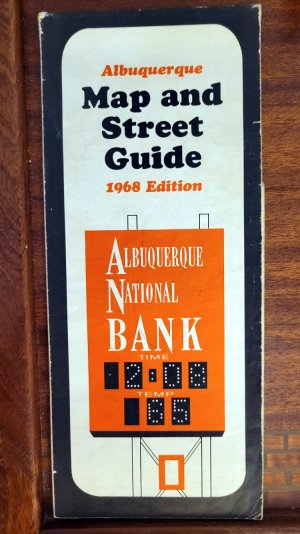
Time and temperature lines existed in the 1960s, often sponsored by a local bank, in the days when bank accounts were far more heavily regulated, and banks had to compete for deposits on something other than interest, since all banks paid the same. Time and temperature lines, and signs, were one way to stand out from the other banks. Albuquerque National Bank went one step farther, publishing a detailed street map of Albuquerque with an image of its time and temperature sign on the front of the map.


20231010_212342-resized.jpg
 
You probably remember "POPCORN", which was available in the Bay Area until September 2007. I suspect that was manually synchronized.
I do remember good old POPCORN, but back in New York, where I grew up, NY Tel (later NYNEX and now Verizon) had "WEather 6-1212" and "MEtronome 7-1212". And the "1212" part could be substituted with any four random digits, weather and time each had its own dedicated exchange within each area code. I don't recall when they went away, possibly around the turn of the century, but doing so was probably a tactic to delay the day they needed to split their area codes (or overlay new ones) as faxes, modems and cell phones turbocharged the demand for additional phone numbers.
 
Last edited:
I do remember good old POPCORN, but back in New York, where I grew up, NY Tel (later NYNEX and now Verizon) had "WEather 6-1212" and "MEtronome 7-1212". And the "1212" part could be substituted with any four random digits, weather and time each had its own dedicated exchange within each area code. I don't recall when they went away, possibly around the turn of the century, but doing so was probably a tactic to delay the day they needed to split their area codes (or overlay new ones) as faxes, modems and cell phones turbocharged the demand for additional phone numbers.
Pretty sure the "ME" in the "ME7" exchange stood for "Meridian," not "Metronome."
 
I do remember good old POPCORN, but back in New York, where I grew up, NY Tel (later NYNEX and now Verizon) had "WEather 6-1212" and "MEtronome 7-1212". And the "1212" part could be substituted with any four random digits, weather and time each had its own dedicated exchange within each area code. I don't recall when they went away, possibly around the turn of the century, but doing so was probably a tactic to delay the day they needed to split their area codes (or overlay new ones) as faxes, modems and cell phones turbocharged the demand for additional phone numbers.
The BOCs in the larger cities had similar setups. "POPCORN" worked across the Bay Area area codes, and any four digits after 767 worked. In Kansas City, the service was 844 followed by any four digits, in either the Kansas or Missouri area code. United Missouri Bank sponsored it. I know it's no longer in service, but will have to research when it stopped. My understanding is that the recordings were on large metal drums.

The time and temperature number for the southern Iowa town where I spent part of my childhood is still in operation - I just tried it and it's 64 degrees at 1 pm. Probably a good service, since the local radio station there (KCOG) doesn't have much local programming.
 
In Kansas City, the service was 844 followed by any four digits, in either the Kansas or Missouri area code. United Missouri Bank sponsored it. I know it's no longer in service, but will have to research when it stopped. My understanding is that the recordings were on large metal drums.
I was trying to remember which bank sponsored the number and what the number was, thanks for the info. I think it was a woman’s voice on the recordings but not sure. I know it was around in the late 80s because I remember calling it as a kid.
 
The BOCs in the larger cities had similar setups. "POPCORN" worked across the Bay Area area codes, and any four digits after 767 worked. In Kansas City, the service was 844 followed by any four digits, in either the Kansas or Missouri area code. United Missouri Bank sponsored it. I know it's no longer in service, but will have to research when it stopped. My understanding is that the recordings were on large metal drums.

The time and temperature number for the southern Iowa town where I spent part of my childhood is still in operation - I just tried it and it's 64 degrees at 1 pm. Probably a good service, since the local radio station there (KCOG) doesn't have much local programming.
Good service only for those with landline phones. Who pulls out their smart phone and calls a phone number to get the time?

As a kid in the '60s, I was fascinated by those automated information lines. Two in the Boston area I remember fondly were an astronomy (the science, not astrology) line, 491-1497, that was updated daily with when you could see satellites crossing the sky, lunar phases, and other space events; and the Mass. Audubon Society's "Voice of Audubon," with comprehensive weekly roundups of bird sightings around eastern Massachusetts, with western sightings added several decades later. That number was 259-8805, and it remained in operation until just about a year ago, when the service for birders went online-only.
 
Pretty sure the "ME" in the "ME7" exchange stood for "Meridian," not "Metronome."
Yes, I believe you're right. Meridian sounds like the right mnemonic. Thanks for the correction.

Good service only for those with landline phones. Who pulls out their smart phone and calls a phone number to get the time?
As I wrote in #3 above, we all carry a NIST-synchronized clock in our pockets or handbags, so it's an obsolete service these days for anyone but blind people.
 
Good service only for those with landline phones. Who pulls out their smart phone and calls a phone number to get the time?
I did because I don't have a landline now and, yes, people in that community do have cellphones, of course. But, who knows? Old habits die hard? At least the number provides the local temperature as well.
 
I was trying to remember which bank sponsored the number and what the number was, thanks for the info. I think it was a woman’s voice on the recordings but not sure. I know it was around in the late 80s because I remember calling it as a kid.
A Kansas City Star article from 1997 identified the voice as that of a WAGA-TV Atlanta meteorologist, John Doyle. The equipment for the service was provided by Audichron USA, also of Atlanta. Time and temperature were both given. The recordings of Doyle's voice were digitized and sent "by modem" to Kansas City. The system kept time internally. The Star article said the service received more than 100-thousand calls a day.

Edit: I found another Star article, this one from 2002, indicating that the service would be shut down November 18 of that year. It stated that the time was synchronized to a NIST atomic clock in Boulder, Colorado (I believe this should have referred to Fort Collins). It had been in service for 53 years at that point and was still getting 70-thousand calls a day. The equipment, apparently the same equipment as described in the 1997 article, was described as obsolete and costly to upgrade.
 
Last edited:
You probably remember "POPCORN", which was available in the Bay Area until September 2007. I suspect that was manually synchronized.

Damn I completely forgot about POPCORN. Probably the last time I called or anyone even talked to me about POPCORN was about 30 years ago.
 
Status
This thread has been closed due to inactivity. You can create a new thread to discuss this topic.


Back
Top Bottom