• Get involved.
    We want your input!
    Apply for Membership and join the conversations about everything related to broadcasting.

    After we receive your registration, a moderator will review it. After your registration is approved, you will be permitted to post.
    If you use a disposable or false email address, your registration will be rejected.

    After your membership is approved, please take a minute to tell us a little bit about yourself.
    https://www.radiodiscussions.com/forums/introduce-yourself.1088/

    Thanks in advance and have fun!
    RadioDiscussions Administrators

CDs - Radio - (undoable) Audio Processing

IIRC, Robert Orban was of the opinion that the CD would usher in a new era of wide(er) dynamic range radio broadcasts (sorry, I don't have a link).

He later admitted he was wrong and radio would continue to demand reduced dynamic range.

There have been a few proposals for undoable audio processing, AFAIK, Dolby FM was the only one that was actually used OTA.

Is there any evidence that home radio listeners would want an (expander) specifically taylored to exactly undo radio station compression so that the original dynamic range of the music (probably classical) could be restored?


Kirk Bayne
 
CDs and digital files are all loudness-war master-limited to death now. The waveforms almost look like square waves with the tops sheared off. It's amazing that they sound like music at all. Classical and jazz are probably exceptions to this, but that aside, I don't know how any post-broadcast expander technology could restore dynamic range when there was almost none to begin with.

In fact, I wonder how much additional compression modern processing even adds to the music now. I assume today's digital technology is smart enough to look at those waveforms and determine they're already crushed and they're allowed to pass without much additional gain reduction which would make the music sound worse. Maybe some AGC levelling, multiband EQ and final peak limiting. That's just my guess, I'm not an engineer but I'd be surprised if there's not some advanced analysis of the source waveforms, not analog-style across-the-board dumb compression that could be reverse-expanded at the receiver end like dbx in its day.
 
It's easy to add reverb and compression but removing them is another matter. I'd be surprised if you could restore dynamics in a way that the artists intended, and the artifacts could be worse than the compression.

I've always felt that processing should be an option in the receiving equipment (as it is in some TVs these days,) not at the source, because the need for it was dependent on the listing environment. But the technology wasn't cost-effective for consumer devices at the time when record producers and radio stations started to squash audio.
 
CDs and digital files are all loudness-war master-limited to death now. The waveforms almost look like square waves with the tops sheared off. It's amazing that they sound like music at all.
Perhaps my old ears are responding to to the technical quality of new music when I hear it, and thus giving up on it too soon.

No, I'll admit it. It would make me grouchy no matter what. Guess that's my problem.
 
If this matters, from telos’ website on the Omnia.9 “Undo” is a two-step process that restores peaks and dynamic range to - and removes distortion from - source material that has been damaged by over-compression and clipping during the mastering process.”

Though for home audio use you’d have to run your audio to an Omnia 9, or PTN to undo the clipping.
 
If this matters, from telos’ website on the Omnia.9 “Undo” is a two-step process that restores peaks and dynamic range to - and removes distortion from - source material that has been damaged by over-compression and clipping during the mastering process.”

Though for home audio use you’d have to run your audio to an Omnia 9, or PTN to undo the clipping.
Marketing hype. You can't undo recordings that have been altered with compression or limiting. It's a physics thing..
Adding expansion would only create weird artificial dynamic range changes, not changing peak levels at the specific frequency or time intended.
 
Marketing hype. You can't undo recordings that have been altered with compression or limiting. It's a physics thing..
Adding expansion would only create weird artificial dynamic range changes, not changing peak levels at the specific frequency or time intended.
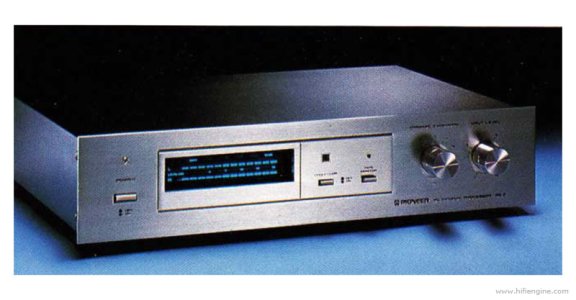
Back in the day, (70s) Pioneer made a Dynamic Range Expander that was supposed to restore Dynamic Range to compressed audio sources. As "Kelly A" stated, it created some really weird artificial changes and did not sound natural at all! I used it for about a day, and never used it again.
 

Attachments

  • pioneer_rg-2_audio_processor.jpg
    pioneer_rg-2_audio_processor.jpg
    58.1 KB · Views: 3
HD Radio was supposed to accomplish this, by adding 5 dB of extra headroom above the analog signal level and lacking the pre-emphasis curve that severely restricts the high end of analog FM. But since frequent switching between analog and digital reception in fringe signal areas makes having any great difference in audio quality between analog and HD extremely annoying for the listener, most stations give their HD audio the same highly processed texture and limited high end as their analog audio, to make the transition less noticeable.
 
HD Radio was supposed to accomplish this, by adding 5 dB of extra headroom above the analog signal level and lacking the pre-emphasis curve that severely restricts the high end of analog FM.
I never heard such a claim that HD radio would eliminate compression of recordings. The frequency response of HD Radio is wider than analog, because there is no need for filters to keep high frequencies above 15kHz away from the pilot. In theory, if a station were to run separate audio processing for HD and analog, HD could better reproduce the dynamics of the original recording, and would require hardly any compression or filtering vs. analog. In the interest of simplicity, most stations have opted for all-in-one audio processing with an HD and analog output. The good part of this solution, is when the receiver switches between HD audio and analog, there is less of a noticeable change. At least for the average listener. The bad part is the amount of compression, limiting, and EQ, is being done for both HD and analog. For that reason, the frequency response for the HD transmission is wider than analog, but dynamic range/peak levels are essentially equal. Depending on the station and format, HD can sound as good or as gross as the analog.
 
One thing is certain, the quality of music on streaming services (Spotify, Apple, Amazon, etc.) sounds far better than on the radio. It's another thing that puts radio at a disadvantage against streaming, along with streaming's abilities to let the user customize music preferences, skip songs, listen ad-free, etc.

Radio people still seem to cling to the old misguided mentality that music has to have every ounce of dynamic range squeezed out of it and be EQed and compressed to the max so the station will be the loudest one on the dial (which it's usually not). Well it's not 1965 or even 1985 any more. Music sounds better when you hear it the way is was meant to be heard, and now people have more alternatives than ever to hear it that way.
 
Radio people still seem to cling to the old misguided mentality that music has to have every ounce of dynamic range squeezed out of it and be EQed and compressed to the max so the station will be the loudest one on the dial (which it's usually not). Well it's not 1965 or even 1985 any more. Music sounds better when you hear it the way is was meant to be heard, and now people have more alternatives than ever to hear it that way.
And audio quality alone being one factor why radio is considered by younger listeners as inferior to streaming. Antique thinking left over from the AM days, where brick wall modulation could mean a slight coverage advantage. Never mind it doesn't have the same effect with FM, and potentially drives lower TSL, it's what was done back in the 70's.
 
I read an article somewhere that engineers are rethinking their mastering to meet streaming protocols.
 
I read an article somewhere that engineers are rethinking their mastering to meet streaming protocols.
The streaming services implementing loudness normalization was supposed to have ended the "Loudness War", but the problem is that they all have different reference levels for their normalization, so rather than trying to make sense of the multiple different standards, most mastering engineers just ignore those recommendations and make their tracks just as loud as they did 20 years ago when everyone was buying CDs. Maybe they've backed off a bit from the brink of insanity like on RHCP's "Californication", but not by much.
 
One thing is certain, the quality of music on streaming services (Spotify, Apple, Amazon, etc.) sounds far better than on the radio. It's another thing that puts radio at a disadvantage against streaming, along with streaming's abilities to let the user customize music preferences, skip songs, listen ad-free, etc.

Radio people still seem to cling to the old misguided mentality that music has to have every ounce of dynamic range squeezed out of it and be EQed and compressed to the max so the station will be the loudest one on the dial (which it's usually not). Well it's not 1965 or even 1985 any more. Music sounds better when you hear it the way is was meant to be heard, and now people have more alternatives than ever to hear it that way.
Streaming used to sound like crap, but yes, it has come a long way.

Have you heard HD radio, though? Where dos that fit into your perception of fidelity, when compared to streaming?

As for the bigger picture, does the average listener, hearing the result on earbuds or a mono smart speaker for the most part (yeah, I realize that car stereo speakers still exist -- although some of them have these massive, distortion inducing subwoofers), really care about the difference?
 
Streaming used to sound like crap, but yes, it has come a long way.

Have you heard HD radio, though? Where dos that fit into your perception of fidelity, when compared to streaming?

As for the bigger picture, does the average listener, hearing the result on earbuds or a mono smart speaker for the most part (yeah, I realize that car stereo speakers still exist -- although some of them have these massive, distortion inducing subwoofers), really care about the difference?
The biggest thing i've noted about my car and truck's HD Radio shifting from Non-HD to HD is the immediate appearance of stereo separation in HD. Most car analog radios these days are designed to minimize the stereo separation almost to the point of "non-existent" in order to eliminate noise. When HD kicks in, it's like a breath of fresh air to hear the stereo imaging in the music again. The fidelity; higher highs and lower lows are also evident in HD but not as dramatic as one would think.
 
The biggest thing i've noted about my car and truck's HD Radio shifting from Non-HD to HD is the immediate appearance of stereo separation in HD. Most car analog radios these days are designed to minimize the stereo separation almost to the point of "non-existent" in order to eliminate noise. When HD kicks in, it's like a breath of fresh air to hear the stereo imaging in the music again. The fidelity; higher highs and lower lows are also evident in HD but not as dramatic as one would think.
Is this anything like when I used to hear the singers from one speaker and the instruments on the other?
 
I've been driving around the Valley of the Sun for almost a decade with digital FM and have yet to notice a switch from HD to normal FM. It didn't even happen when traveling from Phoenix to Tucson. The HD signal just pulled a MacArthur.......you know, just faded away.
 
I've been driving around the Valley of the Sun for almost a decade with digital FM and have yet to notice a switch from HD to normal FM. It didn't even happen when traveling from Phoenix to Tucson. The HD signal just pulled a MacArthur.......you know, just faded away.
Don't know what that means. Are you sure HD Radio is turned on for your receiver?
 
Status
This thread has been closed due to inactivity. You can create a new thread to discuss this topic.


Back
Top Bottom