• Get involved.
    We want your input!
    Apply for Membership and join the conversations about everything related to broadcasting.

    After we receive your registration, a moderator will review it. After your registration is approved, you will be permitted to post.
    If you use a disposable or false email address, your registration will be rejected.

    After your membership is approved, please take a minute to tell us a little bit about yourself.
    https://www.radiodiscussions.com/forums/introduce-yourself.1088/

    Thanks in advance and have fun!
    RadioDiscussions Administrators

Changing Technology: A British Perspective.

I believe my friend said the 30% of their TMobile sites that have generators, are either diesel or propane powered.
In a related issue (From Inside Radio):

"The biggest headache for broadcasters during Hurricane Ida was fuel, and an inability to access it. That is the message Louisiana Association of Broadcasters President Polly Prince Johnson told the FCC Tuesday during a field hearing on communications recovery and resiliency during disasters."
 
Leisure FM The community radio station for Braintree.
With a format that we know from experience would get no audience in the US: "Leisure FM broadcast 24 hours per day and spans the music decades with air-play from the 1950’s to the present day."

No music station that has attempted to span four generations has ever been successful in any nation where I have worked and programmed stations.
 
With a format that we know from experience would get no audience in the US: "Leisure FM broadcast 24 hours per day and spans the music decades with air-play from the 1950’s to the present day."
Let alone advertisers. 'Wait, what's your target demographic?'
No music station that has attempted to span four generations has ever been successful in any nation where I have worked and programmed stations.
Exactly. Some smaller operators have tried something similar. All have failed.
 
With a format that we know from experience would get no audience in the US: "Leisure FM broadcast 24 hours per day and spans the music decades with air-play from the 1950’s to the present day."

No music station that has attempted to span four generations has ever been successful in any nation where I have worked and programmed stations.
Let alone advertisers. 'Wait, what's your target demographic?'

Exactly. Some smaller operators have tried something similar. All have failed.
I believe that would be called a Variety format in the United States, and yeah, most of the ones that are like Leisure FM are on non-commercial stations. Sounds like a fun format to me, but to agree with David, the money would be low.
 
My wife's station is even more eclectic and the listeners have been paying for it for 17 years. Right now we're playing a song by a music group from Peru. Pan flutes. Oh, we forgot to .hire a music consultant
 
I believe that would be called a Variety format in the United States, and yeah, most of the ones that are like Leisure FM are on non-commercial stations. Sounds like a fun format to me, but to agree with David, the money would be low.
This is what we often had in the distant past in smaller markets where there was just one station... block programming. As markets got two, three or thirty stations, each one carved out a piece for ownership.
 
My wife's station is even more eclectic and the listeners have been paying for it for 17 years. Right now we're playing a song by a music group from Peru. Pan flutes. Oh, we forgot to .hire a music consultant
Radio stations don't have "music consultants". Radio Consultants look at audience research to determine what the target listeners of a station want to hear.

Peruvian woodwind music is called huayno. "Pan flute" is a European misnomer.
 
Leisure FM The community radio station for Braintree.
Lemme' see... a town of about 50,000 and an immediate area of maybe 100,000. How many local commercial stations are there?

And equivalent would be Traverse City, MI. It has just under 20 stations in the country and the immediately adjacent ones that program specifically for Traverse City. Each one has highly specific music formats, and they don't try to be "a little something for everyone". None of them would, or should, play Peruvian flute music.
 
Lemme' see... a town of about 50,000 and an immediate area of maybe 100,000. How many local commercial stations are there?

And equivalent would be Traverse City, MI. It has just under 20 stations in the country and the immediately adjacent ones that program specifically for Traverse City. Each one has highly specific music formats, and they don't try to be "a little something for everyone". None of them would, or should, play Peruvian flute music.
Except there are no major cities near Traverse City, MI. Braintree is about 35 miles from London.
So, London comes in well. We use to listen to Radio Caroline-the pirate station there.
 
Classifying the BBC stations as "government run" from a programming standpoint isn't entirely fair. The stations have their own programming and music team and presenters that are often very good. Radio 1 and 6 Music have been quite successful while programming a lot of new and relevant music. Radio 2 is an excellent adult contemporary choice. There is a lot of investment in and quality in their product.
 
Classifying the BBC stations as "government run" from a programming standpoint isn't entirely fair.
The BBC is a government entity, finance principally by the tax levied on radios and TVs on pretty much every resident of the UK.
The stations have their own programming and music team and presenters that are often very good.
Yes, the government appointed administrators hire people to operate the stations, just like any government organization does. No different than the Army or the DOT or National Park Rangers.
Radio 1 and 6 Music have been quite successful while programming a lot of new and relevant music.
And remember, the BBC would not program more than a tiny portion of its schedule with pop music in the later 50's and 60's. Earlier on, in the UK fans of that music had to listen to Radio Luxembourg on 1439 or long-wave. Later, we got Radio Caroline and a slew of stations in international waters broadcasting what tens of millions of Brits deeply wanted to hear.

Only when discontent took on political overtones did the stuffed shirts at the BBC start opening up to what had become one of the UK's greatest exports: pop music!
Radio 2 is an excellent adult contemporary choice. There is a lot of investment in and quality in their product.
Of course there is a big investment. They have an annual stipend provided by every radio and TV user in the nation. I could invest a lot in programming if I had those funds at my disposal.
 
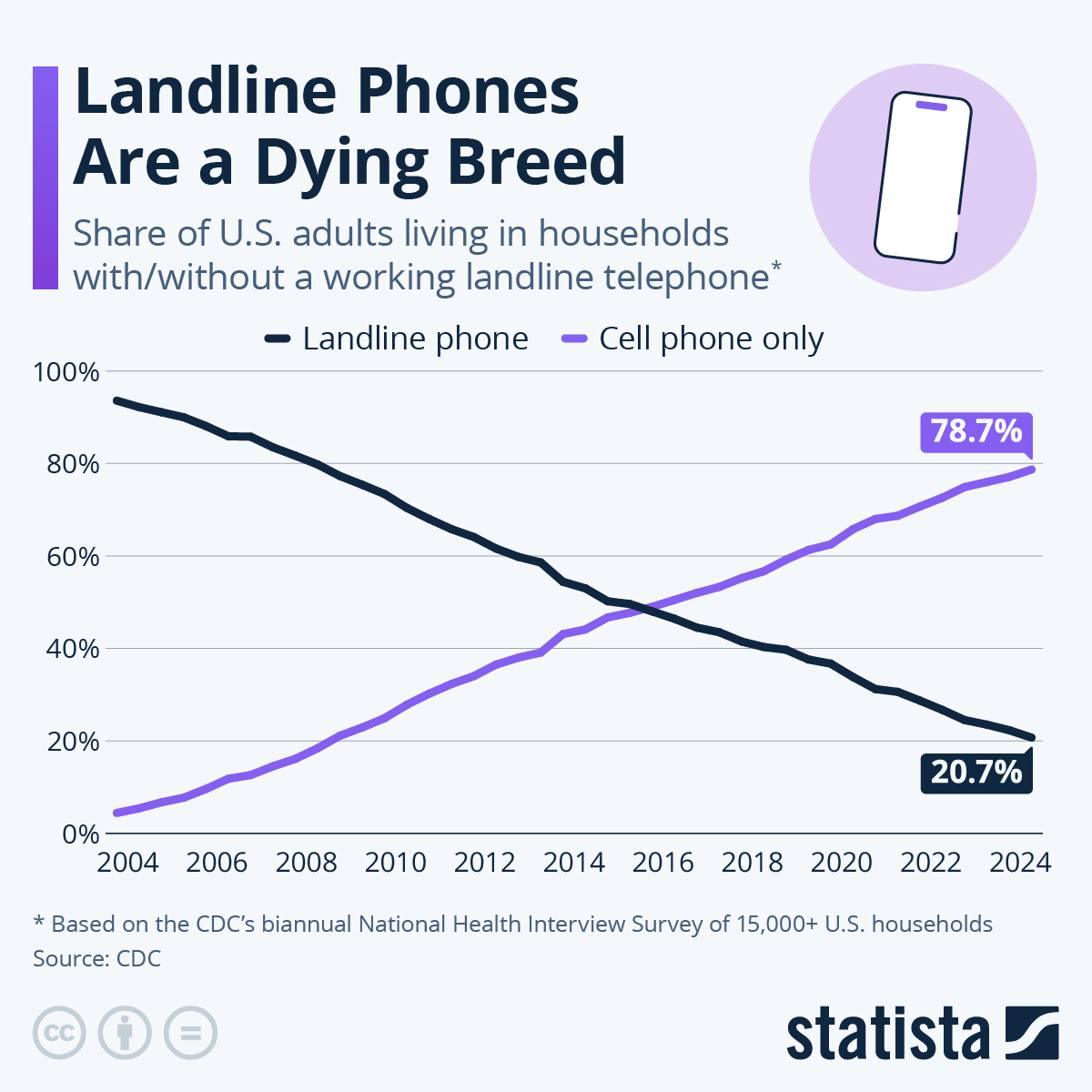
You're correct, but according to some statistics, fewer than 40% of households have a "landline" phone.

Also, and most importantly, many who have a landline "home phone", may no longer have hard-wired "POTS" copper lines that will work in cases of power failure. When my parents signed up for a plan to get internet and home phone under 1 package, AT&T went to their place and installed a modem which now feeds their home phone service as well as their internet. This meant they no longer had "hard wired" phone service that would work during a power outage. When they called the phone company to complain, they were told that reconnecting their POTS service was not possible. When they explained they needed phone service in cases of power outages, the phone company provided them a UPS unit to supply power to their phone/internet modem for a few hours. See below from AT&T's website:

Fascinating. In other words, if you don't have some sort of generator, you're SOL if the power outage lasts 30-40 hours -- or 8 days, as I experienced once in the 2010s.
 
People in the UK have a good reason to still be listening to radio because their radio is good. Americans have a good reason to get an Alexa.

I would like to see a more progressive FCC under Biden reverse some of the bad rules made during the Trump years. Most of the FM translators for AM's were given to broadcasters who already had plenty FM signals. And, they got the FM frequencies without having to face competition for the frequencies like everyone else.

Just more crap on the air.
People were complaining about translators being used by religious broadcasters here on RD long before Trump, so I don't think Trump's Administration had anything to do with FM translator law or FCC translator policy, as stated upthread by Mr. Eduardo.
 
And now Radio World expands on the subject with this:

"Planning to shut down British AM (MW) radio should begin, while analog FM services should stay on air until at least 2030. These are some of the key recommendations in the just-released Digital Radio and Audio Review, which was commissioned by the U.K. government in February 2020."

Interesting article with further analysis of the use of radio in the UK.


In the UK, some believe that if radio receivers are not promoted, "old" media including DAB, will fall to the wayside as online content continues to attract followers and increase usage.
 
"Planning to shut down British AM (MW) radio should begin, while analog FM services should stay on air until at least 2030. These are some of the key recommendations in the just-released Digital Radio and Audio Review, which was commissioned by the U.K. government in February 2020."
Just as with here in the States, AM/MW is an expensive-to-operate form of media delivery, with severely declining audience and associated relevance. Also unlike here; since the BBC/government pays to keep these legacy transmission facilities running, it makes a lot of sense to plan for a sun-setting period. Besides utility and operations costs, most of the BBC MW stations are overdue for substantially expensive capital equipment replacement. The sunset timing of the band is no doubt timed to the calculated end of life for those old MW transmission systems.
In the UK, some believe that if radio receivers are not promoted, "old" media including DAB, will fall to the wayside as online content continues to attract followers and increase usage.
As was stated in the link; smart speakers are WAY more popular than DAB these days, which when you think about it, makes a lot of sense. Especially around the holidays, smart speakers see a lot of growth as gifts because they do more than just play news or music, where DAB is relegated to just playing radio programming.
 
People were complaining about translators being used by religious broadcasters here on RD long before Trump, so I don't think Trump's Administration had anything to do with FM translator law or FCC translator policy, as stated upthread by Mr. Eduardo.
Partly true. A certain religious supercaster did apply for and received many many translators. Large Class B and C FM's were also allowed to expand beyond their primary radius while the rules prohibited the small FM's that needed a translator most from applying to do the same.
 
Last edited by a moderator:
Long ago, the train put canals and canal boats out of business. Radio is like a canal boat. The internet is like the train. The decline of radio in the US can be blamed on three things. One. The advance of technology. Two. Bad radio programming.
Three. Bad FCC rules.
 
Some years ago, "experts" expressed an interest in stopping all MW transmissions in the UK and handing over the band to mobile radio companies to use for extra local channels.
What are "mobile radio companies"? Do they mean cell phones? If so, MW doesn't seem like it would be very useful for that purpose anyway.

There has also been criticism of the sound quality of DAB transmissions, with the audio frequency range being compressed in order to pack more stations in to the multiplex
Shocking. The same thing happens here. Look at SiriusXM cramming so many channels into their limited bandwidth that the bitrate has become too low for anyone with a critical ear to tolerate. Similar situation with some HD FM stations and TV stations reducing bitrates to their minimums accommodate multiple subchannels, even cable TV providers reducing video bandwidth to cram more in. It always end up being quantity over quality. But...it's still no worse than MW so this argument holds no water.

There have been many complaints that DAB coverage is very patchy in remote parts of the country. Battery-operated DAB sets are very hungry for batteries, compared with the long battery lives of AM and FM sets.
Is this still true? That was the case with the first-generation HD Radio chipsets too, but the current chipsets are more efficiently designed and consume way less power. Is there something different about DAB where the chipsets haven't evolved the same way?

The people who want us to throw away old-technology radio receivers have not considered what would happen if the internet went down or the electricity grid was compromised and all the "new" short-range radio devices stopped working and the government wanted to send alerts and information to the general public. I am not talking about a nuclear attack but rather a series of extreme weather events.
I don't know how it is in the UK, but we saw how ineffective radio was in an emergency during the Texas freeze when even the top "News Talk" stations stuck with their syndicated canned programming, had no news staff on hand to speak of, and broadcast no EAS alerts, even as people froze to death while the cell phone networks went down.
 
Look at SiriusXM cramming so many channels into their limited bandwidth that the bitrate has become too low for anyone with a critical ear to tolerate.
This is the #1 reason I've never subscribed to SiriusXM. The music channels sound so flat that it's almost unlistenable to me. Months ago they said they were launching new satellites and planning to offer better quality audio on at least some of their music stations, but each time they open the service and offer it free during a given weekend I'll tune in and give it a listen. From what I've heard it still can't hold up to FM or streaming from an audio quality standpoint.
 
What are "mobile radio companies"? Do they mean cell phones? If so, MW doesn't seem like it would be very useful for that purpose anyway.
It would be perfectly ironic if cell phone companies bought out medium wave spectrum only to discover *gasp* that there is too much RFI noise and so they petition the government to crack-down harder on it, hence circling back around to when MW was good. 😆
Shocking. The same thing happens here. Look at SiriusXM cramming so many channels into their limited bandwidth that the bitrate has become too low for anyone with a critical ear to tolerate. Similar situation with some HD FM stations and TV stations reducing bitrates to their minimums accommodate multiple subchannels, even cable TV providers reducing video bandwidth to cram more in. It always end up being quantity over quality. But...it's still no worse than MW so this argument holds no water.
I tend to not notice the bitrate on the music, but it makes the announcer's voices sound so tinny. To me, that is not worth the $5 dollar subscription that will eventually jump into the double digits. And, I too will listen to SiriusXM on their free trial when it comes out (the nationwide coverage is nice), but yeah, the bitrate is a concern.
 
Status
This thread has been closed due to inactivity. You can create a new thread to discuss this topic.


Back
Top Bottom