
• Get involved.
    We want your input!
    Apply for Membership and join the conversations about everything related to broadcasting.

    After we receive your registration, a moderator will review it. After your registration is approved, you will be permitted to post.
    If you use a disposable or false email address, your registration will be rejected.

    After your membership is approved, please take a minute to tell us a little bit about yourself.
    https://www.radiodiscussions.com/forums/introduce-yourself.1088/

    Thanks in advance and have fun!
    RadioDiscussions Administrators

Chicago Radio Ratings Released 12-27-22

I'm seeing fewer OTA TV antennas. People have been streaming more.
Since the recession began, the cutting of streaming and paid video services has declined and more have become total OTA cord cutters due to the cost. This affects ethnic and lower income households, and many use antennas in the attic or or on a balcony in apartment dwellings.

Almost every investment bank and mutual fund has issued a cautionary note about a full recession coming about, so this will likely get worse.
 
95.1 had an old Harris unit from the 80s that used to wipe out the lower end of the band with harmonics. They patched it up over the years, but at some point last year it was having harmonics up to 100.3. I told their corporate engineer and they completely replaced the transmitter, finally. Took months. It was very problematic for them over the years.

Harmonics are multiples of a station frequency. The first harmonic of 100.1 is 200.2. What you were hearing was not harmonics.
I heard a story at one point in the 80s, 96.9 was putting harmonics onto 96.3. CBS' engineer called 96.9's engineer in the middle of the night and told him to get out there and fix it or he would be reporting it to the FCC in the morning. They used to take this stuff seriously.
That sounds like a huge exaggeration. First, few engineers gave their numbers to engineers at other stations unless they were friends or the local SBE had "backup contact" listings.

And again, a spurious signal on 96.3 is not a harmonic.
 
I'm from Kenosha. From my experience most people listen to Milwaukee radio and WWDV is played in businesses all over town because of it's strong signal. 103.7, 100.7 and 99.1 are among the ones I hear most frequently.
Nielsen has a simple criteria for market inclusion of suburban counties: listening in the largest percentage to a particular market's stations determines the market that county will be included in.

This is why market definitions are changed or updated every year.
 
One situation I have found is that if a nearby AM signal got into an FM transmitter, you could get spurs on either side of the FM station with the sum and difference frequencies. If WWDV 96.9 had a transmitter near Union Grove near the WTMJ 620 towers, it could conceivably put spurs at 96.28 MHz and 97.52 MHz. I have seen that happen, but the AM tower was right next to the FM station tower which had the spurious sidebands. The affected station DID complain to their engineer, and it was soon fixed.
 
Harmonics are multiples of a station frequency. The first harmonic of 100.1 is 200.2. What you were hearing was not harmonics.

That sounds like a huge exaggeration. First, few engineers gave their numbers to engineers at other stations unless they were friends or the local SBE had "backup contact" listings.

And again, a spurious signal on 96.3 is not a harmonic.

The station was basically transmitting on 100.4

It also had problems in the past with 94.0 and 96.0

It also had problems with 93.3. In the 80s, people wanting to listen to 93.3 in Milwaukee would call them and ask them to shut the station off so they could hear it.

Harmonics was being tossed around because their AM used to come along for the ride sometimes on these frequencies. Usually The 96.0

The word I believe I was looking for was spur. My mistake.

They replaced it with a solid state transmitter. It was a tube transmitter and did things like this for years.

And yes, that call between CBS and WNIB did happen in the middle of the night. They must have known each other or traded numbers. A lot of engineers generally knew each other. Sometimes stations would borrow equipment. A station up here borrowed some equipment from ABC. Maybe it was unique to this area.
 
Last edited:
Nielsen has a simple criteria for market inclusion of suburban counties: listening in the largest percentage to a particular market's stations determines the market that county will be included in.

This is why market definitions are changed or updated every year.
They last considered removing Kenosha County in 2017 as far as I remember. Either that or it was last talked about beyond their own discussions in 2017. Some stations were apparently for it. Nielsen wanted to closer align their radio markets with their TV markets. Other stations thought WWDV had an unfair advantage. They ended up leaving it in place. It was in a Robert Feder article
 
Since the recession began, the cutting of streaming and paid video services has declined and more have become total OTA cord cutters due to the cost. This affects ethnic and lower income households, and many use antennas in the attic or or on a balcony in apartment dwellings.

Almost every investment bank and mutual fund has issued a cautionary note about a full recession coming about, so this will likely get worse.
Indoor antennas are only useful 20 miles or less and those pizza shape or fly swatters antennas about 30-35 miles from the transmitter even installed outside. Downtown Kenosha is 50 miles from the Chicago tv transmitters, realistically you need a deep fringe antennas and likely a 35’ tower especially if you’re not in line of sight of the transmitters or have trees or other building near by, at that point you’re looking at spending 1,500-2500 dollars for equipment and professional installation, my guess that is way to much for people to spend. Kenosha is about 35 miles from most Milwaukee transmitters and that’s even stretching it for those Walmart antennas.

I would like to see a study but I’m assuming the majority of cord cutters that are going OTA only are living in the city center or inner ring suburbs, otherwise those outside of that will likely have difficulties and are looking for other options.
 
Last edited:
My experience visiting that Racine Kenosha area over the years is that the analog transmitters from both Chicago and Milwaukee came in fine. There is a problem with those indoor antennas with digital stations in Chicago. It is kind of hit and miss. But as far as line of sight, over the lake and fairly low elevation inland areas a few miles from the shore are not problematic. But the earth curvature is significant at 50 miles. My relatives have an Antenacraft HBU-22 in the attic toward Milwaukee. They frequently get WWTV 9 with 45 kW from about 1640 feet HAAT from Cadillac, MI, with tropospheric events over Lake Michigan, so I guess it would have been problematic for WGN-TV in that area if they had stayed on 9.
 
Last edited:
My experience visiting that area over the years is that the analog transmitters from both Chicago and Milwaukee came in fine. There is a problem with those indoor antennas with stations in Chicago. It was kind of hit and miss.
In the analog days I could get clear signals from the VHF channels from Milwaukee in Evanston about 75 miles. But the signals were traveling over Lake Michigan, when the antennas was pointed to Milwaukee you just saw water because of where Evanston is located. I don’t think the digital signals does that or not as good. Even in the analog days it would be difficult to signals from 75 miles with just a rooftop antenna with obstructions in between the antenna and transmitter. It’s likely Kenosha could have seen some signal enhancement from the Chicago tv stations when they were in analog because they were traveling over mostly water but only if you were a few miles from shore.

There were at least a handful of cable companies in lake shore communities of Michigan that carried at least a few Milwaukee tv stations (mainly WTMJ and WMVS) until about 2000 or so because they could pick them up OTA.
 
My relatives have an Antenacraft HBU-22 in the attic toward Milwaukee. They frequently get WWTV 9 with 45 kW from about 1640 feet HAAT from Cadillac, MI, with tropospheric events over Lake Michigan, so I guess it would have been problematic for WGN-TV in that area if they had stayed on 9.
WGN’s rf channel is 19 it shares it with WMTV in Madison and a tv station in Grand Rapids. WMTV probably doesn’t mess with WGN in Kenosha but all Grand Rapids stations mess with Chicago and Milwaukee stations that are on the same rf channels during troposphere events to at least some degree especially if you’re closer to Lake Michigan. In Harvard, IL WMTV comes in stronger than WGN checking on a spectrum analyzer (realistically it’s likely you won’t get either channel) and Harvard is in the Chicago tv market. WCIU and WFLD shared the same rf channel with LP stations from Milwaukee even with a highly directional antenna it would be impossible to pick up WFLD or WCIU 100 percent of the time in Kenosha, likely it would be unusable for the regular viewer.
 
Nielsen has a simple criteria for market inclusion of suburban counties: listening in the largest percentage to a particular market's stations determines the market that county will be included in.

This is why market definitions are changed or updated every year.
This is what I was getting at in my original post. A lot of people who live in Kenosha commute to the Chicago area, which increases listenership to Chicago stations. But we can't rule out the locals who probably do listen to the Milwaukee stations more. Advertisers on Milwaukee stations will target Kenosha. I never hear Chicago stations advertise for the Kenosha market.

Reception is another thing to consider. Milwaukee stations certainly have better reception in Kenosha. But Milwaukee stations drop almost as soon as you hit the Illinois boarder. Chicago stations will travel well into Wisconsin. Reception has gotten worse with the recent addition of translators that interfere with stations in the adjacent market. It really is an odd location between two metros.
 
According to the late Charles Gustafson, who worked at WIND, WCFL, and WTAQ 1300, and later at WKZO-TV, WJFM, WWTV, and WWTV-FM, the FCC allowed overlap over Lake Michigan to allow WKZO-TV and WTMJ-TV to both be on Channel 3. But it proved to be problematic, and that is why WTMJ-TV changed to Channel 4. But even with cochannel interference, you usually just got a few lines and 10 KHz audio from the offset. DTV interference completely wipes signals out, and shoreline areas are particularly problematic. As you probably remember, before IBOC, WJFM and WOOD-FM were easily received on a decent very selective receiver across the Lake on 93.7 and 105.7. WOOD-TV 8 had to put a translator in Muskegon due to shadowing and interference across the Lake when digital arrived.
 
And yes, that call between CBS and WNIB did happen in the middle of the night. They must have known each other or traded numbers. A lot of engineers generally knew each other. Sometimes stations would borrow equipment. A station up here borrowed some equipment from ABC. Maybe it was unique to this area.
Yes, that happens. Years ago, a competitor in Ecuador had their whole studio robbed overnight when nobody was there. I heard about it the next morning, and I went to see the owner and offered use of my second production studio. My stations were located just four or five blocks away, so they ran telephone cable on street light posts to their studio location to link to the transmitter. We had them as guests for four or five days while they got some temporary equipment.

In another case, a competitor in San Juan, PR, was destroyed by fire. The next morning, four or five of us who managed or owned other stations collected old equipment, blank carts, some old furniture and lots of wire and tools and gave them enough stuff to get on the air quickly with a "Rube Goldberg" studio (wiki that one for fun...).

On several occasions I've loaned a spare transmitter tube to a station that had no spare or found that their spare was too gassy to fire up...

That sort of stuff is common. But it takes an owner or manager who knows engineering to allow it.
 
Nielsen has a simple criteria for market inclusion of suburban counties: listening in the largest percentage to a particular market's stations determines the market that county will be included in.

This is why market definitions are changed or updated every year.
The only stations that have a useful signal from the Chicago into at least parts of Kenosha county are 96.9, WXLC and WPPN and the 50,000 watt AM stations. My guess most radio listening from Kenosha county residents are when they are northern Illinois, the useful signal for DT Chicago stations is up to around Waukegan.

How close of % people listen to Milwaukee compared to Chicago stations in Kenosha County? I imagine it’s has to be close to 50/50. Contrast that to tv viewership, there are only 4 stations from the Chicago market that are SD only and only on the local cable system( no streaming, apps or dish) and ratings for all 4 Chicago tv stations in Kenosha County are almost nonexistent.
 
Last edited:
My experience is that Kenosha regards itself as a far out Chicago suburb, and Racine as a far out Milwaukee suburb. Younger listeners in Kenosha were usually listening to WLS and WCFL in the 1960s. You had to go pretty close to Milwaukee to get WOKY and WRIT. In places like Grand Haven, MI, WOKY was a go to station in the Daytime. And of course, areas along the shoreline in Berrien County and to the North, with all the influential Chicago peoples' cottages, they just watched and listened to Chicago Radio and TV.
 
The only stations that have a useful signal from the Chicago into at least parts of Kenosha county are 96.9, WXLC and WPPN and the 50,000 watt AM stations. My guess most radio listening from Kenosha county residents are when they are northern Illinois, the useful signal for DT Chicago stations is up to around Waukegan.

How close of % people listen to Milwaukee compared to Chicago stations in Kenosha County? I imagine it’s has to be close to 50/50. Contrast that to tv viewership, there are only 4 stations from the Chicago market that are SD only and only on the local cable system( no streaming, apps or dish) and ratings for all 4 Chicago tv stations in Kenosha County are almost nonexistent.

96.9 was originally licensed to Kenosha and programmed to the city in the 1960s. The COL changed in the 70s but the tower to this day remains in Kenosha County. It’s widely listened to within the county.

WXLC is a North Suburban station.

As for TV, they rarely do news or weather for this area. Milwaukee does. Something happens here? It’s on Milwaukee TV. Bad weather? Milwaukee TV. Most people here are Packers fans (Although there are Bears fans too). Again, Milwaukee TV.

On radio, the younger (30 something now) generation I am in grew up with 103.7 for Top-40. Sometimes they would DJ events at schools here. 100.7 was popular both because of it’s music and it’s signal. I had teachers that listened to 102.9. Most Country fans listened to WMIL. Milwaukee radio, even out of market would do remotes here. Chicago would not. But as far as listening now, I’m guessing 50/50, depending on how the signal is at the time. Chicago goes out on the north side because of HD. Used to be better. B96 was fuzzy, but people would listen anyway for the mixshows.
 
Last edited:
ndoor antennas are only useful 20 miles or less and those pizza shape or fly swatters antennas about 30-35 miles from the transmitter even installed outside. Downtown Kenosha is 50 miles from the Chicago tv transmitters, realistically you need a deep fringe antennas and likely a 35’ tower especially if you’re not in line of sight of the transmitters or have trees or other building near by, at that point you’re looking at spending 1,500-2500 dollars for equipment and professional installation, my guess that is way to much for people to spend. Kenosha is about 35 miles from most Milwaukee transmitters and that’s even stretching it for those Walmart antennas.
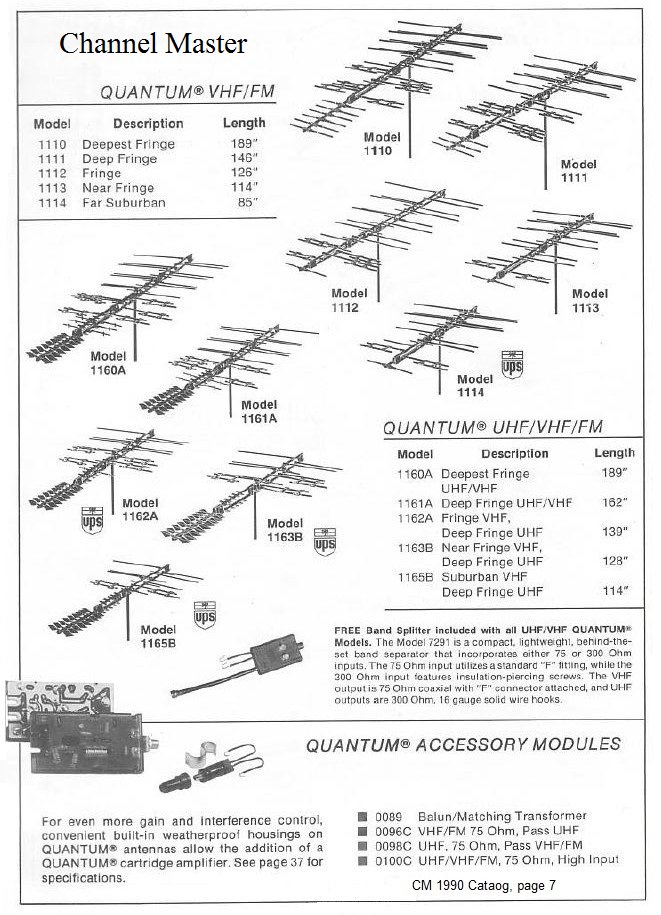
A pair of 8-bay bowties- one aimed North and one South- have become a common configuration here and they work just fine for Chicago and Milwaukee signals. The exceptions are WBBM (RF12) and WIWN (RF5). Usually WMVS/WMVT (RF8) are strong enough to sneak in with this setup. I have no problem with Chicago stations here; I use an OLD (like late 70s vintage) Channel Master Quantum on a rotor. These antennas are VHF monsters, but are not known for stellar UHF reception.
 

For the record, I live in Milwaukee.

This antenna is made for TV, but I hooked up to my receiver, taped it to the wall near the ceiling and attached about 10ft of thin cheap speaker wire to the unscrew-able base and ran it across the wall pointing south. Local stations now come in crystal clear and LPFM and fringe stations are now as clear as local stations were with my old antenna 102.5 (Smooth Jazz), 104.3 (Classical) and even WIIL Rock 95.1 comes in with little static. On a really good day it can pick 94.1 in Madison.
 
Last edited:
The Channel Master Quantum Series for VHF-UHF weren't that bad for UHF, but if you notice, most newer antennas for UHF have a large screen, small dish, or corner reflector configuration, all having to do with increasing antenna aperture, the area of signal capture.

4nZ2xL4.jpg
 

For the record, I live in Milwaukee.

This antenna is made for TV, but I hooked up to my receiver, taped it to the wall near the ceiling and attached about 10ft of thin cheap speaker wire to the unscrew-able base and ran it across the wall pointing south. Local stations now come in crystal clear and LPFM and fringe stations are now as clear as local stations were with my old antenna 102.5 (Smooth Jazz), 104.3 (Classical) and even WIIL Rock 95.1 comes in with little static. On a really good day it can pick 94.1 in Madison.
I have to wonder if your 10 foot wire is acting as your FM antenna. You might do as well with a twin lead dipole. Back when I was very young and didn't know a lot about signals, we got a Magnavox Stereo Theater TV/AM/FM/Phonograph. I ran a wire into the BASEMENT to a wire curtain rod and connected it to one FM antenna terminal. I remember hearing WJIM-FM 97.5 and WXYZ-FM 101.1 on it, both 40-45 miles away in different directions. You might also try separating the two speaker wires to make a 5 foot half wave dipole and connecting it to your FM antenna input. As I recall, the calculated impedance of the transmission line speaker wire is somewhere in between 75 and 300 ohms. You have a mismatch at both ends, but it still works well for receiving relatively strong signals. I also remember someone who lived in the highlands area between Flint and Ann Arbor who got excellent TV reception on VHF with just a long wire, maybe 10-15 feet out the window. If you do a Longley Rice on TVFool of FMFool from that location South of Fenton, MI, everything is Line Of Sight for a good 50-60 miles in every direction. And the tower lights on a clear Night prove it.
 
Status
This thread has been closed due to inactivity. You can create a new thread to discuss this topic.


Back
Top Bottom