
-
Get involved.
We want your input!
Apply for Membership and join the conversations about everything related to broadcasting.
After we receive your registration, a moderator will review it. After your registration is approved, you will be permitted to post.
If you use a disposable or false email address, your registration will be rejected.
After your membership is approved, please take a minute to tell us a little bit about yourself.
https://www.radiodiscussions.com/forums/introduce-yourself.1088/
Thanks in advance and have fun!
RadioDiscussions Administrators
You are using an out of date browser. It may not display this or other websites correctly.
You should upgrade or use an alternative browser.
You should upgrade or use an alternative browser.
dBu contours
- Thread starter MVB13
- Start date


The easiest thing to remember is that the majority of listening takes place in a station's 70 dBu contour. The 60, 54, 50 and 45 dBu contours are used for protections against co-channel and adjacent channel interference within their contours depending on the class of each station.Hi could someone kindly explain dBu contours and the 70 dBu, 60 dBu, 50 dBu contours using this link for the map for Z100 in basic terms? Thanks!
The Black and green circles more or less mean you can pick up a signal on a radio inside a building. Within the blue you're likely to get it in a car. Orange and red depend on how clear the frequency may be.
Using your Z100 example, because of co-channel 100.3 WRNB Media PA and adjacent channel 100.1 WJRZ Manahawkin, their signal is more or less non-existent beyond the 54 dBu level to the south. There's less interference to the north and east so it may over-perform there.

Furthermore, the FCC contours were developed in the 1940s more to determine where a station is "protected" and less to show its actual coverage. The contours use a set of elevations a set distance from the transmitter to determine the "average" terrain in each direction (hence, Height Above Average Terrain), and were developed long before computers and exact terrain elevation data were available.
The advent of such terrain data led to real world modeling, like Longley-Rice elevation maps, that can give a true picture of a signal's performance... analyses that can be especially helpful in mountainous terrain where the contours can be incredibly misleading. Here's what WHTZ's signal looks like:
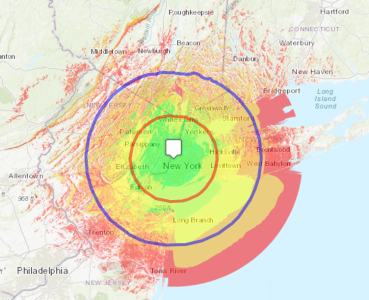
The advent of such terrain data led to real world modeling, like Longley-Rice elevation maps, that can give a true picture of a signal's performance... analyses that can be especially helpful in mountainous terrain where the contours can be incredibly misleading. Here's what WHTZ's signal looks like:
Last edited:

And, back in the 40's far fewer vehicles had radios, so stations were interested in "in home" listening. With the introduction of smaller transistorized radios in the mid to later 50's, radios were now small enough to have on your job's desk, counter or workbench and car radios became the norm.Furthermore, the FCC contours were developed in the 1940s more to determine where a station is "protected" and less to show its actual coverage.
Thank you so much Lance! I can understand how why in West Milford, NJ (where I grew up) which is Northwest of the city, I was able to get Z100 clearly in the car and at home on the stereo (we lived up on a hill) in addition to Hudson Valley stations like K 104.7. I know it was difficult to get in buildings, I remember in high school our teacher had the radio up high in her classroom and she was able to get Z100 on it.The easiest thing to remember is that the majority of listening takes place in a station's 70 dBu contour. The 60, 54, 50 and 45 dBu contours are used for protections against co-channel and adjacent channel interference within their contours depending on the class of each station.
The Black and green circles more or less mean you can pick up a signal on a radio inside a building. Within the blue you're likely to get it in a car. Orange and red depend on how clear the frequency may be.
Using your Z100 example, because of co-channel 100.3 WRNB Media PA and adjacent channel 100.1 WJRZ Manahawkin, their signal is more or less non-existent beyond the 54 dBu level to the south. There's less interference to the north and east so it may over-perform there.
Far north they have adjacent channel 100.1 WDST and farther west they have 100.1 WQFN.The easiest thing to remember is that the majority of listening takes place in a station's 70 dBu contour. The 60, 54, 50 and 45 dBu contours are used for protections against co-channel and adjacent channel interference within their contours depending on the class of each station.
The Black and green circles more or less mean you can pick up a signal on a radio inside a building. Within the blue you're likely to get it in a car. Orange and red depend on how clear the frequency may be.
Using your Z100 example, because of co-channel 100.3 WRNB Media PA and adjacent channel 100.1 WJRZ Manahawkin, their signal is more or less non-existent beyond the 54 dBu level to the south. There's less interference to the north and east so it may over-perform there.
Where did you get that great map of WHTZ'S signal?
RabbitEars.Info
RabbitEars, where you can learn all about local, over-the-air TV channels.
 www.rabbitears.info
- Status
- This thread has been closed due to inactivity. You can create a new thread to discuss this topic.