
Questionnaires at the end of an on-line session or app are easy and relatively inexpensive.Most companies, not just radio, seem obsessed with surveys. Every time I make a purchase, visit a doctor or use the ATM at my bank, I receive a survey to fill out. I ignore them all.

-
Get involved.
We want your input!
Apply for Membership and join the conversations about everything related to broadcasting.
After we receive your registration, a moderator will review it. After your registration is approved, you will be permitted to post.
If you use a disposable or false email address, your registration will be rejected.
After your membership is approved, please take a minute to tell us a little bit about yourself.
https://www.radiodiscussions.com/forums/introduce-yourself.1088/
Thanks in advance and have fun!
RadioDiscussions Administrators
You are using an out of date browser. It may not display this or other websites correctly.
You should upgrade or use an alternative browser.
You should upgrade or use an alternative browser.
Dealing with Listener Calls and Communications
- Thread starter davideduardo
- Start date
But there are people who answer questionnaires and those who don't. Two mutually exclusive sets of users. So my guess is that the results of these questionnaires don't represent the views of the entire population. I still think being available to listen to people who take the time to reach out is the best way to learn.Questionnaires at the end of an on-line session or app are easy and relatively inexpensive.
Uh, yes...that's a true statement. Not sure what about, but it's factually correct.But there are people who answer questionnaires and those who don't.
Depending on the questions and responses, there may be a multitude of user experiences. Not just two. Have never seen a user experience survey be binary; yes or no.Two mutually exclusive sets of users.
I don't know of a single on line survey that believes it's going to reach the entire population. Of what? The U.S.? Continent of Africa?So my guess is that the results of these questionnaires don't represent the views of the entire population.
The entire world?
As it relates to radio, by the 70's most stations took requests, and would record to good ones to play if and when that song came up on the playlist. It was determined that less than one tenth of an audience ever, let alone with frequency, called a radio station.I still think being available to listen to people who take the time to reach out is the best way to learn.
That's why not much weight was ever placed on request line calls.
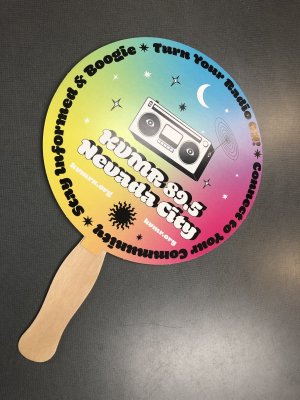
That was a timely question. I just walked in to our lobby and saw 10 boxes filled with these fans. Most of them will be given away at our county fair in 2 weeks, where we will be broadcasting live.Do radio stations still hand out promotional items—e. g. bumper stickers, refrigerator magnets, etc.—at such events?
Dave B.
My point is, why pay some research firm to seek responses to boilerplate questions when people who are passionate about the business or product are more than willing to share their opinions, IF they could reach a human being to speak with?Uh, yes...that's a true statement. Not sure what about, but it's factually correct.
Depending on the questions and responses, there may be a multitude of user experiences. Not just two. Have never seen a user experience survey be binary; yes or no.
I don't know of a single on line survey that believes it's going to reach the entire population. Of what? The U.S.? Continent of Africa?
The entire world?
As it relates to radio, by the 70's most stations took requests, and would record to good ones to play if and when that song came up on the playlist. It was determined that less than one tenth of an audience ever, let alone with frequency, called a radio station.
That's why not much weight was ever placed on request line calls.

But, whatever one might think about this fact, those who participate in station research are also those who will participate in Nielsen ratings research. For the business of radio, research-friendly people are all that matters.But there are people who answer questionnaires and those who don't.
But only one is of value to a commercial radio station.Two mutually exclusive sets of users.
Those who will spontaneously "reach out" are not typical and, often, may be dangerous to listen to.So my guess is that the results of these questionnaires don't represent the views of the entire population. I still think being available to listen to people who take the time to reach out is the best way to learn.
Because a research group worth their salt will curate the results into something more usable than yes or no tabulations. For example; a lot of on-line research might have a participant rate topics on a 1-10 scale. In those examples, many times the question is asked differently, or might change depending on what a prior response is. This establishes whether the participant is serious about their answer, or just clicking on a number.My point is, why pay some research firm to seek responses to boilerplate questions when people who are passionate about the business or product are more than willing to share their opinions, IF they could reach a human being to speak with?

and that's exactly my point - with things the way they are today - i don't think any station (except for maybe the smaller-market ones) is doing the whole listener phone call thing (unless it's a sports station or if there is a giveaway going on)But, except for old, old, leaning stations listeners do not "phone home".
Texting and email can be done from anywhere.
Not all research projects have "boilerplate" questions and answers. Many allow for deep exploration with open ended questions and "if/or" options depending on the answer to each question.My point is, why pay some research firm to seek responses to boilerplate questions when people who are passionate about the business or product are more than willing to share their opinions, IF they could reach a human being to speak with?
One of the most revealing experiences I had was doing one-on-one interviews with listeners to an "oldies" station in DC about 25 years ago. One listener, who had a dead-end really boring job filing papers in the third basement level of the DOJ said, "that's the music that reminds me of when life was fun".
Wow. A whole format wrapped up in 11 words. It became obvious that this was not just about individual songs, but about the mood of the whole station. That listener did not want to be told again who was the lead singer of the Cowsills or stuff like that. They wanted to create their own scenario using the music as the stage. Suddenly, things like flow and flavor became as important as individual songs. A lesson that applies to every format, even talk.
And we often put in trick questions and dummy songs to see if the participant is paying attention. Ones that "miss" those questions are not tabulated in the results.Because a research group worth their salt will curate the results into something more usable than yes or no tabulations. For example; a lot of on-line research might have a participant rate topics on a 1-10 scale. In those examples, many times the question is asked differently, or might change depending on what a prior response is. This establishes whether the participant is serious about their answer, or just clicking on a number.
This is an example of why "talking to folks at the station event" or "at the rodeo" is not useful and potentially dangerous.
Let me give you guys an example.
Some years ago I had an American Express card. It had an annual fee and I found that, unlike MasterCard and Visa, several merchants I frequented didn't accept it. So I went out of my way to phone American Express to cancel and to tell them why. There response was basically, "Oh, okay (yawn.)"
About 6 months later I received an urgent, "We Want You Back!" email complete with a survey with a long list of reasons to check to let them know why I cancelled. Two reasons NOT among them were:
Surveys are generally boilerplate, incomplete, ambiguous or not nuanced enough to be effective, IMO.
Steve Jobs had some interesting things to say about surveys and focus groups. Had he paid attention to them we might not have iPhones today.
Some years ago I had an American Express card. It had an annual fee and I found that, unlike MasterCard and Visa, several merchants I frequented didn't accept it. So I went out of my way to phone American Express to cancel and to tell them why. There response was basically, "Oh, okay (yawn.)"
About 6 months later I received an urgent, "We Want You Back!" email complete with a survey with a long list of reasons to check to let them know why I cancelled. Two reasons NOT among them were:
- Annual Fee
- Not Universally Accepted
Steve Jobs had some interesting things to say about surveys and focus groups. Had he paid attention to them we might not have iPhones today.
I went out of my way to phone American Express to cancel and to tell them why. There response was basically, "Oh, okay (yawn.)"
I had the same experience with my car/home insurance company. I do a package deal because its cheaper. One day my home insurance shot up in price by 30% for no reason. I have never put in a claim. So I called to cancel. During my call, it was obvious that the person I was talking to didn't care one way or the other. I kept pointing out that I'm a regular customer, pay my bill quickly, never filed a claim. No change from the rep on the phone. Then I asked to speak to a supervisor, and things changed. They sent me to an agent, and we redid all of my deductibles, and that fixed the issue.
The point is that if you really want to get things done, you have to speak to the right person. And that fits with the topic of this thread. As the article in the OP states, if you're going to have someone answering your radio station's phone, that person needs to have expertise in things other than knowing how to speak English (or the language of the audience). Which, by the way, isn't always a given.
Because the job of the agent was to take as many calls an hour as possible, not to do research.Let me give you guys an example.
Some years ago I had an American Express card. It had an annual fee and I found that, unlike MasterCard and Visa, several merchants I frequented didn't accept it. So I went out of my way to phone American Express to cancel and to tell them why. There response was basically, "Oh, okay (yawn.)"
A smart company would have a "trigger" that would send the call to an agent who might fix the issue. See BigA's insurance experience of an example of how that worked out positively.
Some are, some are not. Often a "boilerplate" survey is used to determine how to put together a deep dive into specific areas that might include, for example, "what would make you come back to American Express" with open ended responses triggering specific possibilities depending on the content of the open-ended answer.About 6 months later I received an urgent, "We Want You Back!" email complete with a survey with a long list of reasons to check to let them know why I cancelled. Two reasons NOT among them were:
Surveys are generally boilerplate, incomplete, ambiguous or not nuanced enough to be effective, IMO.
- Annual Fee
- Not Universally Accepted
The first is that you can't research something nobody has even seen or heard before. This is why, no matter how hard record labels and radio stations have tried to research brand new songs, there is no way to predict a hit.Steve Jobs had some interesting things to say about surveys and focus groups. Had he paid attention to them we might not have iPhones today.
You can easily research how iPhone users like and employ various features, screen sizes, cost-to-benefit perspectives and the like. But they have to have had the phone for some time to form opinions. And even more useful: find former iPhone users and dig to find why they left the brand.
Apple also produced the Newton. It took them a decade to figure that failure out. And then there was the "Lisa"...
Even the best consumer brand ever, P&G, fails with nearly 50% of all new products.
"Settlers" build farms and ranches and grow a family. "Pioneers" get ambushed, shot or killed.
Last edited:
Agreed! Good points.Because the job of the agent was to take as many calls an hour as possible, not to do research.
A smart company would have a "trigger" that would send the call to an agent who might fix the issue. See BigA's insurance experience of an example of how that worked out positively.
Some are, some are not. Often a "boilerplate" survey is used to determine how to put together a deep dive into specific areas that might include, for example, "what would make you come back to American Express" with open ended responses triggering specific possibilities depending on the content of the open-ended answer.
The first is that you can't research something nobody has even seen or heard before. This is why, no matter how hard record labels and radio stations have tried to research brand new songs, there is no way to predict a hit.
You can easily research how iPhone users like and employ various features, screen sizes, cost-to-benefit perspectives and the like. But they have to have had the phone for some time to form opinions. And even more useful: find former iPhone users and dig to find why they left the brand.
Apple also produced the Newton. It took them a decade to figure that failure out. And then there was the "Lisa"...
Even the best consumer brand ever, P&G, fails with nearly 50% of all new products.
"Settlers" build farms and ranches and grow a family. "Pioneers" get shot or killed.
I've been amazed about how many companies don't snag opportunities to save a missed sale.Agreed! Good points.
Two on-line examples:
I browsed and finally ordered an item from Amazon. Now I get daily reminders about that general product area despite having already ordered. Useless, as "I already got one."
Newegg remembers when I browse a category. I was looking for 1tb and 2tb fast (6000/6000 read and write speeds) SSDs and checked the stats and data on a half dozen. I did not order. I got reminders, highlighting ones on sale. I finally bought several Firecudas based on reviews, stats and price. I never got another "fast M.2 SSD" reminder from them again. But I did start getting high-end release data on MBs and CPUs.
Now, for computer and tech items, I go to Newegg first and then price shop with Amazon and B&H just in case. As a result, last week I upgraded my "scan center" monitors to three 32" Asus ProArt 4k HDR monitors... from Newegg.
That is how brand loyalty in our new era of "no personal contact" buying works.

One of the most revealing experiences I had was doing one-on-one interviews with listeners to an "oldies" station in DC about 25 years ago. One listener, who had a dead-end really boring job filing papers in the third basement level of the DOJ said, "that's the music that reminds me of when life was fun".
Wow. A whole format wrapped up in 11 words. It became obvious that this was not just about individual songs, but about the mood of the whole station. That listener did not want to be told again who was the lead singer of the Cowsills or stuff like that. They wanted to create their own scenario using the music as the stage. Suddenly, things like flow and flavor became as important as individual songs. A lesson that applies to every format, even talk.
YES! @DavidEduardo
You hit on something that ive tried to explain on and off over the years on what makes me successful, despite being an average at best jock.. its the mood and attitude created during the show.. and where i am now, the mood and attitude the entire station puts forth.
And that is why a "curated playlist" that doesn't just shuffle the same songs is better than just random play. Knowing what songs segue well and which don't is a big part of programming; unfortunately, little time today is spent on feel and texture.YES! @DavidEduardo
You hit on something that ive tried to explain on and off over the years on what makes me successful, despite being an average at best jock.. its the mood and attitude created during the show.. and where i am now, the mood and attitude the entire station puts forth.
Selector and MusicMaster have no heart and soul. It requires a sentient being to insert those qualities. The keyword in "artificial intelligence" is "artificial".
And that is why a "curated playlist" that doesn't just shuffle the same songs is better than just random play. Knowing what songs segue well and which don't is a big part of programming; unfortunately, little time today is spent on feel and texture.
Selector and MusicMaster have no heart and soul. It requires a sentient being to insert those qualities. The keyword in "artificial intelligence" is "artificial".
Here,, sometimes.. often really, i let the computer churn out what its gonna do, but were a special case.. but from time to time, ill see a pattern start to form on any given day, liek tempo or mood.. and try and then keep it moving by picking out songs that match the mood/tempo, and remove ones that dont.
Was this by chance Liberty Mutual? I had something very similar with them, customer since Christ was a corporal, rates on my motorcycles went up almost 50% at renewal, and I hadn't had a ticket or accident in over twenty years. Their agents could give a crap, but the supervisor agreed to lower the increase to only 20% more. I dumped them and went with another company.I had the same experience with my car/home insurance company. I do a package deal because its cheaper. One day my home insurance shot up in price by 30% for no reason. I have never put in a claim. So I called to cancel. During my call, it was obvious that the person I was talking to didn't care one way or the other. I kept pointing out that I'm a regular customer, pay my bill quickly, never filed a claim. No change from the rep on the phone.
Plus, I HATE those stupid emu spots with the creepy Doug character. Note to parents, if you see Doug from the Liberty Mutual spots hanging around a school yard or community park, call the authorities.
- Status
- This thread has been closed due to inactivity. You can create a new thread to discuss this topic.