• Get involved.
    We want your input!
    Apply for Membership and join the conversations about everything related to broadcasting.

    After we receive your registration, a moderator will review it. After your registration is approved, you will be permitted to post.
    If you use a disposable or false email address, your registration will be rejected.

    After your membership is approved, please take a minute to tell us a little bit about yourself.
    https://www.radiodiscussions.com/forums/introduce-yourself.1088/

    Thanks in advance and have fun!
    RadioDiscussions Administrators

Directional Daytimers

The post about a 4 tower daytime station in Cincinnati shutting down got me thinking, are or were there a bunch or directional daytimers? FCC night flea power (less than 250 watts doesn't disqualify the station.

I believe the proper classification is AM class D directional. There might be some downgraded B's that went D but why would someone keep a directional day timer?
 
The post about a 4 tower daytime station in Cincinnati shutting down got me thinking, are or were there a bunch or directional daytimers? FCC night flea power (less than 250 watts doesn't disqualify the station.

I believe the proper classification is AM class D directional. There might be some downgraded B's that went D but why would someone keep a directional day timer?

WCTF Vernon, CT 2.5kw day 1kw critical hours

WFIF 1500 Milford, CT
 
I worked at a directional daytimer. That sort of thing used to be viable. As a matter of fact, one such local station was owned by Frank Sinatra and later, Danny Kaye!
 
Look at any edition of the Broadcasting Yearbook's radio section at


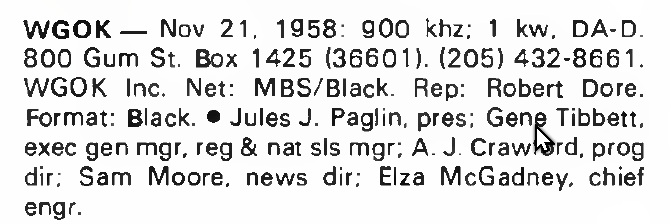
This is an example of a listing for a daytimer that is directional from the 1975 yearbook.

1715258192746.png

At the end of the radio section for each year, there is a listing by frequency of all US radio stations. The ones that were daytime and directional show as DA-D-(and the power) with no night listing.
 
My favorite directional daytimer was the one on 1550 in Miami / Coral Gables, FL. 10,000 watts with a directional antenna system located on pilings in Biscayne Bay off the coast from Miami.
 
Yes, my first station was and is a directional daytimer, and there are tons of them, some very creatively squeezed into Ohio, Indiana and Michigan that went on in the 1960s. WERK, Muncie, IN on 990 was one that came to mind, with 6 towers squeezed between 2 980s with no pre-sunrise.
 
860 WWDB in Philly is 10 kW directional (4 towers), daytime-only.

1100 WHLI on Long Island is 10 kW directional daytime-only as well, with 2 towers.
 
700 WDMV north of Washington DC, 3 tower 5kw daytime only. Has been sitting on a CP to increase power to 50kw with 4 towers, doubt it ever happens.
 
I worked for a few brief unhappy months at WBNR in Beacon, New York, a 1 kW daytimer at 1260 - two towers if I recall correctly, next to the Beacon city landfill. The pattern aimed west toward Newburgh and also had a boost northward. (If I had known better, I would have realized that rimshotting Newburgh was not exactly the road to wealth.) WBNR's main competition was 1220 WGNY, also a directional daytimer, 5 kW with 3 towers. Subsequent to my time at Beacon, WBNR added nighttime service with 400 watts and two additional towers.

Ground conductivity in the Hudson Valley was absolutely awful.
 
Where I grew up - South Dakota. KXRB (now KSOO) Sioux Falls and KGFX Pierre. Both very popular country stations at the time, in the land of fantastic ground conductivity. I see they both have added nighttime operation since I moved away.

Dave B.
 
Status
This thread has been closed due to inactivity. You can create a new thread to discuss this topic.


Back
Top Bottom