• Get involved.
    We want your input!
    Apply for Membership and join the conversations about everything related to broadcasting.

    After we receive your registration, a moderator will review it. After your registration is approved, you will be permitted to post.
    If you use a disposable or false email address, your registration will be rejected.

    After your membership is approved, please take a minute to tell us a little bit about yourself.
    https://www.radiodiscussions.com/forums/introduce-yourself.1088/

    Thanks in advance and have fun!
    RadioDiscussions Administrators

Directional FM


This FM translator doesn't have an omnidirectional signal, are there any full power FM signals that are specifically designed to have a non-omnidirectional signal (not including nearby terrain issues that limit reception in certain directions)?


Kirk Bayne
 
A good candidate would be KMLV Omaha, over flat land, having a null to the north that other full-power stations don't have. KIIS in Los Angeles is listed by radiolocator.com as directional, but I fail to see how.
 
Some of the Charleston, SC stations on the bigger TV towers outside of town (WSCI comes to mind, I think) have a directional signal to the East…out into the Atlantic. What are they trying to protect? Bermuda, 500 miles away? Or is it more efficient to radiate over 2/3rds of your coverage area?

The shorter tower where most of the FMs are located do not have that directionality BTW
 
Some of the Charleston, SC stations on the bigger TV towers outside of town (WSCI comes to mind, I think) have a directional signal to the East…out into the Atlantic. What are they trying to protect? Bermuda, 500 miles away? Or is it more efficient to radiate over 2/3rds of your coverage area?

The shorter tower where most of the FMs are located do not have that directionality BTW
Depends on the station. Give us call letters, and I can pretty much tell you why the pattern is the way it is.
 
Depends on the station. Give us call letters, and I can pretty much tell you why the pattern is the way it is.
WSCI-FM and WIWF. The only class C’s in Charleston, SC. They’re located on the TV towers about 15 miles out of town in Awendaw, SC. SC Public Radio’s stations are usually co-located on the same tower with the local SC ETV station.

The vast majority of C1’s are much closer to the city on a much smaller tower (800’ or so) that I think was a full 300m/981’ before Hurricane Hugo. They are Omni-directional or directional due to traditional spacing requirements
 
Some of the Charleston, SC stations on the bigger TV towers outside of town (WSCI comes to mind, I think) have a directional signal to the East…out into the Atlantic. What are they trying to protect? Bermuda, 500 miles away? Or is it more efficient to radiate over 2/3rds of your coverage area?

The shorter tower where most of the FMs are located do not have that directionality BTW
Sending thousands of watts of power out to empty ocean is a waste of money, unless your target audience are dolphins. By concentrating your power in the direction of populated land, you can use less power in total for the same coverage. Think of it like using a sprinkler (that sprays out in all directions) vs. a hosepipe.
 
WSCI-FM and WIWF. The only class C’s in Charleston, SC. They’re located on the TV towers about 15 miles out of town in Awendaw, SC. SC Public Radio’s stations are usually co-located on the same tower with the local SC ETV station.

The vast majority of C1’s are much closer to the city on a much smaller tower (800’ or so) that I think was a full 300m/981’ before Hurricane Hugo. They are Omni-directional or directional due to traditional spacing requirements
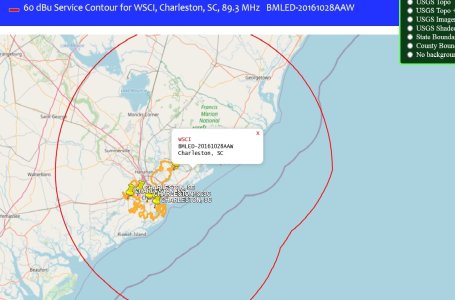
WSCI is a full class C station: 100kW at 89.3Mhz. The one designed null in their pattern is toward open ocean.
With a HAAT of 419m (1,374') close to the Atlantic, I don't see an example where the station is intentionally putting power into unpopulated areas. Their location, class, height and ERP combinations just mean there is field strength out over open water. Not much you can do about that:

Calculated 60dBu pattern courtesy of the FCC:

WSCI-FM.jpg
 
WSCI is using a side-mount transmitting antenna. When mounted on a big tower, these antennas will certainly be directional.
I'm guessing that the null is a result of this phenomenon.
 
WSCI is using a side-mount transmitting antenna. When mounted on a big tower, these antennas will certainly be directional.
I'm guessing that the null is a result of this phenomenon.
According to the Commission database, their antenna is listed as a directional antenna. That said; they could be including the tower as part of their directional design:

Directional Antenna ID: b46efe2b443f40b5a941c1b6063ebeb7
Antenna Make: DIE Antenna Model: DCRM 10, 10 SECTIONS, 0.68 WAVELENGTH SPACED
No. of antenna sections: 10

Relative Field values for directional antenna

0° 1.000​
60° 1.000​
120° 0.501​
180° 1.000​
240° 1.000​
300° 1.000​
10° 1.000​
70° 1.000​
130° 0.501​
190° 1.000​
250° 1.000​
310° 1.000​
20° 1.000​
80° 1.000​
140° 0.631​
200° 1.000​
260° 1.000​
320° 1.000​
30° 1.000​
90° 1.000​
150° 0.794​
210° 1.000​
270° 1.000​
330° 1.000​
40° 1.000​
100° 0.794​
160° 1.000​
220° 0.980​
280° 1.000​
340° 1.000​
50° 1.000​
110° 0.631​
170° 1.000​
230° 1.000​
290° 1.000​
350° 1.000​
Additional azimuths:
225° 1.000​

Oh, and that use of .68 wavelength spacing is cool. I've had antennas built with .78 wavelength spaced to reduce downward radiation, but discovered in the process, it really benefited the vertical azimuth toward the horizon.
 
Last edited:
While the FCC lists the coverage as directional, the DCRM 10 antenna system is not designed to be directional. It is the mounting on the tower which makes the antenna system directional due to the reflections from the tower leg(s).
 
While the FCC lists the coverage as directional, the DCRM 10 antenna system is not designed to be directional. It is the mounting on the tower which makes the antenna system directional due to the reflections from the tower leg(s).
Isn't that what I said?
 

This FM translator doesn't have an omnidirectional signal, are there any full power FM signals that are specifically designed to have a non-omnidirectional signal (not including nearby terrain issues that limit reception in certain directions)?

As some of the other posters have noted, there are plenty of directional FM's. I believe WKQC 104.7 in Charlotte is directional as WNOK in Columbia is only around 100 miles away and is co-channel. So, it has to cut off some of its signal toward the southeast.

Something else to note is that directional FM only subtracts from its coverage. Directional AM is like a balloon, and you can increase increase the signal in some directions while reducing it other. I understand that's technically possible for a directional FM, though you won't likely be able to get as tight and specific of patterns as you can with AM. The FCC, however, doesn't allow increasing a signal in any particular direction on FM beyond the station's class limits.
 
Why would the FCC set up full power FM allocations such that power reductions are required in certain directions to protect other full power FMs?


Kirk Bayne
 
A little snippy aren't you?
No, I wanted to make sure I was being accurate: "That said; they could be including the tower as part of their directional design:"
When you repeated that same point back, wanted to make sure you saw my point. We all miss things sometimes.
 
Why would the FCC set up full power FM allocations such that power reductions are required in certain directions to protect other full power FMs?
The FCC's purpose is at least double in this instance: first, to make sure that stations don't interfere with each other and, second, to give as many people as many radio services as possible.

If giving a license for a directional station in a particular area allows that area to have an additional station (or allows a low power station to cover more people), then the overall "public good" is served.

The example might be something like this: A station in Cadillac, MI, could run at 6 kw non-directionals and serve, roughly, its home country. But it might move up to a higher class with more power and height, but doing so non-directionally, would interfere with an existing station farther south in MI. So they file to be directional, not getting to the south of their home county, but to the north getting into Traverse City and surrounding areas. That gives more service to more people, including a number of more rural counties, too.

The listener benefits by having more choices.
 
Status
This thread has been closed due to inactivity. You can create a new thread to discuss this topic.


Back
Top Bottom