• Get involved.
    We want your input!
    Apply for Membership and join the conversations about everything related to broadcasting.

    After we receive your registration, a moderator will review it. After your registration is approved, you will be permitted to post.
    If you use a disposable or false email address, your registration will be rejected.

    After your membership is approved, please take a minute to tell us a little bit about yourself.
    https://www.radiodiscussions.com/forums/introduce-yourself.1088/

    Thanks in advance and have fun!
    RadioDiscussions Administrators

DSP Analog Tuning AM 9/10 kHz Stepping

Most of the DSP Analog tuning Radios for AM are 9 kHz stepping like people are saying

I don't hear much diffents, locking in a station sounds the the same to me

Is this a myth?
 
I know I cant word suff Good

I try to word it as best so people here know what I'm talking about

With the DSP chip, it locks on a strong or a Semi weak station

I have 740 KCBS, it locks on no problem here in Rocklin. it would be 738 on 9k Radios

Same with 770 KCBC that would be 774 on a 9k Radio

I still think it's a myth it locks on the Nearest Frequency doesn't matter if it's 9 or 10k
 
Stop ignoring me :(
I can't speak for other posters, but I'm unsure what you're trying to put across. Is it a specific model of radio that you're having issues with? I for one wasn't "ignoring" you, I read the posts and didn't have anything to add because I didn't understand.

Most radios of recent years allow you to change from 9kHz to 10kHz tuning steps on AM.
 
Radio Jay Allen has a good write-up on this issue in his recent review of a DSP-based but analog-tuned radio that is now being made in a version suitable for the Western Hemisphere:

 
I can't speak for other posters, but I'm unsure what you're trying to put across. Is it a specific model of radio that you're having issues with? I for one wasn't "ignoring" you, I read the posts and didn't have anything to add because I didn't understand.

Most radios of recent years allow you to change from 9kHz to 10kHz tuning steps on AM.
They should also allow you to do the steps on FM at .1 and .2 increments.
 
They should also allow you to do the steps on FM at .1 and .2 increments.
I've never seen that. My car radio lets me tune in .05s (i.e. 98.85, 98.90, 98.95 etc) but I've never seen a station on those .05 frequencies. Car radios I've used in the US have skipped the evens and gone 98.7, 98.9, 99.1 but I never dug into the settings to see if that was changeable. (The other weirdness is the US use of RDS. In Europe, PS is for a static 8-character station name and RT is for the program information. In the US, the program information seems to be squeezed into an ever-changing PS.)

These days, my portable radio for travel is a DAB+/FM receiver which suffices to pick up all the local stations of any consequence anywhere I'm likely to visit. AM is done - manufacturers of AM radios may as well preset them to Region 2 tuning steps for all the use they are in Region 1.
 
I've never seen that. My car radio lets me tune in .05s (i.e. 98.85, 98.90, 98.95 etc) but I've never seen a station on those .05 frequencies.
FM stations that use a XX.xx or XXX.xx frequency are pretty much gone these days, though they were not unusual in many countries decades ago. Back in the 1960s South Africa had FM stations with a XX.xx frequency, and a few that even went out to XX.xxx! IIRC it was part of a extreme “narrow step” frequency plan.

The almost extinct OIRT FM band used the XX.xx format, usually in 30 kHz steps, so you would have FMs on frequencies such as 66.74, 68.66, 70.28, and 73.19 MHz.

These days an FM receiver with 0.1 MHz tuning steps should work fine as a travel radio.
 
These days an FM receiver with 0.1 MHz tuning steps should work fine as a travel radio.
I have one of those, a little pocket radio (Retekess), about the size of a small pack of playing cards. It has DSP and tunes FM in 100 khz steps. I can't see any advantage to that "feature" when in North America. The only result is having to tap the button twice as many times when tuning between frequencies (as opposed to using presets), which is an annoyance. Maybe that has some value in other parts of the world, but not here.
 
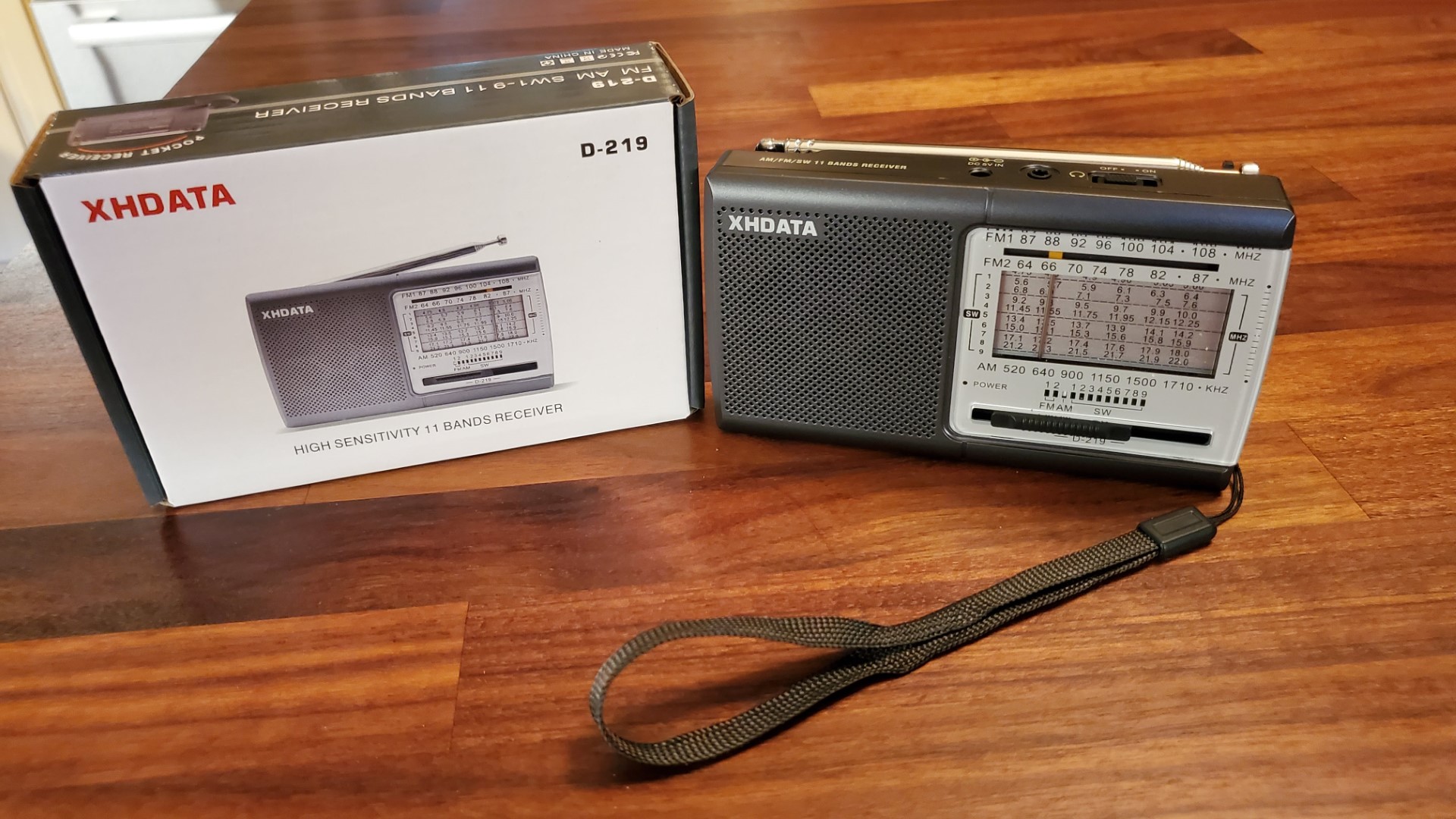
The radios Mario is talking about have what looks like an analog slide-rule tuning dial, but use a Digital Signal Processing (DSP) chip to perform all the radio functions. Instead of a variable capacitor, the tuning knob is connected to a potentiometer, and the DSP constantly reads its resistance value and converts that to an equivalent frequency to tune to.

Since the refresh rate of this system is not instantaneous, it produces an annoying choppiness as you tune across the dial, because the DSP briefly mutes the audio every time it detects that the tuning dial position has changed.

Also to make tuning easier, they seem to have a form of automatic frequency control (AFC) on both AM as well as FM. I have noticed this causing some strange effects where if I'm listening to a weak but steady local groundwave signal and a skywave signal starts coming in on an adjacent frequency, the radio will re-tune itself to the neighboring station when its signal strength exceeds the one you were originally tuned to, and then switch back to the original station when the adjacent skywave signal starts to fade out.

But there are some true analog-tuning radios still being manufactured, by 5 Core in India:

 
I have one of those, a little pocket radio (Retekess), about the size of a small pack of playing cards. It has DSP and tunes FM in 100 khz steps. I can't see any advantage to that "feature" when in North America. The only result is having to tap the button twice as many times when tuning between frequencies (as opposed to using presets), which is an annoyance. Maybe that has some value in other parts of the world, but not here.
No, not especially fun with skew buttons. This is less troublesome for radios with a tuning knob or thumbwheel. And there are always presets, ATS, and, in the case of Tecsuns, Easy Tuning Mode (ETM), a second set of memories that leaves your other memory presets untouched, which is wonderful for travel. As an aside: I have a few of the Retekess/Tivdio/Zhiwhis radios that have recording capabilities built in. They are all cumbersome to tune.

I have an NAD 4300 tuner from 1989 that tunes FM in 50 kHz increments - which, I believe, was the default for all NAD digital tuners in the 1980s. Since it has a tuning knob and presets (8!) this hasn't been an issue for me - and I've had that tuner since 1990. On the other hand, it only tunes AM in 10 kHz increments. It's never been outside the United States, to be sure.
 
I can't speak for other posters, but I'm unsure what you're trying to put across. Is it a specific model of radio that you're having issues with? I for one wasn't "ignoring" you, I read the posts and didn't have anything to add because I didn't understand.

Most radios of recent years allow you to change from 9kHz to 10kHz tuning steps on AM.
What Mario is talking about is the fact that his radio (?) has a DSP chip, that is tuned via an analog dial. SiLabs turned out a DSP chip that could be tuned by a potentiometer. Most DSP chips are controlled via a microprocessor, which 'tells' the DSP chip how many kHz to ratchet up or down when being tuned. Hence the 9 khz / 10 khz step switch on the DSP radios (which there also have been used on PLL tuned radios for decades).

I recently bought a Tecsun PL-398MP. It theoretically has 9 khz / 10 khz spacing, something you change with a menu button. The only difference I can see is that switching from 10 khz spacing to 9 khz and back is that the thermometer on the LCD readout goes from degrees F to C and back. The actually tuning of the MW band is in 1 khz steps, with the fast tuning going up or down anywhere from 3-5-9-15 khz or whatever, depending on how fast the tuner knob is turned. The PL-398 does not use the mechanically tuned SiLabs DSP chip, but the radio is an example where the 9/10 kHz step switch seems to do little aside from switching the thermometer reading.

So I think Mario is encountering a similar issue -- his radio claims to have 9 khz / 10 khz spacing on MW, which is switchable, but in reality the radio appears to tune in 1 khz steps, making the idea of 9 khz / 10 khz spacing superfluous. Maybe the 'fast' slewing, where you tune up and down the dial really fast, actually operates in 9 or 10 khz jumps. But I would guess that slow tuning of the dial is in 1 khz steps.

FWIW, the datasheet for the SiLabs Si4820, the mechanically tuned chip used in my Radio Shack Pocket Radio and apparently other radios as well, doesn't mention 9 khz / 10 khz switching. Just switching between AM, FM, and SW (where needed). It doesn't show it in the sample diagram, either. And it mentions that the Si4820 covers "worldwide AM band reception from 504 to 1750 kHz".

Maybe some other radios than the RS Pocket Radio use different DSP chips. But my guess is that their basic tuning steps on the AM band are 1 khz increments.

 
Last edited:
Status
This thread has been closed due to inactivity. You can create a new thread to discuss this topic.


Back
Top Bottom