
Hi, what's your DTV setup. I've been using a Winegard Flatwave Amped( Think that's what it's called) and it has been performing quite well. I'm in Southeastern Connecticut Zip Code 06370 and it is often a trouble spot for digital tv. With analog it I could get my locals, Hartford and Providence 24 hours a day and sometimes Boston. Now, it's a lot harder. I have 2 Ions that come in like locals and PBS which is like 3 miles away. Then after that the only guarantee is PBS out of Hartford. WTNH from Hamden is usually ok sometimes choppy, WFSB Hartford has been getting worse and worse and now WPRI Providence comes in better( which is strange to me) WTIC isn't coming in well anymore and WVIT is ehhhh. What is weird to me is I get channel 67 out of long island somewhere and it always comes in better than most of the Hartford signals and I get 27 out of Worcester but that's usually choppy. What channels or setups do you get and what's your experiences with DTV? Hopefully this is the right forum to talk about this.

-
Get involved.
We want your input!
Apply for Membership and join the conversations about everything related to broadcasting.
After we receive your registration, a moderator will review it. After your registration is approved, you will be permitted to post.
If you use a disposable or false email address, your registration will be rejected.
After your membership is approved, please take a minute to tell us a little bit about yourself.
https://www.radiodiscussions.com/forums/introduce-yourself.1088/
Thanks in advance and have fun!
RadioDiscussions Administrators
You are using an out of date browser. It may not display this or other websites correctly.
You should upgrade or use an alternative browser.
You should upgrade or use an alternative browser.
DTV Setup
- Thread starter Carltheradioguy
- Start date
My experiences with DTV have been disappointing. I currently reside in the Seattle area, and it seems that I am not the only one in this area who has experienced difficulties pulling in DTV signals. In the age of analog television, my directional Radio-Shack outdoor antenna was plenty to pull in all of the Seattle locals at 25 miles away (most of which were VHF, and broadcasting from towers towers placed on some of Seattle's profound hills). Even with terrain blocking my LOS from antenna to transmission sites, those VHF signals were perfectly clear on my old TV set. The UHF is a different story, as some of the higher band stations suffered from considerable noise and ghosting. I could easily pick up a station broadcasting on the low VHF band, while a sister-station broadcasting on the UHF band from the same tower would be considerably more noisy.
Using a DTV converter as a tool, I've been able to pull in about 30-40% of the signal from my location (30% appears to be the cut-off for the "all or nothing" threshold). I have tried a variety of antennas, but it seems like my problem is a result of the terrain, which I cannot control.
In conclusion, I really felt that analog television was a better, and more reliable system. Analog signals are very watchable, even if you live in a terrible location for reception, or happen to reside a considerable distance from the transmission site. I would trade the black "no program" screen for electrical noise and ghosting if I could. Even if it was weak, you could still watch it if you really wanted to.
Using a DTV converter as a tool, I've been able to pull in about 30-40% of the signal from my location (30% appears to be the cut-off for the "all or nothing" threshold). I have tried a variety of antennas, but it seems like my problem is a result of the terrain, which I cannot control.
In conclusion, I really felt that analog television was a better, and more reliable system. Analog signals are very watchable, even if you live in a terrible location for reception, or happen to reside a considerable distance from the transmission site. I would trade the black "no program" screen for electrical noise and ghosting if I could. Even if it was weak, you could still watch it if you really wanted to.
Last edited:
I agree with you Ford ranger! Analog stunk in certain situations but it was a lot better to watch and at the very least I could listen to it like a radio if the picture was bad. But as you know, it gets all pixally and sound cuts out.
Also, have you tried an amplifier. I got on with my winegard and I tried a scan with amp and without and at my suburban almost rural location I got twice the amount of stations with the amp and everything else was way stronger. Like from 10 to 60 on average.
I use an old Insignia converter because I can manually scan the band easier than with the TV, it lists both the real and virtual channels, etc. There are a couple of roof-mounted antennas on a rotor- one FM yagi and one combo VHF/FM/UHF. They both work about the same!
I'm sort of between DC, Charlottesville, and Hampton Roads. None of those stations are regulars, they need some skip help. Distances are roughly 100, 60, and 80 miles.
I also liked the analog reception better, but dx is dx- get as many signals as possible with available equipment, whatever the conditions. One thing I do like better now is all the subchannels.
I'm sort of between DC, Charlottesville, and Hampton Roads. None of those stations are regulars, they need some skip help. Distances are roughly 100, 60, and 80 miles.
I also liked the analog reception better, but dx is dx- get as many signals as possible with available equipment, whatever the conditions. One thing I do like better now is all the subchannels.
K
kenglish
Guest
Amplified antennas are really "iffy", especially if there are other stations nearby. The strong signals will mix and their distortion products will overpower many other stations on other frequencies. Weak signals are not a problem for Digital TV.....distorted and noisy signals are usually the culprit.
Amplified antennas are really "iffy", especially if there are other stations nearby. The strong signals will mix and their distortion products will overpower many other stations on other frequencies. Weak signals are not a problem for Digital TV.....distorted and noisy signals are usually the culprit.
I installed a Wingard antenna for my grandmother who was experiencing difficulties due to terrain. While some channels DID show some sign of improvement, a channel that was broadcasting nearby was completely lost.
A rotary antenna may be a big step in improving your viewing of DTV. Sometimes difficult channels improve greatly if the antenna is moved only a few inches. I have a summer cottage on the NH/Maine border about 35 miles from Portland ME. I get excellent reception from three Portland stations, NBC, CBS and ABC. But I have to move the antenna a bit for the ABC station (which is on VHF Channel 8) and move it back for CBS and NBC (both on UHF). In analog days, if the antenna were pointed in the general vicinity, that was OK. Today a few inches can mean getting perfect reception of a distant station, or not getting it at all. Oddly, even with the rotary antenna, I never get the Maine PBS station, even though its transmitter is only 15 miles from me. But my best station is the NH PBS station, which is about 20 miles from me.
When I point the antenna at Boston at night, many nights I get CBS and NBC great. Sometimes ABC, Fox and PBS come in. A few times a year even CBS and Fox from Providence come in. (Above, someone in CT mentions getting CBS 12 from Providence better than in the past. That same station sometimes comes in by me 100 miles north of Boston.) But as stated above, the antenna has to be pointed JUST RIGHT. I also have an antenna booster, which I believe also improves my reception.
And as mentioned above, with the use of subchannels, I feel digital is a big improvement over analog. The NH PBS station has three subchannels. Among those four program streams, one of them nearly always has something of interest to me. And the other local stations have at least one subchannel.
When I point the antenna at Boston at night, many nights I get CBS and NBC great. Sometimes ABC, Fox and PBS come in. A few times a year even CBS and Fox from Providence come in. (Above, someone in CT mentions getting CBS 12 from Providence better than in the past. That same station sometimes comes in by me 100 miles north of Boston.) But as stated above, the antenna has to be pointed JUST RIGHT. I also have an antenna booster, which I believe also improves my reception.
And as mentioned above, with the use of subchannels, I feel digital is a big improvement over analog. The NH PBS station has three subchannels. Among those four program streams, one of them nearly always has something of interest to me. And the other local stations have at least one subchannel.
Last edited:
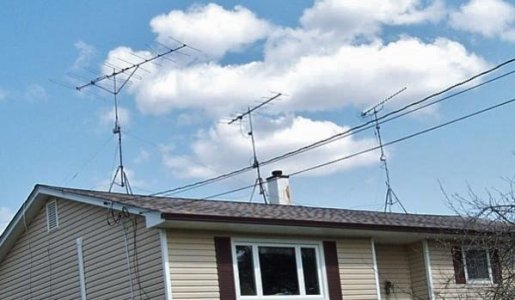
I am an avid DTV DXer, so I have a variety of roof mounted antennas.... separate ones for UHF, VHF-Hi, and also FM, plus a lower "ground-mounted" VHF Lo for DTV Skip. I have amps on each antenna except for FM. I also use the Insignia converter box. Like dxho, I am located between markets.... Albany at 60 miles, New York City at 70 miles, and Connecticut around 55 miles, although I have a couple of megawatt locals, and a few close by translators. I find that ch67 Long Island (WFTY - Smithtown) is my farthest dependable (24/7) UHF signal at 77 miles, better than anything in Connecticut, although Connnecticut stations WTNH-8 and WEDH-24 in particular are quite dependable. I never had a set-up here during the analog era, although trying with rabbit ears or even the FM antenna, the only TV station I could get was WRGB-6 Schenectady... fair but watchable if I had to. Now with DTV, even though I still have cable, I'll watch a show over-the air because the picture often looks better.
Attachments
Very Cool guys/gals! dtvdxer, that is quite impressive and you seem like one of the few that actually are better off in DTV world, I thought NYC would be easier for you because those signals are always strong and on some occasions I have gotten them.
Any suggestions for a portable DTV with an external antenna connection that could be used for DXing? Thanks.
Yes, the market for Portable DTV's honestly sucks but there is one that I use, It's an RCA pocket TV and it's also branded in Auvio and MYGOTV.
http://www.amazon.com/RCA-DHT235A-3...pebp=1440371223437&perid=176YXVN9HXE1SE47NEZ1
I got mine a lot cheaper on ebay but here it is. It takes 4 AA's which it seems like no other portable dtv does which I find to be very stupid to have lithium ions and they last like 2 hours. The only problem is you'll have to buy a special adapter to plug in your regular antenna because it's an oddball.
http://www.amazon.com/coaxial-coax-cable-assembly-female/dp/B00CTJN480/ref=pd_bxgy_504_img_z
It does have an internal antenna on it but I tested it and It only got 2 channels and they were going in and out despite being 5 miles away. It's a great TV in my opinion and if you have any other questions, feel free to ask.
Great stuff, the Portland towers are mostly high on Mountains in Norway I believe and they aren't directed toward New Hampshire so that is very cool! I have the same problem with some of my signals, I can get Spanish Long Island which is like 60 Miles Away but can't get CW in Waterbury which is 35 miles away so it's very weird. That is also surprising about WPRI coming so far up, Boston doesn't surprise me because there signals travel.
Very cool!! You need a lot of help on DTV Haha!! You are very far from everything!! I also agree on the subchannels, Most are garbage but a few Like Cozi and Ant Tv are fun to watch in my opinion.
Yes, the market for Portable DTV's honestly sucks but there is one that I use, It's an RCA pocket TV and it's also branded in Auvio and MYGOTV.
http://www.amazon.com/RCA-DHT235A-3...pebp=1440371223437&perid=176YXVN9HXE1SE47NEZ1
I got mine a lot cheaper on ebay but here it is. It takes 4 AA's which it seems like no other portable dtv does which I find to be very stupid to have lithium ions and they last like 2 hours. The only problem is you'll have to buy a special adapter to plug in your regular antenna because it's an oddball.
http://www.amazon.com/coaxial-coax-cable-assembly-female/dp/B00CTJN480/ref=pd_bxgy_504_img_z
It does have an internal antenna on it but I tested it and It only got 2 channels and they were going in and out despite being 5 miles away. It's a great TV in my opinion and if you have any other questions, feel free to ask.
Thanks, Carl. I will definitely have to get that TV and the adapter. I checked out the specs, and they say that it can receive analog signals as well. That's great to know because when there's good tropo from the S/SW, I get strong audio from XHPNG TV in Piedras Negras on 87.75.
Thanks, Carl. I will definitely have to get that TV and the adapter. I checked out the specs, and they say that it can receive analog signals as well. That's great to know because when there's good tropo from the S/SW, I get strong audio from XHPNG TV in Piedras Negras on 87.75.
Yes Jim, the reception seems just as good as a regular tv but that's just my awful eyes
 I have used it with analog because there is one analog within 50 miles of me but it comes in very weak so it's hard to comment.
One problem with DTV is that one cannot evaluate the quality of a DTV signal if they are getting neither any picture nor any sound. In the analog days, if you had an unacceptable picture, you could turn or "work" the antenna to get t best picture. With DTV, one is clueless.
The other problem is that the average person will always assume that if they cannot get reception, the signal can only be "weak", or "out of range". In reality, the problem is that the signal is corrupted by multipath - a signal affected by echoes. If you analog reception of a station came with significant ghosting, picture rolling, or fade-outs of color or sound, that signal won't work for DTV. The numerals that make a DTV signal are turned to gibberish by multipath.
The problem has sent engineers "back to the drawing board", and someday we may need new converter boxes for our converter box!
The other problem is that the average person will always assume that if they cannot get reception, the signal can only be "weak", or "out of range". In reality, the problem is that the signal is corrupted by multipath - a signal affected by echoes. If you analog reception of a station came with significant ghosting, picture rolling, or fade-outs of color or sound, that signal won't work for DTV. The numerals that make a DTV signal are turned to gibberish by multipath.
The problem has sent engineers "back to the drawing board", and someday we may need new converter boxes for our converter box!
Last edited:
One problem with DTV is that one cannot evaluate the quality of a DTV signal if they are getting neither any picture nor any sound. In the analog days, if you had an unacceptable picture, you could turn or "work" the antenna to get t best picture. With DTV, one is clueless.
Signal strength meter doesn't help?

Unfortunately ATSC receiver manufacturers labeled that meter or indicator incorrectly. Rather than calling it signal strength, it should be called: Signal Quality. I've seen receivers displaying unacceptable signal 'strength' a few blocks from a transmitter site. Attenuating the signal by placing a paperclip into the receiver F-connector as an antenna, returned a 98% 'signal strength.
Unfortunately ATSC receiver manufacturers labeled that meter or indicator incorrectly. Rather than calling it signal strength, it should be called: Signal Quality. I've seen receivers displaying unacceptable signal 'strength' a few blocks from a transmitter site. Attenuating the signal by placing a paperclip into the receiver F-connector as an antenna, returned a 98% 'signal strength.
Mine doesnt even have signal strength , It just days Bad,Normal,Good
- Status
- This thread has been closed due to inactivity. You can create a new thread to discuss this topic.