Here was the equivalent for TV stations -- videotape "carts":

-
Get involved.
We want your input!
Apply for Membership and join the conversations about everything related to broadcasting.
After we receive your registration, a moderator will review it. After your registration is approved, you will be permitted to post.
If you use a disposable or false email address, your registration will be rejected.
After your membership is approved, please take a minute to tell us a little bit about yourself.
https://www.radiodiscussions.com/forums/introduce-yourself.1088/
Thanks in advance and have fun!
RadioDiscussions Administrators
You are using an out of date browser. It may not display this or other websites correctly.
You should upgrade or use an alternative browser.
You should upgrade or use an alternative browser.
Early Radio Automation: IGM System from 1968
- Thread starter davideduardo
- Start date
I worked with the RCA TCR-100, it was a great machine, until one of its "belts" broke. If I recall correctly there were two belts, one on each playback side, as one cart was playing. say on Side 1. it would load the next cart, etc., on Side 2.
Like I said . . . a decent machine until the belts broke.
When they did, to get by, we had to load commercials manually on Ampex 2" machines (reel to reel) until the belt was replaced in the TCR-100.
Some TV stations had no cart machine and instead would assign a person to make up a commercial "spot reel," following the program log . . . you'd put together the "spot reel" the night before, that method worked perfect . . . unless there was a last-minute change to the program log.
I know of stations that had the Ampex cart machine, I don't recall how it worked but was always told there was a "suction" that took the tape from the cart
before it treaded it. I might be wrong on the suction thingy but that is what I was always told.
Naturally you'd manually loaded the carts per the order of the program log for each break. Often you could load a number of upcoming breaks, a commercial that ran often had maybe three carts made of the same commercial OR you'd move it around for the next break sometimes a "fun" challenge???
This was all around 1973 or so.
Like I said . . . a decent machine until the belts broke.
When they did, to get by, we had to load commercials manually on Ampex 2" machines (reel to reel) until the belt was replaced in the TCR-100.
Some TV stations had no cart machine and instead would assign a person to make up a commercial "spot reel," following the program log . . . you'd put together the "spot reel" the night before, that method worked perfect . . . unless there was a last-minute change to the program log.
I know of stations that had the Ampex cart machine, I don't recall how it worked but was always told there was a "suction" that took the tape from the cart
before it treaded it. I might be wrong on the suction thingy but that is what I was always told.
Naturally you'd manually loaded the carts per the order of the program log for each break. Often you could load a number of upcoming breaks, a commercial that ran often had maybe three carts made of the same commercial OR you'd move it around for the next break sometimes a "fun" challenge???
This was all around 1973 or so.
Maybe it's old footage, but this TV signoff from 1988 shows one of those RCA TCR-100 video cart machines still in use, although they only had three carts loaded in it:

If that were the early 60's, I'd say it was the Ampex magnetic disk, played and inserted like a 45rpm disk but a heavy magnetic disk like the contents of a floppy disk a decade or so later.I know of stations that had the Ampex cart machine, I don't recall how it worked but was always told there was a "suction" that took the tape from the cart
before it treaded it. I might be wrong on the suction thingy but that is what I was always told.
Naturally you'd manually loaded the carts per the order of the program log for each break. Often you could load a number of upcoming breaks, a commercial that ran often had maybe three carts made of the same commercial OR you'd move it around for the next break sometimes a "fun" challenge???
This was all around 1973 or so.
OK Kev. . . that way a great video, that is exactly the way TV stations were in the early 70's when I got in the business. They had either AMPEX or RCA tape machines, like I said good video, Thanks.Maybe it's old footage, but this TV signoff from 1988 shows one of those RCA TCR-100 video cart machines still in use, although they only had three carts loaded in it:
No David, is wasn't that AMPEX disk you are thinking about, this was definitely a cart machine and as I said people said it had an unusual way to get the tape out of the cart and thread it.If that were the early 60's, I'd say it was the Ampex magnetic disk, played and inserted like a 45rpm disk but a heavy magnetic disk like the contents of a floppy disk a decade or so later.
The Ampex cart machine too came out in the early 70's. I think it was the ACR-25.
here it is . . .
What a frightening maintenance challenge! I can imagine the issues as all the rotating and grasping and pushing devices wore a bit during use. The video shows how many different little motors, solenoids and stuff it has and my first thought was "keeping it running".No David, is wasn't that AMPEX disk you are thinking about, this was definitely a cart machine and as I said people said it had an unusual way to get the tape out of the cart and thread it.
The Ampex cart machine too came out in the early 70's. I think it was the ACR-25.

I just added to WorldRadioHistory a brochure for the IGM System 300 radio automation system from 1968. It used "punch cards" to schedule and was a "roomfull" of gear.
Many think that it was not until microcomputers were fully developed that radio was commonly automated. In fact, by the 70's there were thousands of automated or live-assist installations in the U.S.
MID CENTURY RADIO COLLECTION: Unique or short-run publications.
Short run journals, one-of-a-kind catalogs, local program schedules and single issues of magazines can be found on this page. All are from the post-Golden Age period to the beginning of the new Millennium (1950-2010)www.worldradiohistory.com
View attachment 9056
God help the person who's finger gets pinched inserting a last minute weather forecast cart while the carousel is rotating.
We almost always used a fixed deck cart machine for weather and news items. But even a Go-Cart or Carousel would not trap your hand in them. You just inserted the carts in slots just as you did in a single cart deck.God help the person who's finger gets pinched inserting a last minute weather forecast cart while the carousel is rotating.
The dangerous one was the 50 cart vertical elevator which could snap an entire cartridge in half if it was not properly inserted.
Oh yes WSKP AM (Beautiful Music format) was automated from December 1956. Lot of FM stations whose primary source of income came from providing background music to clients went to automation very early. Muzak's Programatic from 1958 provided an elemental automated operation.
But most of those early operations were playing the music reels sequentially. When did providers start offering category reels of music. I know the technology was there early on. WDBN FM broke things down on to category reels by 1963, IGM's Spectrum Service from 1965 used that but I am wondering when that started. In programming before were the categories on a single reel and they just set it up to take selections from each category? The random access function seems to have been used first for cartridges before it was for music reels. Was there any middle ground between running taped music only sequentially and category reels which seems to have become common by 1966?
But most of those early operations were playing the music reels sequentially. When did providers start offering category reels of music. I know the technology was there early on. WDBN FM broke things down on to category reels by 1963, IGM's Spectrum Service from 1965 used that but I am wondering when that started. In programming before were the categories on a single reel and they just set it up to take selections from each category? The random access function seems to have been used first for cartridges before it was for music reels. Was there any middle ground between running taped music only sequentially and category reels which seems to have become common by 1966?
I don't remember who manufactured it, but there was a random select reel-to-reel called a "Spotter." I used tape with a clear window every 70 sec. The reel would get a play command and then switch on a 25 Hz tone placed at the end of the spot. Once the clear window on the tape passed a photo cell, the machine would stop and begin running either backwards or forwards to the next programmed spot. A stepping relay kept track of where it was. Both a joy and a terror to behold.

K.M. Richards
Program Director, The Eighties Channel™
I don't remember who manufactured it, but there was a random select reel-to-reel called a "Spotter." I used tape with a clear window every 70 sec. The reel would get a play command and then switch on a 25 Hz tone placed at the end of the spot. Once the clear window on the tape passed a photo cell, the machine would stop and begin running either backwards or forwards to the next programmed spot. A stepping relay kept track of where it was. Both a joy and a terror to behold.
That was another innovation by the genius, Paul Schafer.

This is all so fascinating to learn how far back and varied the automation was. My radio career and earliest experience to automation was on our FM side (WQYX-Clearfield, PA). I should have thought to take pictures when they were removing it. It was similar to the IGM that David initially displayed. On the far right was a rack with the relays, liner cart machines, ID cart machines, and DJ cart machine. Next rack to the left was a 3 row carousal for spots and promos, then (historically) the next 2 racks on the left were the reel-to-reels (not present when I arrived).
My job was simply to replace the DJ liners on their shift times and those DJ's were "satellited" in via Westwood One which sent tones for the various needs.
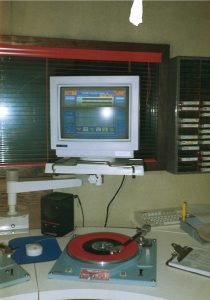
Then, it was the Arrakis Digilink III and getting in trouble for learning about and using it before we were supposed to use it on the AM side (WCPA-Clearfield, PA). LOL. A pic from the AM booth is shown. I had to edit the photo due to the 60 Hz to attempt a full desktop view.
Final automation was what I am still trying to isolate. I believe it was Wizard for Windows and it was used for WINU in Highland, IL (then 880).
My job was simply to replace the DJ liners on their shift times and those DJ's were "satellited" in via Westwood One which sent tones for the various needs.
Then, it was the Arrakis Digilink III and getting in trouble for learning about and using it before we were supposed to use it on the AM side (WCPA-Clearfield, PA). LOL. A pic from the AM booth is shown. I had to edit the photo due to the 60 Hz to attempt a full desktop view.
Final automation was what I am still trying to isolate. I believe it was Wizard for Windows and it was used for WINU in Highland, IL (then 880).
Attachments
I have read about the Schafer Spotter. Came out about 1959. Tell me did they use it for music as well as spots and announcements? Specifically Beautiful Music radio?I don't remember who manufactured it, but there was a random select reel-to-reel called a "Spotter." I used tape with a clear window every 70 sec. The reel would get a play command and then switch on a 25 Hz tone placed at the end of the spot. Once the clear window on the tape passed a photo cell, the machine would stop and begin running either backwards or forwards to the next programmed spot. A stepping relay kept track of where it was. Both a joy and a terror to behold.
K.M. Richards
Program Director, The Eighties Channel™
I have read about the Schafer Spotter. Came out about 1959. Tell me did they use it for music as well as spots and announcements? Specifically Beautiful Music radio?
No. You couldn't put a lot of long cuts on a Spotter. It was limited to the capacity of a 10½ reel.
Generally speaking, the Spotter was more like a Carousel in concept, although with a greater capacity; it could hold up to 99 spots (the limit that could be "selected" by the control technology) but had the same limitation of only being able to be a source once per break.
Single play carts were more likely to be used for announcements, and back then reel-to-reel was the only reasonably-priced means to record and playback music.
That is what I remember. But theoretically they could have recorded the musical selections onto tape which could be selected in the order they desired by the apparatus counting the number or coating erasures on the tape. I never saw that done but I wonder if anyone did it. Rather than just playing a tape sequentially - from start to finish always in the same order.No. You couldn't put a lot of long cuts on a Spotter. It was limited to the capacity of a 10½ reel.
Generally speaking, the Spotter was more like a Carousel in concept, although with a greater capacity; it could hold up to 99 spots (the limit that could be "selected" by the control technology) but had the same limitation of only being able to be a source once per break.
Single play carts were more likely to be used for announcements, and back then reel-to-reel was the only reasonably-priced means to record and playback music.
This might have been at WRAL-FM in Raleigh. It's got to be 50 years ago. I remember seeing two Spotters in the system which would allow one to search while the other was playing. That way you could have two or more elements from the Spotters back to back. However, I remember the engineer telling me that it was sometimes a "race to the finish" and would occasionally throw tape all over the room. More scary than the Gates 55? You tell me.
K.M. Richards
Program Director, The Eighties Channel™
That is what I remember. But theoretically they could have recorded the musical selections onto tape which could be selected in the order they desired by the apparatus counting the number or coating erasures on the tape. I never saw that done but I wonder if anyone did it. Rather than just playing a tape sequentially - from start to finish always in the same order.
Wasn't worth the effort to be able to "select" from the 24 or 25 songs that could fit on the reel, in a format where it didn't matter what order the songs played in.
As I said over in the other thread about Beautiful Music just now, so much of that format's listening was in the background. You're worrying about something that wasn't an issue ... if even a couple of listeners per market would be able to predict song play order, I would have been surprised. (And accused them of not having lives.)
K.M. Richards
Program Director, The Eighties Channel™
However, I remember the engineer telling me that it was sometimes a "race to the finish" and would occasionally throw tape all over the room. More scary than the Gates 55? You tell me.
I actually saw both on a visit to Fresno in the mid-1970s, when KFYE/93.7 was soft rock with a Schafer automation system that had one Spotter in its racks, although (as I had suggested earlier) it was secondary to the Carousels and was only used once per break. I will say that if if had to go nearly end-to-end between spots, it did get up quite a head of steam, although (as I understood it from talking to their engineer) the photoelectric cell would trigger the opposite direction control on the deck -- rewind if it was fast forwarding, or vice versa -- which slowed it down as it got closer to the next spot in was seeking.
KARM/1430 had a Gates automation with two Gates 55s. They told me that they had to be careful that carts didn't fit in the slots too tightly or the mechanism that moved them in and out to the playback machine could lock up. IIRC, the 55 was a non-random selectable device that simply went top to bottom and then started over at the top slot.
The simple manual solution was to start random select reels at 5 AM by skipping a certain number of cuts so that there were different start points and, thus, different combinations of songs. I used a very simple table where each deck had a different "new reel start" for every day of the month so that you never heard the same start points of same combinations of songs together for about a year (start points times the number of reels in the category).Wasn't worth the effort to be able to "select" from the 24 or 25 songs that could fit on the reel, in a format where it didn't matter what order the songs played in.
I know that I got comments even on different versions of the same songs being repeated around the same time during the span of a few days. This was, in those 60's and 70's years, more of a foreground format than most people think today.As I said over in the other thread about Beautiful Music just now, so much of that format's listening was in the background. You're worrying about something that wasn't an issue ... if even a couple of listeners per market would be able to predict song play order, I would have been surprised. (And accused them of not having lives.)