• Get involved.
    We want your input!
    Apply for Membership and join the conversations about everything related to broadcasting.

    After we receive your registration, a moderator will review it. After your registration is approved, you will be permitted to post.
    If you use a disposable or false email address, your registration will be rejected.

    After your membership is approved, please take a minute to tell us a little bit about yourself.
    https://www.radiodiscussions.com/forums/introduce-yourself.1088/

    Thanks in advance and have fun!
    RadioDiscussions Administrators

Entercom's alternative experiment not a success?

Alternative was always niche but it was a format for adventurous music fans who did not want to hear the same old stuff that dominated the rest of the commercial radio dial.
Now 'adventurous fans' get their music live from someone's bedroom posted on TikTok. New music isn't hitting Alt playlists, because it isn't being produced by record labels.
In the 80's and 90's, MTV was still playing a dog's breakfast of pop music videos and there was no such thing as YouTube or streaming services so Alternative radio served those who were looking for new and different music. Maybe it didn't matter if their tastes were fragmented because they had nowhere else to turn.
Why does the discussion always have to regress to the 80's and 90's? Dude, look around. This isn't the 80's or 90's anymore, nor do consumers get their music the same way as the 80's and 90's. MTV does reality shows now, not music videos.
These days, music fans who do not want to hear the mainstream stuff do not have to turn on the radio at all. That's probably why Alternative radio is having trouble, there are so many other options for them to find the music they like.
You're finally getting it, sort of. That doesn't mean that Alt formats can't still do well, even if they play music that encroaches into the 90's grunge scene.
YouTube, social media and steaming services with their AI-generated playlists have become today's tastemakers and now, more than ever, commercial radio's role is to serve up pabulum for the masses.
Pabulum for the masses?? Spoken like someone stuck in the 80's and 90's.
 
Alternative was always niche but it was a format for adventurous music fans who did not want to hear the same old stuff that dominated the rest of the commercial radio dial.
And, as I have said over and over, with the exception of a smaller number of songs, there is extreme polarization within the genre with most music appealing to only a portion of people who would self-describe as alternative fans.
These days, music fans who do not want to hear the mainstream stuff do not have to turn on the radio at all. That's probably why Alternative radio is having trouble, there are so many other options for them to find the music they like.
Again, the issue is not all the new media options; it is the fact that there are multiple subsets of the alternative rock universe and none are large enough to sustain a radio station in most markets.

So many stations don't play much new music as it is so divisive. They play the broad, mass appeal stuff of a decade or more ago.
YouTube, social media and steaming services with their AI-generated playlists have become today's tastemakers and now, more than ever, commercial radio's role is to serve up pabulum for the masses.
You give too much credit to the providers of so-called "AI" generated playlists. All those services do is register songs that you skip or indicate dislike for. Then they compare other subscribers who dislike that song and look for other songs that group does not like. They refine what you get based on statistics, not on "intelligence". At each step, they personalize your potential playlist.

Radio is not on demand and refinable at the listener level. It is one-to-many, not one-to-one. So only songs that lots of people "like you" all like will get played, and ones that fragment the target audience into some who like, some who tolerate and some who hate won't get played.

Radio is sort of like going to the movies: for everyone there the script is the same, the actors are the same, the scenes are the same and the ending is the same.
 
Now 'adventurous fans' get their music live from someone's bedroom posted on TikTok. New music isn't hitting Alt playlists, because it isn't being produced by record labels.
The major labels do have some. The rest of the good stuff is on indie labels and is well represented at college radio, but big radio has a symbiotic relationship with the three major labels and only a very small percentage of indie stuff gets through any more.

Why does the discussion always have to regress to the 80's and 90's? Dude, look around. This isn't the 80's or 90's anymore, nor do consumers get their music the same way as the 80's and 90's. MTV does reality shows now, not music videos.
Because that's the last time Alternative radio did well overall, and my comments discussed why. Also, I'm not the only one gushing about the 90s, just scroll up and read the comments about WNYL's 90s Alternative weekend.

Pabulum for the masses?? Spoken like someone stuck in the 80's and 90's.
Actually all you have to do is read through numerous current threads on this very website where the businessmen constantly tell us radio's role is to follow trends, not create them. Everything should be based on music testing, only consensus music can attract an audience and few-to-no risks should be taken. Ergo, pabulum for the masses. Today -- not in the 90s when Alternative radio was actually taking risks and breaking new music. Oops, there I go talking about the 90s again..

You give too much credit to the providers of so-called "AI" generated playlists. All those services do is register songs that you skip or indicate dislike for. Then they compare other subscribers who dislike that song and look for other songs that group does not like. They refine what you get based on statistics, not on "intelligence". At each step, they personalize your potential playlist.

That actually sounds like AI, and I give credit because at least for me, it works really well. Spotify offers me daily playlists which tend to be a mix of music I've played and songs I haven't heard yet, and it's usually very good at predicting what I like and surprising me with some new songs I find interesting. Furthermore, if I just play one particular artist, song or album, Spotify continues to play music from similar artists once my selection is done. Those mixes are often fantastic and a terrific source of new music discovery. I don't know whether the music is chosen by statistics or how you want to define "intelligence", but maybe it's not me giving who is giving too much credit , but you who are giving it too little. It actually sounds like you haven't spent much time hearing the results for yourself.

Radio is not on demand and refinable at the listener level. It is one-to-many, not one-to-one. So only songs that lots of people "like you" all like will get played, and ones that fragment the target audience into some who like, some who tolerate and some who hate won't get played.

Again, pabulum for the masses. I don't mean it as in insult, simply the reality of the situation. This is the role radio must have in today's entertainment landscape where it must compete against so many other sources of new music discovery and customization. And that goes back to my earlier point -- those sources did not exist at the height of Alternative's popularity so those stations could "dare to be different," as one of the slogans proclaimed. Today, they dare not.

 
Last edited:
The major labels do have some. The rest of the good stuff is on indie labels and is well represented at college radio, but big radio has a symbiotic relationship with the three major labels and only a very small percentage of indie stuff gets through any more.

The reason for this, as covered during numerous payola hearings, is that indie labels have a propensity for getting radio stations in trouble. And vice versa. The majors have more to lose, so they're less likely to play hanky panky. It's not just payola, but licensing and all of the requisite legal matters involving music today. There have been numerous lawsuits between artists, writers, and labels.

Again, pabulum for the masses. I don't mean it as in insult, simply the reality of the situation. This is the role radio must have in today's entertainment landscape where it must compete against many other sources of new music discovery and customization.

It's a tough thing to generalize. There are a lot of formats that take huge chances on new artists and even utilize indie labels. At least one-third of the country Top 30 is made up of artists on their first or second singles. Some of these artists, as discussed earlier in this thread, once had music released to alternative radio. They feel they have a better shot at getting airplay in the country format.
 
The reason for this, as covered during numerous payola hearings, is that indie labels have a propensity for getting radio stations in trouble. And vice versa. The majors have more to lose, so they're less likely to play hanky panky. It's not just payola, but licensing and all of the requisite legal matters involving music today. There have been numerous lawsuits between artists, writers, and labels.

I think you are confusing indie labels with independent promoters who were deeply involved with the money payoffs between the major labels and radio.

Most indie LABELS have no budget for payola, even if they wanted to pay for play.
 
Most indie LABELS have no budget for payola, even if they wanted to pay for play.

Which is another problem when promoting music to radio. They see adding new artists as an investment, in time and talent. That usually involves getting the artist to the station for listener concerts and other promotional activities. The indie labels I know understand that and provide those resources for their artists. The #1 song in country radio this week is an artist on an indie label. There are five different indie labels in this week's country Top 30. Another reason why a few alternative artists have been looking at other formats.
 
Country radio is about as far from Alternative as you can get, and the notion that any of those artists getting airplay on big Country radio are truly "independent" is farcical. They are either part of the Nashville country music machine or they are not likely getting played.
 
It's a tough thing to generalize. There are a lot of formats that take huge chances on new artists and even utilize indie labels. At least one-third of the country Top 30 is made up of artists on their first or second singles. Some of these artists, as discussed earlier in this thread, once had music released to alternative radio. They feel they have a better shot at getting airplay in the country format.
History repeats. The sea change in country music that started in the late '80s included such artists as Steve Earle, Mary Chapin Carpenter, Deana Carter, Kentucky Headhunters. Today country has Luke Combs, Morgan Wallen, Miranda Lambert, Elle King. One huge advantage country music has over alternative is a home base, Nashville, where not only Capitol, Warner and Mercury are operating but also home-grown indies like Big Machine, Big Loud and Thirty Tigers. They're all in the same city, with the same producers, songwriters, engineers, session musicians, etc. available to everyone. At its worst, it tends to homogenize artists and create cookie-cutter, trend-following music. At its best, it keeps the genre alive, evolving and attention-grabbing. Do you think alt would be doing better today if all of its production and marketing resources were in one place?
 
Last edited:
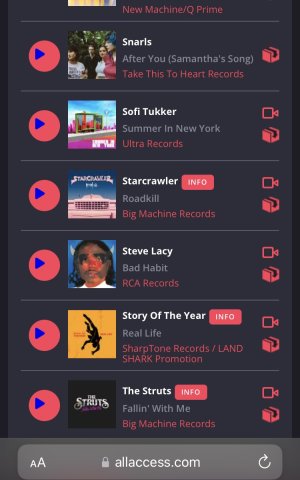
Big Machine (under the John Varvatos sub-label), Big Loud, and Thirty Tigers are all signing and marketing rock/alternative artists now. Thirty Tigers is even the home of rapper Lupe Fiasco now (remember him?). I don’t know what you’re smoking Big A but it looks like the country labels want to get into rock and alternative’s business, and that has to mean something.

EDIT: attached proof of Big Machine’s involvement with Alternative with two different artists they’re pushing.
 

Attachments

  • E71B60C4-C34A-45ED-9BB3-2D2BDBD18839.jpeg
    E71B60C4-C34A-45ED-9BB3-2D2BDBD18839.jpeg
    173.1 KB · Views: 5
Last edited:
I don’t know what you’re smoking Big A but it looks like the country labels want to get into rock and alternative’s business, and that has to mean something.

The consistent part of it is country radio. It's something they don't have in alternative, and they can see the difference, even now without as much physical product. The country labels just want to make money, and if they can do it with alternative artists, so much the better.

Country radio is about as far from Alternative as you can get, and the notion that any of those artists getting airplay on big Country radio are truly "independent" is farcical. They are either part of the Nashville country music machine or they are not likely getting played.

They're doing both. The artists are making music they believe in and creating with the Nashville music machine. They musicians are better than what they're used to, the studios have better deals than they have in LA, and everyone is rowing their boat in the same direction.

The one example I gave earlier is Jelly Roll. You look at him with the prison tattoos on his face and run away. But he has a song in the Top 15 on country radio.

Do you think alt would be doing better today if all of its production and marketing resources were in one place?

It sort of is in LA. But the atmosphere isn't as cohesive as it once was. Nashville is always cohesive, because the bars are close by and always open.
 
The reason for this, as covered during numerous payola hearings, is that indie labels have a propensity for getting radio stations in trouble. And vice versa. The majors have more to lose, so they're less likely to play hanky panky. It's not just payola, but licensing and all of the requisite legal matters involving music today. There have been numerous lawsuits between artists, writers, and labels.
Of course, the big labels would just hire an independent promoter to do the "relationship" promotion. Think "Joe Isgro".
It's a tough thing to generalize. There are a lot of formats that take huge chances on new artists and even utilize indie labels. At least one-third of the country Top 30 is made up of artists on their first or second singles. Some of these artists, as discussed earlier in this thread, once had music released to alternative radio. They feel they have a better shot at getting airplay in the country format.
The same is true with Urban / R&B music and particularly with Spanish language Regional Mexican and Reggaetón labels and artists.
 
Country radio is about as far from Alternative as you can get, and the notion that any of those artists getting airplay on big Country radio are truly "independent" is farcical. They are either part of the Nashville country music machine or they are not likely getting played.
Not exactly. There's something called "alternative country". That tends to get played on AAA.
 
Not exactly. There's something called "alternative country". That tends to get played on AAA.
Alternative country was where performers like Chris Stapleton and Eric Church came to mainstream country radio from, although Chris had the advantage of having come to Nashville as a songwriter, if I'm not mistaken, so he was known in that role before radio decided that his music would play with a mainstream audience.
 
Alternative country was where performers like Chris Stapleton and Eric Church came to mainstream country radio from,

Not really. Eric was signed as a mainstream act to a major label. Alternative country is Sturgell Simpson, Lyle Lovett, Steve Earl, The SteelDrivers, (that may be where Chris Stapleton came from), Jason Isbell, and a bunch of other people.
 
Not really. Eric was signed as a mainstream act to a major label. Alternative country is Sturgell Simpson, Lyle Lovett, Steve Earl, The SteelDrivers, (that may be where Chris Stapleton came from), Jason Isbell, and a bunch of other people.
Thanks for the correction. I was on a personal hiatus from country radio listening when Church's career started, so I just assumed he'd had alt "cred" when I became aware of him and the respect from country hipsters he was getting. Lovett and Earle are interesting -- was there really an alt-country scene 30-plus years ago? I thought both made conscious decisions to try to make it in Nashville and found the major labels in a receptive mood for new sounds in the late '80s/early '90s.
 
was there really an alt-country scene 30-plus years ago?

Absolutely. That's when Lyle Lovett got started, along with Roseanne Cash, BR549, Kelly Willis, Wilco, Bruce Robison, and a bunch of others nobody's heard of. When commercial country got real big and popular, there was a counter country culture that went in the opposite direction.
 
Absolutely. That's when Lyle Lovett got started, along with Roseanne Cash, BR549, Kelly Willis, Wilco, Bruce Robison, and a bunch of others nobody's heard of. When commercial country got real big and popular, there was a counter country culture that went in the opposite direction.
There was even a short lived "Progressive Country" radio format back then. AM and fringe FM's tried it out, but never caught on. I know it was on stations in Phoenix, Sacramento, and Reno. It was where I first heard Cowboy Junkies, and K.D. Lang.
 
Alternative country was where performers like Chris Stapleton and Eric Church came to mainstream country radio from, although Chris had the advantage of having come to Nashville as a songwriter, if I'm not mistaken, so he was known in that role before radio decided that his music would play with a mainstream audience.
Is Alternative Country the same as Americana? I've never quite understood what defines an Americana artist.
 
Is Alternative Country the same as Americana? I've never quite understood what defines an Americana artist.
There's a lot of overlap, but Americana also includes older artists with significant past mainstream success, like Emmylou Harris, and, based on what I've heard of music commonly classified as Americana, is generally more organic/acoustic than alt-country.
 
Status
This thread has been closed due to inactivity. You can create a new thread to discuss this topic.


Back
Top Bottom