There's something very different about the signal from WBBM now. I was able to ID WNIS 790 tonight pretty easily right on Lake Michigan in Chicago, while before today the interference from WBBM was too strong to get a whiff of anything on 790. This was also the last remaining AM frequency I had never gotten any station on before.

-
Get involved.
We want your input!
Apply for Membership and join the conversations about everything related to broadcasting.
After we receive your registration, a moderator will review it. After your registration is approved, you will be permitted to post.
If you use a disposable or false email address, your registration will be rejected.
After your membership is approved, please take a minute to tell us a little bit about yourself.
https://www.radiodiscussions.com/forums/introduce-yourself.1088/
Thanks in advance and have fun!
RadioDiscussions Administrators
You are using an out of date browser. It may not display this or other websites correctly.
You should upgrade or use an alternative browser.
You should upgrade or use an alternative browser.
FCC grants WBBM a CP to move transmitter site
- Thread starter CADXER
- Start date
... I was able to ID WNIS 790 tonight pretty easily right on Lake Michigan in Chicago, while before today the interference from WBBM was too strong to get a whiff of anything on 790. ...
There have been reports of WSGW, 790 (Saginaw, MI) being received in the daytime along/near Lakeshore Drive, in the shadow of Loop buildings from WBBM. That was before the recent relocation of the WBBM tx site.


The Horizontal Plane Inverse Field is essentially the same with 42 kW. The Vertical Radiation Characteristic is different for 211 degrees than for 194 degrees. It has a theoretical null a a lower angle with the new tower. This results in a skywave minimum further away from the respective towers. rfry can give us a link to the graph showing the VRC, theoretical and measured.
The Horizontal Plane Inverse Field is essentially the same with 42 kW. The Vertical Radiation Characteristic is different for 211 degrees than for 194 degrees. It has a theoretical null a a lower angle with the new tower. This results in a skywave minimum further away from the respective towers. rfry can give us a link to the graph showing the VRC, theoretical and measured.
As long as the 780 signal is noise-free 24/7, from Zion to Kankakee and from Aurora to Michigan City, that's all that matters.
... rfry can give us a link to the graph showing the VRC, theoretical and measured.
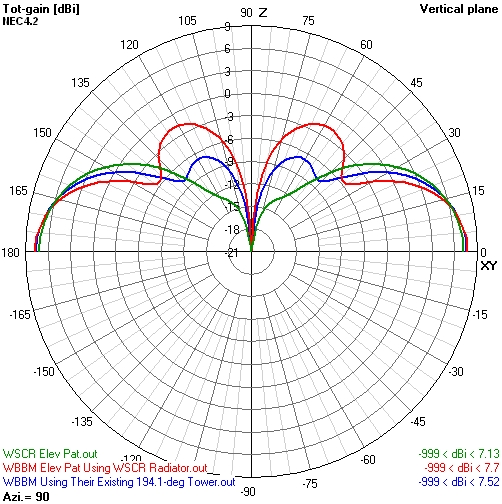
Below are the theoretical elevation patterns for WBBM and WSCR, but I haven't calculated (or measured) the radiated field intensities from either of them.
WBBM using the WSCR tower has 0.18 dB more gain in the horizontal plane than before they moved to WSCR. But the difference in daytime applied power is about 0.76 dB below what it would be with 50 kW.
WBBM also has less gain than before moving at elevation angles from about 12° to about 40°, and a very large minor lobe centered at about 58° — which can cause a nighttime self-interference zone centered at a horizontal radius distance including the Rockford, IL area.
Thanks, Rich. This answers a lot of the anomalies that are being observed.
For 194 degrees with 50 kW Day, the Inverse Field WAS 2845 mV/m @ 1 km in the H Plane.
For 211 degrees with 42 kW Night, the Inverse Field is 2787 mV/m @ 1 km in the H Plane.
This reduction is probably to protect KKOH 780 Reno, one of the original Class II-A Drop Ins. There could be other drop ins also, in other directions, to the South and West. But the WSCR site is probably ~4 miles closer to KKOH Reno than the OLD WBBM site, and that IS significant in the Skywave Calculations. I should look to see the effect on the WSGW NIF, to which it is a primary contributor, under recent rules. It should be less, and this is illustrative of the changes due to the site change, height change, and power reduction. They may have been required to reduce 10%, since this was a voluntary change.
For 194 degrees with 50 kW Day, the Inverse Field WAS 2845 mV/m @ 1 km in the H Plane.
For 211 degrees with 42 kW Night, the Inverse Field is 2787 mV/m @ 1 km in the H Plane.
This reduction is probably to protect KKOH 780 Reno, one of the original Class II-A Drop Ins. There could be other drop ins also, in other directions, to the South and West. But the WSCR site is probably ~4 miles closer to KKOH Reno than the OLD WBBM site, and that IS significant in the Skywave Calculations. I should look to see the effect on the WSGW NIF, to which it is a primary contributor, under recent rules. It should be less, and this is illustrative of the changes due to the site change, height change, and power reduction. They may have been required to reduce 10%, since this was a voluntary change.
Last edited:
Thanks, Rich. This answers a lot of the anomalies that are being observed.
For 194 degrees with 50 kW Day, the Inverse Field WAS 2845 mV/m @ 1 km in the H Plane.
For 211 degrees with 42 kW Night, the Inverse Field is 2787 mV/m @ 1 km in the H Plane.
This reduction is probably to protect KKOH 780 Reno, one of the original Class II-A Drop Ins. There could be other drop ins also, in other directions, to the South and West. But the WSCR site is probably ~4 miles closer to KKOH Reno than the OLD WBBM site, and that IS significant in the Skywave Calculations. I should look to see the effect on the WSGW NIF, to which it is a primary contributor, under recent rules.
Why would WBBM or WSCR have to protect any other stations on the same frequencies?
Why would WBBM or WSCR have to protect any other stations on the same frequencies?
I believe they do have to protect it under more recent rules. I know the International Treaties require it. CBM 940 had to go directional when they changed sites or parameters. The field ratio in the Night DA was 0.12! The new private owners moved off the 690/940 tower as I recall. CBK 540 made some changes, and had to reduce to 46 kW Night. WMVP is a Class A, no longer distinguished between Class I-As and Class I-Bs, and had to increase protection to some Class Bs on 990, 1000, and 1010 when they put up a new dogleg DA, at the same site. I'll have to look at those applications again. KFI 640 was involuntary (tower collapsed in plane crash), and they still had to decrease to several stations with a shorter overall sectionalized tower. I'll have to look that up also.
Last edited:
I believe they do have to protect it under more recent rules. I know the International Treaties require it. CBM 940 had to go directional when they changed sites or parameters. The field ratio in the Night DA was 0.12! The new private owners moved off the 690/940 tower as I recall. WMVP is a Class A, no longer distinguished between Class I-As and Class I-Bs, and had to increase protection to some Class Bs on 990, 1000, and 1010 when they put up a new dogleg DA, at the same site. I'll have to look at those applications again. KFI was involuntary, and they still had to decrease to several stations with a sectionalized tower. I'll have to look that up also.
I will be curious as to what you discover. I cannot picture these heritage clear channel stations agreeing to protect anyone. Thank you!
Bob
According to rfry's graph, WBBM would LOSE about 3 dB in SE Michigan, Skywave angle average is about 30 degrees in SE Michigan.
Probably will reduce WBBM's adjacent-channel skywave interference to the useful, nighttime groundwave coverage area of WSGW, too.According to rfry's graph, WBBM would LOSE about 3 dB in SE Michigan, Skywave angle average is about 30 degrees in SE Michigan.
It was actually CBW 990 Winnipeg that moved and had to reduce Night power to 46 kW. I was confusing CBK 540 with WFLF 540 Pine Hills, FL, which made changes and had to officially reduce from 50 kW to 46 kW Night.
There is a huge difference in using towers close to 5/8 wavelength for Class IVs/Cs and 1 kW Class IIs/IIIs/Bs. With lower power stations above 1200 kHz, the useful ground wave doesn’t go far enough for the high angle Skywave self interference to be a problem. With Class I-As/I-Bs/As, especially those below 1000 kHz, the self interference distance is well within the useful ground wave service area. This is a huge problem for Day CH and Night service for those stations.
This had been worked out by the 1930s, with 195 degree towers becoming the standard for avoiding this, but it appears to have been forgotten. Maybe WBBM should have used a skirted antenna on the WSCR tower, like WRDT 560 has, to avoid this.
This had been worked out by the 1930s, with 195 degree towers becoming the standard for avoiding this, but it appears to have been forgotten. Maybe WBBM should have used a skirted antenna on the WSCR tower, like WRDT 560 has, to avoid this.
Last edited:
Some have posited that by moving to the WSCR tower, WBBM now minimizes the importance of it having a relatively interference-free signal much beyond the "greater Chicagoland area."... With Class I-As/I-Bs/As, especially those below 1000 kHz, the self interference distance is well within the useful ground wave service area. This is a huge problem for Day CH and Night service for those stations. ...
That is a short sighted view on CBS/Entercom’s part. AM isn’t dying, it’s committing suicide! There will be fading problems in Berrien County’s Lakeshore, where Chicago’s movers and shakers spend their Weekends and Summers. Still think they could use a skirting arrangement to shorten the electrical height, and increase the power.
Well, here's my very unscientific observation on WBBM's new transmitting plant. From Kenosha, about 60 miles out: Daytime- sounds about the same signal-wise, but their audio sounds flat. Nighttime- I was shocked to hear actual fading when I was listening Tuesday night around 9:30 PM. Last night I checked signal strength on my Tecsun PL-310ET; it was 5-6 dBu below WSCR and WGN. Was this cancellation I was hearing? Sad for one of the few remaining local AMs that ALWAYS had a city-grade signal here.
Well, here's my very unscientific observation on WBBM's new transmitting plant. From Kenosha, about 60 miles out: Daytime- sounds about the same signal-wise, but their audio sounds flat. Nighttime- I was shocked to hear actual fading when I was listening Tuesday night around 9:30 PM. Last night I checked signal strength on my Tecsun PL-310ET; it was 5-6 dBu below WSCR and WGN. Was this cancellation I was hearing? Sad for one of the few remaining local AMs that ALWAYS had a city-grade signal here.
That is sad! When I lived in Racine from 1986-1989, the big Chicago 50kW AMs all had such great listenable, local or near local grade signals in the Racine-Kenosha area.
Bob
- Status
- This thread has been closed due to inactivity. You can create a new thread to discuss this topic.