• Get involved.
    We want your input!
    Apply for Membership and join the conversations about everything related to broadcasting.

    After we receive your registration, a moderator will review it. After your registration is approved, you will be permitted to post.
    If you use a disposable or false email address, your registration will be rejected.

    After your membership is approved, please take a minute to tell us a little bit about yourself.
    https://www.radiodiscussions.com/forums/introduce-yourself.1088/

    Thanks in advance and have fun!
    RadioDiscussions Administrators

FCC Opens Investigation into NPR and PBS


This is basically an extension of where we are with why the FCC, Trump, Musk and their allies are going after NPR and PBS. This is one clue WNET did a segment about LGBTQ Civil Rights History for the PBS TV app is now removed. Yes we know we bounce around speculation over PBS NewsHour, PBS Frontline, NPR News and their affiliates coverage of Trump and Musk with no direct answers but partial clues like NPR, PBS Newshour and their local affiliates reposting articles from AP and Reuters coverage of Trump and Musk roles in the White House.


In response to a blizzard of executive orders from President Donald Trump, the Public Broadcasting Service recently erased a series of videos made in partnership with New York City Public Schools focused on LGBTQ history.

This week, the city’s Education Department found a new home for them: its own website.

The short films draw on material from the city’s LGBTQ-focused curriculum, part of a series called “Hidden Voices” that seeks to elevate a broad range of underrepresented groups students learn about in their social studies classrooms.
The videos profile prominent LGBTQ people such as the feminist thinker Audre Lorde and civil rights leader Bayard Rustin. They also survey key historical moments, including the mass dismissal of queer government employees during the Lavender Scare of the 1940s–’60s and the 1969 Stonewall uprising in Greenwich Village, widely considered a catalyst of the modern LGBTQ rights movement.

The city partnered with WNET, the local PBS affiliate, to produce the videos, and the broadcaster distributed them on its website. City Council allocated nearly $600,000 in discretionary funding to WNET in recent years to create LGBTQ curriculum resources, city records show.
 
There was a time when AM Stereo radio was tried. I recall that people said it sounded good, but having competing versions of it, and no standardization chosen, seems to have been, at least a part, of AM Stereo's failure. If the FCC would have chosen one standard, or AM Stereo system, could the outcome have been different over time?
The FCC chose and approved, initially, one standard. The creator of a different one sued and delayed AM stereo for over four years... a delay that extended beyond the possible window of AM to create its own "stereo" image as by the early 80's when the cowardly FCC opened up to all systems, AM music was pretty much dead.
 
The FCC did choose Motorola C-Quam as the single standard for AM Stereo in 1993, joining the rest of the world, which had already standardized on it by then (Australia in 1985, Canada in 1988, Japan in 1992, etc.).
Three countries are not "the rest of the world". And as soon as the FCC chose Motorola, Leonard Kahn sued and delayed the process by over four years... until it was too late to save music AM radio.
Failure to standardize on a single system until consumer interest had waned also doomed Teletext and Quadraphonic broadcasting.
Blame Leonard Kahn for that. The FCC was prevented by the courts from doing anything, and when they finally did, they accepted an open market approach that allowed all systems.
 
Three countries are not "the rest of the world". And as soon as the FCC chose Motorola, Leonard Kahn sued and delayed the process by over four years... until it was too late to save music AM radio.
The FCC's initial choice was the Magnavox system back in 1980, but proponents of all the other systems threw a fit and accused the selection process of being flawed and biased. Kahn just so happened to be the biggest cheerleader of the "Let the marketplace decide" approach, and the new deregulation-focused Reagan administration that came in at the time thought that sounded like a good idea -- it wasn't.

And people knew it soon enough. By 1984, broadcasting magazines already had editorials begging the FCC not to repeat the same mistake with Teletext, and guess what happened? Another "let the marketplace decide" approach, and another system that went nowhere because of it.

Kahn's antitrust lawsuit against Motorola did drag on for years, but did not delay the implementation of C-Quam as the standard in 1993. It was one of the stated goals of the Clinton administration's new FCC to "finally settle the AM Stereo issue"... and also to choose a single standard for HDTV, rather than have another marketplace fiasco.
 
The FCC's initial choice was the Magnavox system back in 1980, but proponents of all the other systems threw a fit and accused the selection process of being flawed and biased. Kahn just so happened to be the biggest cheerleader of the "Let the marketplace decide" approach, and the new deregulation-focused Reagan administration that came in at the time thought that sounded like a good idea -- it wasn't.
The others... and I had order #1 for two of them... did not protest. They stated they thought theirs to be superior, but filed no actions and brought no lawsuits. Only Kahn, who had always been litigious and contentious, took it to the court with an "if I can't have it, nobody can" attitude.
Kahn's antitrust lawsuit against Motorola did drag on for years, but did not delay the implementation of C-Quam as the standard in 1993.
That was about 13 or 14 years too late. AM stations of any significance had dropped music a decade prior and there was really no reason in the early 90's to add AM stereo.
It was one of the stated goals of the Clinton administration's new FCC to "finally settle the AM Stereo issue"... and also to choose a single standard for HDTV, rather than have another marketplace fiasco.
"Settling" a dead issue is hardly notable. By the 90's, no AM could care, and receivers were off the market while existing inventories were depleted. Nowhere else in the world did the system gain any traction.
 
"Settling" a dead issue is hardly notable. By the 90's, no AM could care, and receivers were off the market while existing inventories were depleted. Nowhere else in the world did the system gain any traction.
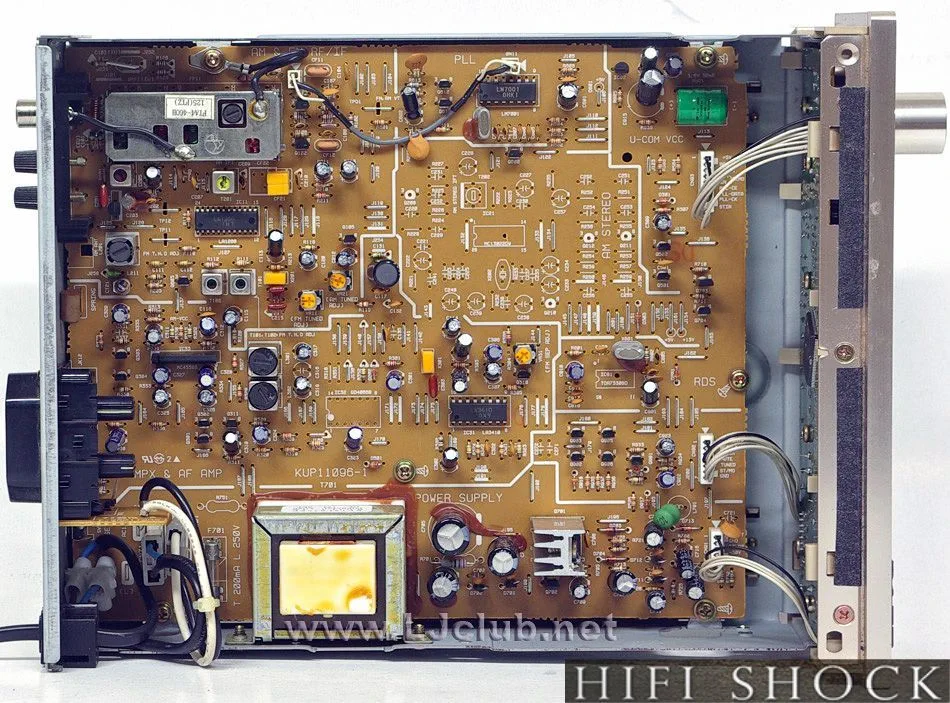
In the '90s and even into the 2000s there were many radios with an empty section on the board for what was the AM Stereo decoder in the Japanese-market model, but was not equipped in the North American version. Same thing with RDS -- just an empty section on the board for U.S., while Europe got the RDS decoder. I knew people who were factory service techs and they were told those parts were strictly not for sale to U.S. customers.

For example, the TEAC T-H300. Big empty space on the board marked "AM Stereo" for the Japanese model only, although this is a U.K. model so it actually does have RDS:
t-h300-1-teac.webp
 
NPR's CEO did an interview where she says she's sure that NPR is in compliance with all FCC sponsorship guidelines:


Here's a link to the original article:


Here is NPR News explanation over the Defund NPR issue.


Now Senator John Kennedy of Louisiana joins in to "Defund NPR and PBS" once again it's directed at CPB to not send funds to the local NPR and PBS affiliates in Louisiana each time we discuss this.


WASHINGTON – Sen. John Kennedy (R-La.), a member of the Senate Appropriations Committee, introduced the Senate companion to the No Propaganda Act to defund the Corporation for Public Broadcasting (CPB). The bill would block federal funding for the CPB because of the organization’s chronically biased content.

“The Corporation for Public Broadcasting refuses to provide Louisianians and Americans with fair, unbiased content. It wastes taxpayer dollars on slanted coverage to advance a leftist political agenda. The No Propaganda Act would save taxpayer money by putting an end to Big Brother’s propaganda outlet,” said Kennedy.

Congress has appropriated more than $15 billion to fund the CPB, which it allocates to National Public Radio (NPR) and the Public Broadcasting Service (PBS). CPB states that its goal is to, “educate, inform, foster curiosity, and promote civil discourse essential to American society.” However, in April, a whistleblower exposed NPR’s decision to not broadcast the Hunter Biden laptop scandal because NPR believed covering the story would help presidential candidate Donald Trump during the 2020 election cycle.
 
Here is NPR News explanation over the Defund NPR issue.

It's a worthwhile read for anyone with an open mind who wants to truly understand.
But, if you skip to the end, you'll find the answer summarized in a single sentence.

Undermining public media would weaken the entire information ecosystem, which would ultimately lead to a less informed American public.

Ah, there it is. And who does that help, I wonder?
 
It's a worthwhile read for anyone with an open mind who wants to truly understand.
But, if you skip to the end, you'll find the answer summarized in a single sentence.


Ah, there it is. And who does that help, I wonder?
True we said this the entire time but it doesn't matter to this group in congress siding with Senator Kennedy of Louisiana and Marjorie Taylor Greene.
 
Bloomberg reports that the FCC has sent letters to 13 public radio stations seeking details on sponsorships.


Two radio stations have confirmed receipt of the letter: WBUR Boston and KPCC LAist in LA.

Here is a free version of the article from MSN:

 
Bloomberg reports that the FCC has sent letters to 13 public radio stations seeking details on sponsorships.


Two radio stations have confirmed receipt of the letter: WBUR Boston and KPCC LAist in LA.

Here is a free version of the article from MSN:

I really don't think that Mr. Carr and company are going to find any smoking guns here. To be honest, I think that there are a lot more violations of the usage of advertisements by noncommercial outlets not affiliated with NPR (or even Pacifica) than by those who are affiliated with the network.
 
I think that there are a lot more violations of the usage of advertisements by noncommercial outlets not affiliated with NPR (or even Pacifica) than by those who are affiliated with the network.

As I said earlier in this thread, the FCC fined Pacifica's WBAI last year for this exact thing.
 
I really don't think that Mr. Carr and company are going to find any smoking guns here. To be honest, I think that there are a lot more violations of the usage of advertisements by noncommercial outlets not affiliated with NPR (or even Pacifica) than by those who are affiliated with the network.

How black-and-white are the rules, though? And conversely, how much are they subject to the malicious interpretations of a politically-motivated FCC, intent on inflicting financial harm on media outlets that don't toe the president's propaganda line?
 
How black-and-white are the rules, though?

Here they are:


An article from BroadcastLawBlog:


The liability is a fine. However, one of the commissioners questions the ability of the FCC to assess fines.
 
Here they are:

So yes, not only does it appear that there is lots of room for interpretation, it's actually stated so in the policy. There is also no definition of what is meant by terms like "good faith" or a "clear abuse," opening the door for a suddenly-hardline FCC to claim that those lines have now been crossed.

We repeat that the Commission will continue to rely on the good faith determinations of public broadcasters in interpreting our noncommercialization guidelines. We emphasize, however, that we will review complaints and, in the event of clear abuses of discretion, will implement appropriate sanctions, including monetary forfeitures.
 
So yes, not only does it appear that there is lots of room for interpretation, it's actually stated so in the policy. There is also no definition of what is meant by terms like "good faith" or a "clear abuse," opening the door for a suddenly-hardline FCC to claim that those lines have now been crossed.

The quoted passage says they will review complaints. The letter that set this off contained no complaints.

we will review complaints and, in the event of clear abuses of discretion, will implement appropriate sanctions, including monetary forfeitures.

So they're already operating outside their own guidelines. Then there's the issue of a fine, which Commissioner Simington says the commission can't levy.
 
Status
This thread has been closed due to inactivity. You can create a new thread to discuss this topic.


Back
Top Bottom