• Get involved.
    We want your input!
    Apply for Membership and join the conversations about everything related to broadcasting.

    After we receive your registration, a moderator will review it. After your registration is approved, you will be permitted to post.
    If you use a disposable or false email address, your registration will be rejected.

    After your membership is approved, please take a minute to tell us a little bit about yourself.
    https://www.radiodiscussions.com/forums/introduce-yourself.1088/

    Thanks in advance and have fun!
    RadioDiscussions Administrators

FM 97.5

Usually FM 97.5 belongs to KFNC-ESPN broadcasting from a tower south of Winnie on the far east side of Houston, halfway to Beaumont. This morning I was at the Spring HEB on 2920 just west of I-45 hearing the dopey KWTX morning show loud and unobstructed from Waco at about 9 to 930.
Both stations are 100 KW. The KFNC tower is about 60 miles from Spring, while the KWTX tower is about 120 miles from Spring, so that’s quite a difference.
I wouldn’t call this a tropospheric ducting incident since that involves much longer distances. It was more like a temporary enhanced atmospheric condition allowing the next nearest station on a frequency to overwhelm the normal occupant.
I wonder if KFNC will ever move its tower closer to Houston, as was proposed several years ago to locate around Mont Belvieu, the current city of license. KFNC uses a highly directional 30 watt translator K223CW on FM 92.5 to serve a tiny slice of Houston from downtown out to Bellaire. I forgot what happened to the 2 KW booster antenna on the east edge of Houston and why KFNC doesn’t use the 99 watt translator on FM 94.1 K231CN used when the failed “SportsMap” had its trial balloon.
As is, the KFNC signal simply does not effectively penetrate most of western Houston, Katy, The Woodlands, and Conroe.
Check the signal pattern = KFNC-FM Radio Station Coverage Map
 
This morning weather conditions brought many stations to Houston. I was able to listen to 106.7 FM playing Mexican regional music. Also 95.5 FM and other stations
 
Usually FM 97.5 belongs to KFNC-ESPN broadcasting from a tower south of Winnie on the far east side of Houston, halfway to Beaumont. This morning I was at the Spring HEB on 2920 just west of I-45 hearing the dopey KWTX morning show loud and unobstructed from Waco at about 9 to 930.
Both stations are 100 KW. The KFNC tower is about 60 miles from Spring, while the KWTX tower is about 120 miles from Spring, so that’s quite a difference.
I wouldn’t call this a tropospheric ducting incident since that involves much longer distances. It was more like a temporary enhanced atmospheric condition allowing the next nearest station on a frequency to overwhelm the normal occupant.
I wonder if KFNC will ever move its tower closer to Houston, as was proposed several years ago to locate around Mont Belvieu, the current city of license. KFNC uses a highly directional 30 watt translator K223CW on FM 92.5 to serve a tiny slice of Houston from downtown out to Bellaire. I forgot what happened to the 2 KW booster antenna on the east edge of Houston and why KFNC doesn’t use the 99 watt translator on FM 94.1 K231CN used when the failed “SportsMap” had its trial balloon.
As is, the KFNC signal simply does not effectively penetrate most of western Houston, Katy, The Woodlands, and Conroe.
Check the signal pattern = KFNC-FM Radio Station Coverage Map


100% tropospheric.
 
The KFNC tower is about 60 miles from Spring, while the KWTX tower is about 120 miles from Spring
The KWTX and KFNC towers are 205 miles from each other.
I wouldn’t call this a tropospheric ducting incident since that involves much longer distances.
Tropo conditions can affect much shorter distances, even less than 50 miles. As our weather warms up there will be more tropo openings.
KFNC is also sometimes clobbered by KFTX in the Corpus Christi market.
I wonder if KFNC will ever move its tower closer to Houston, as was proposed several years ago to locate around Mont Belvieu, the current city of license.
Unlikely due to second adjacent spacing requirements for KBXX.
KFNC uses a highly directional 30 watt translator K223CW on FM 92.5 to serve a tiny slice of Houston from downtown out to Bellaire.
Highly unlikely it is only 30 watts with a directional antenna. I have heard it blasting in at Baybrook Mall 22 miles to the SE of the transmitter site. Others can hear it in Conroe. Much discussed on this board.
I forgot what happened to the 2 KW booster antenna on the east edge of Houston
Hopefully it was shut down. Caused horrible interference to the main signal.
and why KFNC doesn’t use the 99 watt translator on FM 94.1 K231CN used when the failed “SportsMap” had its trial balloon.
Because someone else now leases the translator (Radio Luz.)
As is, the KFNC signal simply does not effectively penetrate most of western Houston, Katy, The Woodlands, and Conroe.
KFNC is farther away than the other eastern rimshots, so more of a disadvantage. I have advocated for Gow to buy KROI and move the sports format there, while dumping 97.5. Will probably never happen (more likely 610 or 790 go after 92.1.)
 
Highly unlikely it is only 30 watts with a directional antenna. I have heard it blasting in at Baybrook Mall 22 miles to the SE of the transmitter site. Others can hear it in Conroe. Much discussed on this board.

It comes in crystal clear on a cheap Sangean clock radio inside my office in Spring, pretty close to the stick that K222CX is on. In fact, my seek often skips over K222CX to hit 92.5 instead...
 
That morning there was interference on just about all the Houston stations in The Woodlands around 6 AM. I was a little over 2 miles from KLJJ-LP and heard WYNK from Baton Rouge interfering.
 
Stations all along the gulf coast (from the RGV to New Orleans) seem to be very active in Houston around this time of the year. WYNK, WRNO, and WRR-FM seem to be the easiest to catch from southeast Louisiana (at least before the translator clutter).

From the south, it's not uncommon to catch a Mexican station from time to time. 107.1 and 93.1 from Reynosa can sometimes sneak in past the IBOC splatter. Same for 105.3 out of Monterrey. I used to catch these three regularly in Bryan TX a few years ago. The weirdest part was seeing KISS-FM's HD carrier lock on over KNFX's analog signal as I drove down Hwy 6 with a clear LOS to KNFX's antenna (it is on top of a commercial building).
 
Stations all along the gulf coast (from the RGV to New Orleans) seem to be very active in Houston around this time of the year. WYNK, WRNO, and WRR-FM seem to be the easiest to catch from southeast Louisiana (at least before the translator clutter).

From the south, it's not uncommon to catch a Mexican station from time to time. 107.1 and 93.1 from Reynosa can sometimes sneak in past the IBOC splatter. Same for 105.3 out of Monterrey. I used to catch these three regularly in Bryan TX a few years ago. The weirdest part was seeing KISS-FM's HD carrier lock on over KNFX's analog signal as I drove down Hwy 6 with a clear LOS to KNFX's antenna (it is on top of a commercial building).
The only New Orleans station I’ve heard in north Houston is WTIX. San Antonio’s HD stations can come in strong. KISS, KSMG, and KVBH can override whatever analog channel I’m hearing. It’s crazy when KVBH can be locked in over KGLK which is also in HD.
 
100% tropospheric.
No, tropospheric conditions allow stations thousands of miles away to appear. In Indiana, I heard a KC Royals baseball game broadcast on FM 100.9 which is a local frequency, having many stations that were leap-frogged. Also in Indiana, I heard an FM station in Arizona repeatedly advertising a concert to be held in Tucson. That is tropospheric ducting.

My reception of Waco’s KWTX in Spring was simply a temporary atmospheric condition that allowed a nearby station to overtake another nearby station.
 
No, tropospheric conditions allow stations thousands of miles away to appear. In Indiana, I heard a KC Royals baseball game broadcast on FM 100.9 which is a local frequency, having many stations that were leap-frogged. Also in Indiana, I heard an FM station in Arizona repeatedly advertising a concert to be held in Tucson. That is tropospheric ducting.
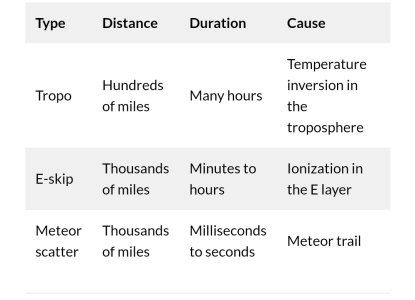
Tropospheric ducting can range from a few dozen miles to well over one thousand, and can be highly directional. Don't confuse this with ionospheric propagation, or E-skip, which can bring in stations 800 to 1,200 miles away for single hop reflection, and would "skip over" closer stations on the same frequency.

If you are hearing a more or less "steady" signal from an exceptionally distant station, it is tropo. If there is fading or rapid signal variations (as on shortwave) it is E-skip.

I have heard amazing tropo reception in Texas from stations in south Florida a number of times, but have also had E-skip reception from Florida as well.

A Waco FM station making it into Houston is due to tropo conditions. Waco is too close for E-skip.

The same phenomenon applies to television, especially in the analog days. E-skip would bring in stations over a thousand miles away on the low-band VHF channels (2-6) but tropo conditions could bring in stations from hundreds of miles away on all the VHF channels as well as the entire UHF band. There were times I could receive UHF TV stations in New Orleans or the Rio Grande Valley with almost local strength, over 300 miles away.
 
Tropospheric ducting can range from a few dozen miles to well over one thousand, and can be highly directional. Don't confuse this with ionospheric propagation, or E-skip, which can bring in stations 800 to 1,200 miles away for single hop reflection, and would "skip over" closer stations on the same frequency.

If you are hearing a more or less "steady" signal from an exceptionally distant station, it is tropo. If there is fading or rapid signal variations (as on shortwave) it is E-skip.

I have heard amazing tropo reception in Texas from stations in south Florida a number of times, but have also had E-skip reception from Florida as well.

A Waco FM station making it into Houston is due to tropo conditions. Waco is too close for E-skip.

The same phenomenon applies to television, especially in the analog days. E-skip would bring in stations over a thousand miles away on the low-band VHF channels (2-6) but tropo conditions could bring in stations from hundreds of miles away on all the VHF channels as well as the entire UHF band. There were times I could receive UHF TV stations in New Orleans or the Rio Grande Valley with almost local strength, over 300 miles away.
Just recently tropos brought in a low powered tv station from McAllen over 300 miles away on UHF 44.
 
No, tropospheric conditions allow stations thousands of miles away to appear. In Indiana, I heard a KC Royals baseball game broadcast on FM 100.9 which is a local frequency, having many stations that were leap-frogged. Also in Indiana, I heard an FM station in Arizona repeatedly advertising a concert to be held in Tucson. That is tropospheric ducting.

My reception of Waco’s KWTX in Spring was simply a temporary atmospheric condition that allowed a nearby station to overtake another nearby station.
I've had that happen many times looking at a FM tower but hearing a station hundreds of miles away....its tropo ducting..period.
 
Stations all along the gulf coast (from the RGV to New Orleans) seem to be very active in Houston around this time of the year. WYNK, WRNO, and WRR-FM seem to be the easiest to catch from southeast Louisiana (at least before the translator clutter).

From the south, it's not uncommon to catch a Mexican station from time to time. 107.1 and 93.1 from Reynosa can sometimes sneak in past the IBOC splatter. Same for 105.3 out of Monterrey. I used to catch these three regularly in Bryan TX a few years ago. The weirdest part was seeing KISS-FM's HD carrier lock on over KNFX's analog signal as I drove down Hwy 6 with a clear LOS to KNFX's antenna (it is on top of a commercial building).

I had 93.1 Reynosa up in Wyoming a few times... Mexican FM's littered my FM band during Eskip in Wyoming

No mistaking who they are with the liner at 15 seconds here:

The furthest south i ever heard from WY was Elcentenario, La Paza, BCS, XHELPZ 92.7: https://drive.google.com/file/d/1-I2PcvPQHgdybAUHu2nUNyyTiAnHJ_6n/view?usp=sharing

I did hear two Monterrey area FMs too.. XET 94.1 and and XHMSN 96.5
 
My record is catching Z104 Norfolk, VA in Houston. This was in 2001 or 2002, I believe. Only heard it for about 3-5 minutes. Same day I caught what is now KENZ-FM Salt Lake City. Craziest e-skip I've ever witnessed.
 
My record is catching Z104 Norfolk, VA in Houston. This was in 2001 or 2002, I believe. Only heard it for about 3-5 minutes. Same day I caught what is now KENZ-FM Salt Lake City. Craziest e-skip I've ever witnessed.
Impressive. The furthest I've ever received was KOMA-FM out of OKC in the Galleria coming in like a local.
 
I’ve picked up New Orleans stations and Austin stations in Beaumont and thought that was quite a reach.
 
I've had that happen many times looking at a FM tower but hearing a station hundreds of miles away....its tropo ducting..period.
The case of hearing stations hundreds of miles away is tropospheric ducting. My case of hearing Waco's KWTX was not tropospheric ducting, just a temporary atmospheric anomaly.
The furthest I've ever received was KOMA-FM out of OKC in the Galleria coming in like a local.
KOMA is now KOKC and booms in here every single night on AM 1520, so is normal reception, not a tropo situation. KOKC is the reason that Houston's KYND is a daytime-only station.
 
Status
This thread has been closed due to inactivity. You can create a new thread to discuss this topic.


Back
Top Bottom