• Get involved.
    We want your input!
    Apply for Membership and join the conversations about everything related to broadcasting.

    After we receive your registration, a moderator will review it. After your registration is approved, you will be permitted to post.
    If you use a disposable or false email address, your registration will be rejected.

    After your membership is approved, please take a minute to tell us a little bit about yourself.
    https://www.radiodiscussions.com/forums/introduce-yourself.1088/

    Thanks in advance and have fun!
    RadioDiscussions Administrators

FM

So, yesterday, on my way to volunteer at the California Radio Historical Society Museum in Alameda, I decided to give Bay Area FM radio a listen. It's been a while. Most of the time, I've got Apple Music going.

I waited until I came around the curve at Richmond to eliminate any reception issue with the hills, give every station its clearest shot. I don't want to talk about programming, but about audio. For decades, being the loudest signal on the dial was a path to success. But, coming off literal months of listening to high-res lossless music on Apple Music---and punching straight from that to over-the-air FM was a rude awakening.

To one degree or another, every station is just a brick wall of audio. Even KOIT and the Breeze. There's no air, no texture---just sound. It's the processing. Last month, when I was in San Simeon, KTEA was extremely listenable. Loud and clear, but with some range---it let the music breathe a bit.

What are we losing younger audiences to? Streaming, and an increasing amount of it high-res audio. Audio quality isn't a snobbery thing---there's a very real fatigue factor. I can listen to Apple Music all day long. The 20 minutes from Richmond to Alameda was deeply fatiguing. I switched back to Apple when I got off the freeway and onto the surface streets.

In the 70s and 80s, FM had to compete with 8-track and cassette players in cars, but the audio fidelity couldn't match a good FM station---even one trying to maximize its loudness. Now, though, the equation has changed. The alternative to radio is cleaner and (mostly---Spotify cheaps out) higher quality.
 
Could you tell if the Public Radio Satellite System audio levels standard for KQED made it easier to listen to compared to other stations? This is what I mean:
 
Could you tell if the Public Radio Satellite System audio levels standard for KQED made it easier to listen to compared to other stations? This is what I mean:

I should have been more clear---I'm talking about the commercial music stations. KQED sounded fine...so does KCBS. But KOIT, Alice, Breeze, Movin'----yikes.
 
Well, let's see. You have heavy audio processing coming from a large amount of stations in an effort to maximize their loudness, limited bandwidth, multipath distortion from signal bouncing, poor reception from both indoor and outdoor interference sources, and the basic limitations of most older and/or cheaper receivers from which to listen with.

How could FM ever hope to compete with Apple Music, Spotify, or any streaming service, not boxed in by the limits of an OTA signal?

It can't. This hits the nail directly on the head as to why FM broadcasting, just like its AM predecessor, is going towards the history books. It's just going to take longer for FM to disappear than AM.
 
Well, let's see. You have heavy audio processing coming from a large amount of stations in an effort to maximize their loudness, limited bandwidth, multipath distortion from signal bouncing, poor reception from both indoor and outdoor interference sources, and the basic limitations of most older and/or cheaper receivers from which to listen with.

How could FM ever hope to compete with Apple Music, Spotify, or any streaming service, not boxed in by the limits of an OTA signal?

It can't. This hits the nail directly on the head as to why FM broadcasting, just like its AM predecessor, is going towards the history books. It's just going to take longer for FM to disappear than AM.

All absolutely correct---but---FM can sound better than this, and maybe drive away fewer people at a slower rate.

I wanted to listen to FM yesterday. I wasn't driven away by the content, but by the audio, after only 20 minutes.
 
How could FM ever hope to compete with Apple Music, Spotify, or any streaming service, not boxed in by the limits of an OTA signal?

They're not the same thing. By definition. FM radio is analog. The other things are digital. The noise floor in digital in lower, so there's less to overcome. Digital provides "CD quality" music. That's how it was positioned and sold to consumers in the 90s. That's why the music industry created the digital music royalty, and why it doesn't apply to broadcast radio. Digital music services were created to basically replace CDs. Broadcast radio isn't in that business.

Having said that, some broadcast radio stations use less processing. Back when there was commercial classical radio, they typically under-processed their sound so there was more dynamic range. They were mainly programming to listeners with home stereo systems, not mainly for use in the car. Today some non-commercial stations continue that approach. But processing is done on a station by station basis. There is no one-size-fits all.
 
when i was in laramie, klove was the best sounding station.. we were a close 2nd on KLMI. We competed against Townsquare and a lawyers cluster.

THe country station even to my ears was real warm, crunchy and had their RDS injection cranked up way too high and that along with the deviation caused issues. Audio like that is known to cause fatigue especially in female ears.

I asked my hair stylist whos store front was next to the station what else she listened to besides us, she said Y95...... i asked how long shed listen for.. she said not long, maybe 30, 40 minutes because then things would get fatiguing and annoying.

KLMI last time i saw, which has been years.. had TSL 2x our nearest competitors and 3 to 4x the rest of the market
 
How could FM ever hope to compete with Apple Music, Spotify, or any streaming service, not boxed in by the limits of an OTA signal?

There will always be a demand for a free and easy way to consume audio entertainment. I've said it before, but I like radio because it's easy. I don't want to spend time making and freshening up playlists. I hit a button, and it's there. If I don't like it, I hit a different button. Whether that kind of demand will be large enough to be sustained and whether it will be delivered on the current FM band are, however, open questions. I don't think anyone here is naive enough to think that demand will go back to levels that it was pre-2008 recession, but the demand won't likely go totally away.

It can't. This hits the nail directly on the head as to why FM broadcasting, just like its AM predecessor, is going towards the history books. It's just going to take longer for FM to disappear than AM.

Every technology eventually sunsets. The technological life cycle is a closed system that can never be broken. Even technological evolution involves the extinction of old tech. I've said that I don't expect FM to go away in my lifetime, but these things tend to have a pattern of happening slowly, then suddenly. We've seen that with AM. For 35-40 years, listening declined. Then, the bottom suddenly dropped out.
 
To one degree or another, every station is just a brick wall of audio. Even KOIT and the Breeze. There's no air, no texture---just sound. It's the processing. Last month, when I was in San Simeon, KTEA was extremely listenable. Loud and clear, but with some range---it let the music breathe a bit.
{…}

In the 70s and 80s, FM had to compete with 8-track and cassette players in cars, but the audio fidelity couldn't match a good FM station---even one trying to maximize its loudness. Now, though, the equation has changed. The alternative to radio is cleaner and (mostly---Spotify cheaps out) higher quality.

I’ve been complaining about this for decades, as anyone who remembers me from ba.broadcast will know. (I’ve only been on RD since 2023.) My standard of comparison was the audio heard on some Chicago stations. WXRT in particular had a sound that was listenable for hours…the content was to my taste, too, but the audio had a crystalline quality. I don’t know if that’s still the case, as I haven’t been back to Chicago for several years. Generally, it does seem that whatever chain of the moment that owns the station hasn’t screwed it up too much.

When I moved to San Francisco, I thought KFOG would pretty much a drop-in replacement for WXRT. But the audio…yecccch. It sounded like they were still using a single-band processor cranked way up. I heard peak inversions all the time. When Susquehanna put in HD, the processing improved somewhat and for about a year or two, the station was listenable. But then some tasteless slob cranked up the audio compression again (or had it cranked up; I don’t want to blame the engineers here; I want to blame the program directors) and it was just loud, loud, loud.

I had looked forward to hearing Live 105 upon moving to San Francisco but, in the CBS takeover, the wall-of-sound approach took hold…and it was distorted.

During Bonneville’s brief time running 95.7 as classic-rock “The Drive”, the station maybe should have processed a bit more. There was also some equalization going on…on ba.broadcast, the standing joke was that the station was trying to compensate for hearing loss among its target audience.

The sound quality of the commercial stations has steadily deteriorated over time. KFRC-FM’s brief time as classic hits was actually pretty decent; the “Dave” interregnum at 105.3 cleaned up the audio considerably. When it flipped back to Live 105, the grungy nature of the audio came back somewhat. It wasn’t as bad as it was in the 2000s and early 2010s, but it’s not nearly as good as it was in the original form of Live 105 in the 1990s.

But iHeart stations sound flat and unengaging, and that’s before the damage that Voltair units do to the audio. This may be a corporate standard; iHeart stations in Denver sound the same way. Audacy varies; Cumulus is down to one music station so it’s hard to see if there’s any kind of corporate standard there at all, at least as applied to San Francisco.

It could be worse. It could be a Hubbard station in St. Louis. Emmis generally ran pretty clean audio on the stations they had there, though the processing gradually cranked up over time. KPNT was more compressed than KSHE, to be sure, but KSHE sounded reasonably good, and I have the tapes to prove it. Hubbard, on the other hand, has cranked up the volume to 11. When I was in St. Louis last year, I could not listen to KSHE for more than about half an hour at a time. I couldn’t believe it: a station I had grown up with and had spent many pleasurable hours with was no longer a pleasure to listen to.

The excuse often used for having an FM station sound this way is that the noise floor for in-car listening is higher than it is at home. OK, but you’ve got to strike a balance. Moreover, in my experience, if you have brick-wall processing, you actually make the signal more prone to multipath interference, which is the real bane of FM. You run the risk of driving off listeners, especially now that digital alternatives are available, if you confront them with a brick wall of loudness.

This is another area where so many program directors are stuck in the past and haven’t adapted to modern realities.
 
There will always be a demand for a free and easy way to consume audio entertainment. I've said it before, but I like radio because it's easy. I don't want to spend time making and freshening up playlists. I hit a button, and it's there.

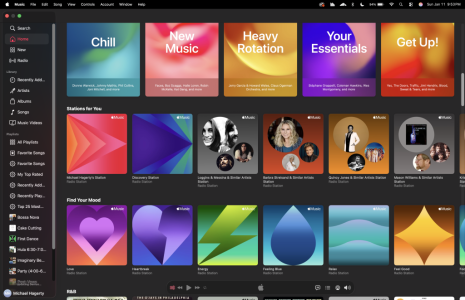
Most people don't make and freshen playlists. There are dozens, if not hundreds, of playlists and stations, some of which are curated, others which are assembled based upon your listening history. This is just a small sample from my Apple Music homepage:

Screenshot 2026-01-11 at 9.53.51 PM.png
 
I agree with @michael hagerty wholeheartedly!

I find San Francisco's FMs to be largely a waste of time. I've heard the occasional song I like on KISQ, but the processing is so bad, I can't stand it for more than a few seconds. With all that Voltaire junk, it sounds like a low-bitrate MP3 stream from the late 90s!

KCBS (AM and FM) are pretty much the only things I can stand.

When I was growing up back in the late 90s, I always thought the processing on the AMs was quite decent, especially KABL and KFRC. I didn't listen to FM much back then, but I sampled a few: Froggy 92.9 (the only one of the lot that still exists in relatively the same format (country)), Young Country KYCY 93.3 (the former KYA-FM; It's Spanish music KRZZ now), KFRC 99.7 (then the 610 simulcast, now KMVQ with a CHR format), and KDFC (when they were a commercial station on 102.1, now classic hip-hop KRBQ). As far as I can remember, they all sounded decent and good at the time. Can't say that about any of them nowadays, however.

The state of affairs in a top ten market such as this is deplorable.

c
 
I find San Francisco's FMs to be largely a waste of time. I've heard the occasional song I like on KISQ, but the processing is so bad, I can't stand it for more than a few seconds. With all that Voltaire junk, it sounds like a low-bitrate MP3 stream from the late 90s!
There is no need to "set it to 11" with the Voltair. It should be used judiciously to allow reasonable and frequent broadcasts of the Nielsen data burst... particularly with the new "three incidents in three separate minutes" Nielsen rule.
When I was growing up back in the late 90s, I always thought the processing on the AMs was quite decent, especially KABL and KFRC. I didn't listen to FM much back then, but I sampled a few: Froggy 92.9 (the only one of the lot that still exists in relatively the same format (country)), Young Country KYCY 93.3 (the former KYA-FM; It's Spanish music KRZZ now), KFRC 99.7 (then the 610 simulcast, now KMVQ with a CHR format), and KDFC (when they were a commercial station on 102.1, now classic hip-hop KRBQ). As far as I can remember, they all sounded decent and good at the time. Can't say that about any of them nowadays, however.
Between the Voltair and excessive limiting, expansion and compression, audio does sound awful.
The state of affairs in a top ten market such as this is deplorable.
Add in the belief that those twice-an-hour 8 minute stopsets are better than "the old ways" and you have enormously destructive practices.

(Note: I believe that the four stops of, at most 3 minutes each in the middle of each quarter hour promotes longer listening spans. Those 8 or 9 minute stops drive listeners away and, most important, don't invite them back. Small gains in single incident listening are not better than extended listening over longer periods.=
 
Add in the belief that those twice-an-hour 8 minute stopsets are better than "the old ways" and you have enormously destructive practices.

As I've often said, there's nobody in programming who likes commercials. The scheduling of four breaks an hour you advocate dates back to the 70s and 80s. Music stations moved to three breaks an hour in the 90s. They settled into two breaks with the advent of PPM about 20 years ago.

There had been discussion among consultants that they might review that practice with Nielsen's adoption of the 3 minute rule, but I haven't seen any data on that.

In the meantime, I haven't seen a major improvement in non-com ratings in reaction to the scheduling of commercial breaks. If listeners are seeking to get away from long commercial breaks, I recommend trying non-commercial radio. No long breaks there.
 
Have you compared the audio quality of the air signal to the stream? That would be a better comparison.
I actually have.

The stream isn't too great either, but it's infinitely more listenable than the on air signal, likely due to the absence of a cranked up voltaire, among other things.

c
 
I actually have.

The stream isn't too great either, but it's infinitely more listenable than the on air signal, likely due to the absence of a cranked up voltaire, among other things.

When you do that, it's more of an apples to apples comparison. As I said, broadcasting is analog, streaming is digital. So of course broadcasting doesn't sound as good as streaming. That should be obvious!

However, stations encode their streams with Nielsen, so I imagine Voltaire is there as well, for the same reason. If it's not, that may also be a factor in why radio streaming is under-reported by Nielsen.
 
As I've often said, there's nobody in programming who likes commercials. The scheduling of four breaks an hour you advocate dates back to the 70s and 80s. Music stations moved to three breaks an hour in the 90s. They settled into two breaks with the advent of PPM about 20 years ago.
I know of very few music stations that ran 3 stops, although some would try to fill 2 stops first, then 3 and, finally, 4 only if fully sold. I had one of the few major market FMs doing a fixed three stop hour which allowed us a sweep from about :50 to :20 in the next hour. When deciding on that, we examined major stations in many markets to see when they were stopping down and found nearly none with just 3 stopsets.

The 4 stops in the middle of each quarter hour came out of the "standardization" of Arbitron in the early 70's. There was the exception of Beautiful Music which nearly always stopped at :00, :15, :30 and :45. Prior to that, with Pulse and Hooper being memory related vs. a diary, we saw more 2 and 4 spot stopsets more often.
There had been discussion among consultants that they might review that practice with Nielsen's adoption of the 3 minute rule, but I haven't seen any data on that.
There is still a fear of blocking a listener from transitioning into another quarter hour. To me, that is very short-sighted as programmers are counting minutes instead of hours of longer term listening.
In the meantime, I haven't seen a major improvement in non-com ratings in reaction to the scheduling of commercial breaks. If listeners are seeking to get away from long commercial breaks, I recommend trying non-commercial radio. No long breaks there.
The problem is that most non-com radio is block programmed. That often impedes long term listening; people listen for shows, not for the station.
 
Last edited:
When you do that, it's more of an apples to apples comparison. As I said, broadcasting is analog, streaming is digital. So of course broadcasting doesn't sound as good as streaming.
Depends on the bitrate and audio codec used.
That should be obvious!

However, stations encode their streams with Nielsen, so I imagine Voltaire is there as well, for the same reason.
Not all station in PPM markets use the Voltair.

I am not aware of any station using Voltair on their stream. I checked with several corporate engineers or engineering consultants, in fact. Usually the Voltair is inserted into a station's audio processor via a post-AGC output which is returned to the processor for final processing.

And I understand that Telos has no more VoltAir units available so when the existing units fail that is the end. Nielsen's enhanced CBET sort of obviates the need for an additional device in the audio chain.


That article, from a decade ago, describes how Nielsen has enhanced the encoding, making the Voltair unnecessary.
If it's not, that may also be a factor in why radio streaming is under-reported by Nielsen.
The main factor in under-reporting of streams in Nielsen is that streams are more often than not listened to on earbuds. Nielsen does not do an adequate job of measuring that listening.


Back
Top Bottom