• Get involved.
    We want your input!
    Apply for Membership and join the conversations about everything related to broadcasting.

    After we receive your registration, a moderator will review it. After your registration is approved, you will be permitted to post.
    If you use a disposable or false email address, your registration will be rejected.

    After your membership is approved, please take a minute to tell us a little bit about yourself.
    https://www.radiodiscussions.com/forums/introduce-yourself.1088/

    Thanks in advance and have fun!
    RadioDiscussions Administrators

Goodbye AM & FM & HD

But I've noticed among my friends and acquaintances that actual network TV watching is less of a thing than it was in the 90s and 2000s.
Agree. About the only thing I watch on OTA TV any longer are live sports (although my sport of choice, hockey, is streamed). I don't watch any scripted TV shows (not from this century anyway).
Obviously, we're both going on what we observe, and what we've read. I just don't see OTA radio and TV in any form growing from here on out.
Again, we agree. And I would put the blame squarely upon the junky shows that seem to proliferate season after season.
But that was in 1996. Long time ago...
At my age everything was a long time ago. :oops:
 
With respect with Mr. Simington, he was speaking at the National Association of Farm Broadcasting. He was delivering a speech that he thought would resonate well with that particular crowd. While AM may have a future of some sort with farmers, what happens when the older farmers who still regularly listen to those AM stations for the farm and ag reports retire, and the younger ones who've never heard of "AM Radio" take over and realize they can instantly get weather forecasts, commodity prices, reports and all other types of information almost instantly, whenever they want it, from any smart phone?

I was told many years ago (Mid 00s) by a major farm advertiser that farmers didn't need farm broadcasting because they got all their market info on their laptops.
 
For those interested in listening to music through their TV, Music Choice is already available through many cable and dish services (Comcast, Cox, Spectrum, DirecTV, etc.). Music Choice in my area offers 50 channels of everything imaginable, and nearly any format. They even have a "Sounds of the Seasons" channel that changes up their offerings depending on the upcoming holiday. For those who just want to listen to the music aside from their TV, as with many other media companies and broadcast stations - There's an app for that.
We listened to “Sounds of the Seasons” at a Wahlburger’s last night in Cleveland before going to the Cavaliers’ game.
 
With respect with Mr. Simington, he was speaking at the National Association of Farm Broadcasting. He was delivering a speech that he thought would resonate well with that particular crowd. While AM may have a future of some sort with farmers, what happens when the older farmers who still regularly listen to those AM stations for the farm and ag reports retire, and the younger ones who've never heard of "AM Radio" take over and realize they can instantly get weather forecasts, commodity prices, reports and all other types of information almost instantly, whenever they want it, from any smart phone?
Have you ever tried to use a smart phone in a rural area not near a major highway or Interstate when you are on the tractor out on "the South 40"?

Yes, the farmhouse may have Internet, but out in the fields or pastures, many if not most farmers don't have a cheap and easy to get signal. Yes, there are more costly alternatives and some farmers even install highly boosted wifi, but AM radio is still a very valuable asset to them.
 
And, on their smartphone and on one of the many screens in the cab of their tractor. It's very cool.
In places where there is a cellular signal. A huge percentage of farms and ranches, particularly in the Midwest and Rocky Mountain zones, have none.

Wealthier farmers can use satellite delivery services like the one you described as having at your Virginia fortress, but that is not always financially possible.

And the local area AMs like WNAX and their low-band friends have people on the air talking about their area, local weather, local commodities prices and the like.
 
Every cluster I've ever visited in a PPM market has had a separate set of encoders for the stream.


Is that why the spot load is different OTA than the stream?
Is that why the stream has completely different processing than on-air for sound?
 
Last edited:
Is that why the stream has completely different processing than on-air for sound?
No, the processing is different because the stream is digital. A major purpose of processing on AM and FM analog signals is to prevent overmodulation (which is prohibited) as well as to sound as loud as possible to overcome things like AM noise and in-vehicle road and motor noise.
 
Every cluster I've ever visited in a PPM market has had a separate set of encoders for the stream.

And I've yet to find any station that geofences any syndicated programming other than sports play-by-play.
I'm familiar with a number of syndicated morning shows that have "suggested" streaming restrictions. However, I don't think any of the syndicators enforces that to any extent.
 
I'll bet there are a lot of folks on this very site using Cricket, and Consumer Cellular senior plans. I hear they especially appreciate the larger buttons and convenient flip phone. Many probably wish for their smartphones to have a rotary dial.

All of the major carriers you can still get flip phones on. No its not a tun of options but online is the best way.
 
Speaking of farm news, a couple a.m.s ago I heard the "PNW Ag Network" on KIT, Yakima (1280), with a big block of regionally based, agricultural programming. It was pretty cool to hear.

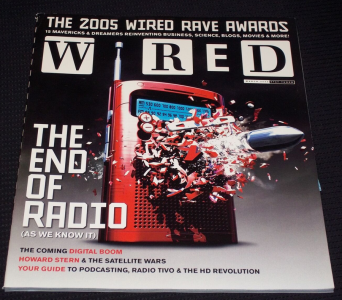
And Mr. Eduardo, I was laughing with you, not at you, with that Wired cover. Yep, they were predicting the demise of OTA radio when satellite hit. It's still here.
 
Yep, they were predicting the demise of OTA radio when satellite hit. It's still here.
It seems every time a new technology comes along there are industry "experts" jumping in to predict how it will negatively impact existing technologies. Most of the time they are only partially correct and frequently they miss the mark completely. New technology frequently brings along significant problems of its own.

In my lifetime, and in the communications industry, the smartphone is probably the largest disrupter. Started out as a phone (with a host of issues), then incorporated camera capabilities (which is a major selling point now even though it's still called a phone), then radio with it's streaming capabilites. The list goes on. Smartphones still have a whole host of issues however.
 
....then incorporated camera capabilities (which is a major selling point now even though it's still called a phone), then radio with it's streaming capabilites.

But you're right that the main marketing point still seems to be the camera, or at least it is in the battle between the iPhone and the others. None of the phone makers ever talk about music or radio, even though Apple owns its own streaming service.
 
But you're right that the main marketing point still seems to be the camera, or at least it is in the battle between the iPhone and the others. None of the phone makers ever talk about music or radio, even though Apple owns its own streaming service.

I was a legacy AT&T/Cingular customer when the iPhone was the only smartphone option we had. Plus, I was an early smartphone adopter. Having roughly 14 years in the Apple ecosystem makes leaving it difficult. Also, as a software developer, developing apps for the iPhone is a lot easier even though you have to use Apple's proprietary system because Apple generally forces you to update until your device hits planned obsolescence. Android has always been a moving target.

I wonder how many people actually move between the two platforms? The actual moving of apps and configurations isn’t difficult, but having to buy new paid apps is a pain. Plus, in app purchases don’t generally carry across ecosystems. I know a couple of antivax/antimask individuals who ditched their iPhones during COVID because they didn’t want to update iOS versions for fear of being tracked. That was some strange thinking given how much tracking already occurs, but most of those people don’t understand basic logic. I can’t imagine too many other people switching between the two systems after two or three years in one.
 
I was a legacy AT&T/Cingular customer when the iPhone was the only smartphone option we had. Plus, I was an early smartphone adopter. Having roughly 14 years in the Apple ecosystem makes leaving it difficult. Also, as a software developer, developing apps for the iPhone is a lot easier even though you have to use Apple's proprietary system because Apple generally forces you to update until your device hits planned obsolescence. Android has always been a moving target.

I wonder how many people actually move between the two platforms? The actual moving of apps and configurations isn’t difficult, but having to buy new paid apps is a pain. Plus, in app purchases don’t generally carry across ecosystems. I know a couple of antivax/antimask individuals who ditched their iPhones during COVID because they didn’t want to update iOS versions for fear of being tracked. That was some strange thinking given how much tracking already occurs, but most of those people don’t understand basic logic. I can’t imagine too many other people switching between the two systems after two or three years in one.
I had 3 iPhones through work, and then bought an Android (Samsung). My wife also got a Samsung (one model down). Eventually, she broke her phone, and we were out of contract with U.S. Cellular (great local coverage, completely sucked everywhere else). I got an iPhone 12, she got another Samsung.
 
Status
This thread has been closed due to inactivity. You can create a new thread to discuss this topic.


Back
Top Bottom