I have been reading that HD power is only 1-3% on their transmitted power, like 100 KW would run 1-3 KW HD. Is that true? I also read some stations have received permission from the FCC to run up to 10%. I live on the Northern Oregon Coast where I get much of the Puget Sound FM radio. The transmitters on Cougar do the best here. KPLZ 101.5 is almost local here at 133 miles, as well as KJEB-95.7. Both always lock into HD, even when condition are poor. KPLZ locks in immediately and KJEB a hair slower. All sub channels are good. Are these two stations only running 1-3 KW in HD? If they are, that is amazing as they are rock solid. 105.3 also locks in fast.

-
Get involved.
We want your input!
Apply for Membership and join the conversations about everything related to broadcasting.
After we receive your registration, a moderator will review it. After your registration is approved, you will be permitted to post.
If you use a disposable or false email address, your registration will be rejected.
After your membership is approved, please take a minute to tell us a little bit about yourself.
https://www.radiodiscussions.com/forums/introduce-yourself.1088/
Thanks in advance and have fun!
RadioDiscussions Administrators
You are using an out of date browser. It may not display this or other websites correctly.
You should upgrade or use an alternative browser.
You should upgrade or use an alternative browser.
HD Power of Seattle stations
- Thread starter MWDXER
- Start date
You touched on something that has fascinated me in engineering and is something I am a bit passionate about because many people misunderstand it — and assume listeners don’t care. Also the radio nerd in me remembers a broadcast on KBKS around 2002, when they became the first station to broadcast in HD in the Seattle, where they talked about it all day, created a big promotion with Car Toys, gave away HD radios etcetc — and got my fresh-into-radio mind thinking “I wonder what it would take to get my little small market station I work at to have something that sounds that clear”… particularly I remember them trying the explain the basics of it on-air — and now realizing that whoever the engineer was at the time probably had multiple transmitters, high level combining, and that it was quite the technical feat. (Behold the power of radio)
You are correct in that the digital subcarriers are injected at a much lower level than analog. The base injection level is -20 db,
or 1% of TPO.
I want to say it was around 2013 the FCC authorized higher levels of -14 (6%) and -10 (10%) provided there were no interference complaints from other stations.
In the Midwest, where it is flat with minimal multipath, a -20 injection level can generally match the 60db protected contour (even though -18 is probably a better idea if you care about digital coverage) — but in areas like Western Washington with plenty of hills and multipath, particularly at a sub-prime site, -20 really doesn’t cut it and reliable digital reception starts to degrade pretty heavily once you get outside of the 70db city grade contour, and even inside it if you drive around a hill that shadows the station you are trying to receive.
This is particularly nasty if your digital and analog audio processing are not perfectly matched, and especially if you do not time-lock your analog and digital signals together (the CPU power required to create the IP stream takes about 8-10 seconds before it can go on air, so you need to buffer the analog signal and match it to the digital signal at the tx site) — which if done incorrectly creates a situation where when driving in and out of digital range the audio gets louder/quieter/more and less compressed, or even worse, jumps back and fourth so you gain and lose words, or even entire verses of music. Nautel has some very handy software built into their transmitters for this, and Innovonics makes a box that takes care of this as well — but you’d be amazed at how many broadcasters either have no idea or don’t care… that’s even before we get into HD2/3/4 where it’s “all or nothing” — and the amount of “nothing” (not counting the programming on some of these) makes them unlistenable.
Remember, the listeners have no idea about this stuff other than “I bought a new truck and your station sounds like garbage!!” — or more often “screw local radio the reception sucks now more than ever” — so bad HD engineering has been a peeve of mine since I was able to play with my first digital transmitter in 2004. It just takes one station that sounds like garbage for a listener to apply that to ALL stations in their mind — even if you are in Eastern Washington or some other desert market (or a certain Class A on this side of the mountains), there is no excuse to have absolutely no time-sync between your analog and digital signals… as I travel it amazes me how many stations I hit upon with audio constantly adding and subtracting 8 seconds as the radio flips between analog and digital. It’s unlistenable — the average listener doesn’t even know that a radio is analog or digital, let alone to know how to get into the menus in their fancy new vehicle to turn off the digital for that one station that does not care.
For example — say your station needs to output 8kw into the antenna from a site that suffers from a good bit of multipath, and has a 10kw transmitter. In my case I ended pushing ours to its limit to pull a -14 signal (~420 watts digital TPO) and get solid digital coverage inside the 70db contour and acceptable coverage into the 60. Ideally we would have went -10 (~800 digital TPO) — but that leads to the fact that it just isn’t that simple as taking your 8kw analog output and adding 800 watts of digital power into it to get a -10 signal from your 10kw transmitter…
Due to the way the analog and digital signals are combined in the transmitter, as well as needing to compensate for different modulation levels, a transmitter with 10kw on the name plate is sold assuming 1% digital injection — a 10kw transmitter actually maxes out at 8kw with -14, and around 4.5kw at -10 (this varies by manufacturer) — and the efficiency goes waaaay down, producing a ton of heat. I’m sure there are some very well-qualified engineers here who can explain this a lot better than me, but in my self-learning, the amount of excess heat I’ve had to deal with running at -14 as well as general transmitter stress and power supply/PA wear has been more than you would expect just to get an extra ~300 watts of digital signal out rather than just the basic 80.
In other words — I would bet that to get truly decent -14 (or -12 or -10) digital coverage around here, most stations would need to upgrade their transmitter (eg. a 10kw tx to get a -10 digital signal would need to be upgraded to a 15kw model, or even 20kw if you wanted to give it a little bit of headroom) — or the antenna needs to be upgraded to at least double the number of bays to get the TPO level down to the 4-5kw range where the transmitter can output said signal.
Either of those options are *expensive* — and unless someone had the forethought (and willingness, and budget) to buy a nice digital-capable transmitter about double the nameplate power that they need for analog, I don’t imagine there are too many stations that can do this, particularly outside of the large markets.
As for around here? I’m not sure who is doing -14 or -10, except for the station I managed for years — and even that was simply by luck since the required TPO was (is) 8kw… my current station has a very nice 10kw transmitter that can easily push out higher injection levels at lower outputs — but uses every bit of that 10kw to make power… so it’s -20 or nothing.
I believe I read an article about KUOW doing higher injection levels… I’m not sure if the other stations around Seattle have upgraded to higher levels or not. Living in the fringe of Seattle coverage and having an idea of what propagation from the various sites around here are, I feel like KIRO might possibly have upgraded as their digital signal seems to extend quite nicely past their -60 — KNUC also seems to do quite well compared to other Tiger stations.
Haha I realized I just vomited up a bit of a mini-rant… but I do think it’d be cool if anyone has some insight about what injection levels or digital transmitters are being used around here in early 2023 lol
You are correct in that the digital subcarriers are injected at a much lower level than analog. The base injection level is -20 db,
or 1% of TPO.
I want to say it was around 2013 the FCC authorized higher levels of -14 (6%) and -10 (10%) provided there were no interference complaints from other stations.
In the Midwest, where it is flat with minimal multipath, a -20 injection level can generally match the 60db protected contour (even though -18 is probably a better idea if you care about digital coverage) — but in areas like Western Washington with plenty of hills and multipath, particularly at a sub-prime site, -20 really doesn’t cut it and reliable digital reception starts to degrade pretty heavily once you get outside of the 70db city grade contour, and even inside it if you drive around a hill that shadows the station you are trying to receive.
This is particularly nasty if your digital and analog audio processing are not perfectly matched, and especially if you do not time-lock your analog and digital signals together (the CPU power required to create the IP stream takes about 8-10 seconds before it can go on air, so you need to buffer the analog signal and match it to the digital signal at the tx site) — which if done incorrectly creates a situation where when driving in and out of digital range the audio gets louder/quieter/more and less compressed, or even worse, jumps back and fourth so you gain and lose words, or even entire verses of music. Nautel has some very handy software built into their transmitters for this, and Innovonics makes a box that takes care of this as well — but you’d be amazed at how many broadcasters either have no idea or don’t care… that’s even before we get into HD2/3/4 where it’s “all or nothing” — and the amount of “nothing” (not counting the programming on some of these) makes them unlistenable.
Remember, the listeners have no idea about this stuff other than “I bought a new truck and your station sounds like garbage!!” — or more often “screw local radio the reception sucks now more than ever” — so bad HD engineering has been a peeve of mine since I was able to play with my first digital transmitter in 2004. It just takes one station that sounds like garbage for a listener to apply that to ALL stations in their mind — even if you are in Eastern Washington or some other desert market (or a certain Class A on this side of the mountains), there is no excuse to have absolutely no time-sync between your analog and digital signals… as I travel it amazes me how many stations I hit upon with audio constantly adding and subtracting 8 seconds as the radio flips between analog and digital. It’s unlistenable — the average listener doesn’t even know that a radio is analog or digital, let alone to know how to get into the menus in their fancy new vehicle to turn off the digital for that one station that does not care.
For example — say your station needs to output 8kw into the antenna from a site that suffers from a good bit of multipath, and has a 10kw transmitter. In my case I ended pushing ours to its limit to pull a -14 signal (~420 watts digital TPO) and get solid digital coverage inside the 70db contour and acceptable coverage into the 60. Ideally we would have went -10 (~800 digital TPO) — but that leads to the fact that it just isn’t that simple as taking your 8kw analog output and adding 800 watts of digital power into it to get a -10 signal from your 10kw transmitter…
Due to the way the analog and digital signals are combined in the transmitter, as well as needing to compensate for different modulation levels, a transmitter with 10kw on the name plate is sold assuming 1% digital injection — a 10kw transmitter actually maxes out at 8kw with -14, and around 4.5kw at -10 (this varies by manufacturer) — and the efficiency goes waaaay down, producing a ton of heat. I’m sure there are some very well-qualified engineers here who can explain this a lot better than me, but in my self-learning, the amount of excess heat I’ve had to deal with running at -14 as well as general transmitter stress and power supply/PA wear has been more than you would expect just to get an extra ~300 watts of digital signal out rather than just the basic 80.
In other words — I would bet that to get truly decent -14 (or -12 or -10) digital coverage around here, most stations would need to upgrade their transmitter (eg. a 10kw tx to get a -10 digital signal would need to be upgraded to a 15kw model, or even 20kw if you wanted to give it a little bit of headroom) — or the antenna needs to be upgraded to at least double the number of bays to get the TPO level down to the 4-5kw range where the transmitter can output said signal.
Either of those options are *expensive* — and unless someone had the forethought (and willingness, and budget) to buy a nice digital-capable transmitter about double the nameplate power that they need for analog, I don’t imagine there are too many stations that can do this, particularly outside of the large markets.
As for around here? I’m not sure who is doing -14 or -10, except for the station I managed for years — and even that was simply by luck since the required TPO was (is) 8kw… my current station has a very nice 10kw transmitter that can easily push out higher injection levels at lower outputs — but uses every bit of that 10kw to make power… so it’s -20 or nothing.
I believe I read an article about KUOW doing higher injection levels… I’m not sure if the other stations around Seattle have upgraded to higher levels or not. Living in the fringe of Seattle coverage and having an idea of what propagation from the various sites around here are, I feel like KIRO might possibly have upgraded as their digital signal seems to extend quite nicely past their -60 — KNUC also seems to do quite well compared to other Tiger stations.
Haha I realized I just vomited up a bit of a mini-rant… but I do think it’d be cool if anyone has some insight about what injection levels or digital transmitters are being used around here in early 2023 lol
Last edited:

At the end of the day I'm not sure what's worse; high level combining or running separate antennas. There are just so many variables with both methods to potentially degrade the HD carrier. At the time, over twenty years ago now, that was pretty much the only choices. In modern times, you just buy a (preferably solid state) transmitter with enough bandwidth and headroom to do analog and HD out of the same box. It's still damned expensive though, and your transmit antenna better be up to the task.You touched on something that has fascinated me in engineering and is something I am a bit passionate about because many people misunderstand it — and assume listeners don’t care. Also the radio nerd in me remembers a broadcast on KBKS around 2002, when they became the first station to broadcast in HD in the Seattle, where they talked about it all day, created a big promotion with Car Toys, gave away HD radios etcetc — and got my fresh-into-radio mind thinking “I wonder what it would take to get my little small market station I work at to have something that sounds that clear”… particularly I remember them trying the explain the basics of it on-air — and now realizing that whoever the engineer was at the time probably had multiple transmitters, high level combining, and that it was quite the technical feat. (Behold the power of radio)
But, let's fast-forward to modern times: Concerns about the economic future and lack of any perceivable revenue out of doing hybrid FM, means even larger companies when faced with transmitter replacement today, would probably choose to pass on HD. The state of advertising and more competition means that HD for smaller market stations is a complete non-starter from a financial perspective. Just as it's always been for HD; the juice may not be worth the squeeze.
Public stations have been able to benefit from running ancillary HD channels the most, because of their donation-funding model. HD makes perfect sense for them. I think the final grade is: Not so much for commercial stations.I believe I read an article about KUOW doing higher injection levels… I’m not sure if the other stations around Seattle have upgraded to higher levels or not. Living in the fringe of Seattle coverage and having an idea of what propagation from the various sites around here are, I feel like KIRO might possibly have upgraded as their digital signal seems to extend quite nicely past their -60 — KNUC also seems to do quite well compared to other Tiger stations.
What, the old Collins combined rigs have finally been sent to their happy hunting ground??Most of this information is in the public domain if you dig. KIRO-FM uses a Nautel GV30, -14 for the HD level and yes that maxes out the GV30 transmitter using a 4 bay antenna.
103.7 is clearly running at -20 (or worse.) I try to listen to the HD2 (The Mountain) when I am in town, but it is pretty much unlistenable except in the most favored areas. Not sure why they even bother at this point- the only two commercial use cases I can see in 2023 for HD2+ are to feed a translator or to clear secondary network programming.
I installed those old Collins girls at WTM. First FM on the air from that site via a Shively 4 bay antenna. Remember clearly being up that tower at 10PM at night in horizontal snow tweaking the fine matcher to the antenna. That was the night we put WTM on the air, and shut down the View Park site for the last time.Yes,Still have one as a backup at WTM and the one at Cougar has been replaced with a 10KW flex so we can do HD from Cougar now when running from there. Cougar HD is also -14.
“The Peak” 102.7 in Vancouver BC tried to transition to a HD-only format when the main signal flipped to something else a few months ago. They maintained live and local programming on the HD signal to see if they could maintain an audience on HD. Long story short, it didn’t work out. Not sure if that’s related to specifically to signal issues, lack of HD radios, or everything in between.
My initial reaction was going to be that people don't use the seek function in their cars. My mom's car has HD, but as far as I know, she's never explored the HD channels in this market. When we were in Seattle, we listened to the HDs because our seek button found them. Then again though, how do people find new stations when a translator signs on? I have noticed too that you can't seem to find tabletop HD radios anymore. It also seems like people stream the analog signals they're familiar with, not the HD stations. Why don't stations promote their HD and online offerings? Look at what iHeart is doing with 93.3. Still, almost a year later, I'm still hearing promos for Sports Radio 93.3 KJR across the cluster. Why are they not just as heavily promoting that you can still find the hits and hip-hop you're looking for on 93.3 HD2 or the iHeart Radio app?
As far as power levels and whatnot, I have no idea, but I can actually see areas of Seattle where HD is an improvement over analog. Two examples would be downtown Everett and west Bellevue just as you get across 520. The HD only dropped briefly once approaching U.S. 2 in Everett, and it was back pretty quickly. This was 95.7 HD2. I've also heard 93.3 in Bellevue, and that's a solid HD lock, even when the analog signal is multipathed. Outside of those situations though, which are very market specific, I don't understand why stations run HD with no subchannels. It seems like it would be quite expensive, and I at least find HD not as pleasant to listen to.
As far as power levels and whatnot, I have no idea, but I can actually see areas of Seattle where HD is an improvement over analog. Two examples would be downtown Everett and west Bellevue just as you get across 520. The HD only dropped briefly once approaching U.S. 2 in Everett, and it was back pretty quickly. This was 95.7 HD2. I've also heard 93.3 in Bellevue, and that's a solid HD lock, even when the analog signal is multipathed. Outside of those situations though, which are very market specific, I don't understand why stations run HD with no subchannels. It seems like it would be quite expensive, and I at least find HD not as pleasant to listen to.
Interesting that you found the HD signals better to listen to in some areas. It seems like HD would very much be subject to the cliff effect, where you’ve either got all of the signal or none of the signal. I would think that areas that are typically rough for analog would result in no HD reception at all.My initial reaction was going to be that people don't use the seek function in their cars. My mom's car has HD, but as far as I know, she's never explored the HD channels in this market. When we were in Seattle, we listened to the HDs because our seek button found them. Then again though, how do people find new stations when a translator signs on? I have noticed too that you can't seem to find tabletop HD radios anymore. It also seems like people stream the analog signals they're familiar with, not the HD stations. Why don't stations promote their HD and online offerings? Look at what iHeart is doing with 93.3. Still, almost a year later, I'm still hearing promos for Sports Radio 93.3 KJR across the cluster. Why are they not just as heavily promoting that you can still find the hits and hip-hop you're looking for on 93.3 HD2 or the iHeart Radio app?
As far as power levels and whatnot, I have no idea, but I can actually see areas of Seattle where HD is an improvement over analog. Two examples would be downtown Everett and west Bellevue just as you get across 520. The HD only dropped briefly once approaching U.S. 2 in Everett, and it was back pretty quickly. This was 95.7 HD2. I've also heard 93.3 in Bellevue, and that's a solid HD lock, even when the analog signal is multipathed. Outside of those situations though, which are very market specific, I don't understand why stations run HD with no subchannels. It seems like it would be quite expensive, and I at least find HD not as pleasant to listen to.

It really does depend on where you're at. KUOW 94.9 always locks in HD at the I-90 Ryegrass Rest Area (Eastbound) even over KIOK Analog. I've had KPND 95.3 Spokane lock in HD over KXLE at the same location. No analog of either KUOW or KPND received.Interesting that you found the HD signals better to listen to in some areas. It seems like HD would very much be subject to the cliff effect, where you’ve either got all of the signal or none of the signal. I would think that areas that are typically rough for analog would result in no HD reception at all.
I get that here with KJR-93.3. Most of the time when I point the yagi at Cougar I receive KJR HD over-powering local KEUB Seaside(Analog). As I mentioned most of everything from Cougar comes in well into HD. KPLZ & KJEB are the strongest followed by KCMS-105.3.It really does depend on where you're at. KUOW 94.9 always locks in HD at the I-90 Ryegrass Rest Area (Eastbound) even over KIOK Analog. I've had KPND 95.3 Spokane lock in HD over KXLE at the same location. No analog of either KUOW or KPND received.
Thanks to everyone for the replies. I wish the HD power was published like on the FCC site. A engineer in the Birmingham AL area tells me most FMs there run 10% in that market.
No HD here in Clatsop County (Astoria). The nearest is 105.5 Longview or a couple in the Aberdeen area. None of the stations here do not have the money. Even the NPR translators/Class A have RDS, but no HD.

MWDXER-
FM band stations are permitted to broadcast digital power at -14 dB below carrier level, and upon FCC approval at -10 dB below carrier level. -20 dB is one percent of power, -14 dB is just under four percent of power, and -10 dB is ten percent of power.
An FM station broadcasting a digital signal requires a transmitting system that uses a form of amplifier that is different from the amplifier used for an analog FM signal. Generally speaking, a digital radio transmitter uses more electrical power and produces more heat than an analog transmitter operating at the same power output. These logistical aspects have to be considered within the context of resources available to a broadcast station.

 en.wikipedia.org
Note that Wikipedia is crowdsourced information. On topics with a small number of writers and editors the probability of opinion and factual errors is higher.
FM band stations are permitted to broadcast digital power at -14 dB below carrier level, and upon FCC approval at -10 dB below carrier level. -20 dB is one percent of power, -14 dB is just under four percent of power, and -10 dB is ten percent of power.
An FM station broadcasting a digital signal requires a transmitting system that uses a form of amplifier that is different from the amplifier used for an analog FM signal. Generally speaking, a digital radio transmitter uses more electrical power and produces more heat than an analog transmitter operating at the same power output. These logistical aspects have to be considered within the context of resources available to a broadcast station.
HD Radio - Wikipedia
Note that Wikipedia is crowdsourced information. On topics with a small number of writers and editors the probability of opinion and factual errors is higher.
Last edited:
There are certainly also examples of that. Downtown Edmonds is a good example. As far as I am aware, no Seattle HD makes it there.Interesting that you found the HD signals better to listen to in some areas. It seems like HD would very much be subject to the cliff effect, where you’ve either got all of the signal or none of the signal. I would think that areas that are typically rough for analog would result in no HD reception at all.
KHTP has the most out of sync HD in the market. I live in the north end closer to the sound and most stations will switch between the regular feed and HD seamlessly. KHTP however sounds like my walkman skipping after I ran over a pothole. There's at least a full second and a half difference and it's an easy tune out for me when I'm in those spotty areas. Even KPLZ who was anti-HD for years has it figured out better than KHTP. If I was Eric Powers I would be on the phone to the 5 engineers who still work for Audacy. Pretty embarrassing.
If you go to the coast or up on the Astoria column, you may be able to receive KQOC 88.1 HD signal. In the Aberdeen area, only KSWW 102.1 transmits HD. There are a couple in the Centralia-Chehalis area as well - KSWS 88.9 and KMNT 104.3.I get that here with KJR-93.3. Most of the time when I point the yagi at Cougar I receive KJR HD over-powering local KEUB Seaside(Analog). As I mentioned most of everything from Cougar comes in well into HD. KPLZ & KJEB are the strongest followed by KCMS-105.3.
Thanks to everyone for the replies. I wish the HD power was published like on the FCC site. A engineer in the Birmingham AL area tells me most FMs there run 10% in that market.
No HD here in Clatsop County (Astoria). The nearest is 105.5 Longview or a couple in the Aberdeen area. None of the stations here do not have the money. Even the NPR translators/Class A have RDS, but no HD.
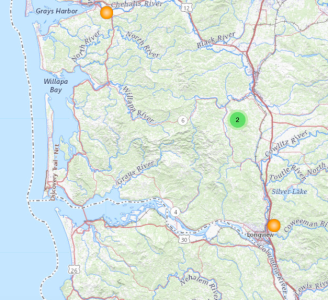
Below is a map (Taken from the map I created https://hddirectory.neocities.org/map/hd_map)
Kelly, I don't disagree with you in most cases, but down here on the coast, we have 3 FM translators, so the HD channels allow us to have 3 more "stations" on the FM band. I know that is not so common in the major markets due to lack of FM translators available.At the end of the day I'm not sure what's worse; high level combining or running separate antennas. There are just so many variables with both methods to potentially degrade the HD carrier. At the time, over twenty years ago now, that was pretty much the only choices. In modern times, you just buy a (preferably solid state) transmitter with enough bandwidth and headroom to do analog and HD out of the same box. It's still damned expensive though, and your transmit antenna better be up to the task.
But, let's fast-forward to modern times: Concerns about the economic future and lack of any perceivable revenue out of doing hybrid FM, means even larger companies when faced with transmitter replacement today, would probably choose to pass on HD. The state of advertising and more competition means that HD for smaller market stations is a complete non-starter from a financial perspective. Just as it's always been for HD; the juice may not be worth the squeeze.
Public stations have been able to benefit from running ancillary HD channels the most, because of their donation-funding model. HD makes perfect sense for them. I think the final grade is: Not so much for commercial stations.
That is interesting as I get several Puget Sound/Seattle stations in HD 130 miles away.There are certainly also examples of that. Downtown Edmonds is a good example. As far as I am aware, no Seattle HD makes it there.
KQOC 88.1 is pretty strong here in HD. The best from Lincoln County here, near Warrenton.If you go to the coast or up on the Astoria column, you may be able to receive KQOC 88.1 HD signal. In the Aberdeen area, only KSWW 102.1 transmits HD. There are a couple in the Centralia-Chehalis area as well - KSWS 88.9 and KMNT 104.3.
Below is a map (Taken from the map I created https://hddirectory.neocities.org/map/hd_map)
View attachment 4186
- Status
- This thread has been closed due to inactivity. You can create a new thread to discuss this topic.