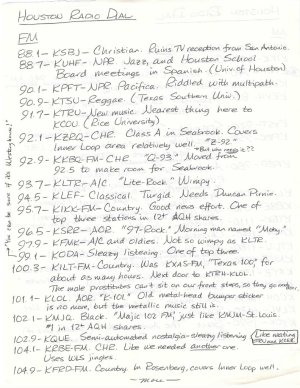
For a 27-year-old, using a term like "turgid" is admirable/enviable/unusual.
I should also explain the Duncan Pirnie reference. The year before this, I spent a brief, unhappy summer in the Hudson Valley, in Beacon, New York. Because Mount Beacon blocked NYC FM signals from Beacon, the local cable company offered an FM service, which brought in many of the New York stations up to 104 kHz. Above that frequency were local WSPK at 104.7 (where I worked) and audio and various tones associated with pay-TV services. So many of the New York FMs were available to me. Listening to WQXR-FM was a delight. Duncan Pirnie was the chief announcer and worked afternoon drive, conveying both seriousness and the ability not to take himself too seriously. It was a breath of fresh air compared to many classical stations at the time, many in the noncommercial band, that were ultra-stuffy.
In the rock genre, WNEW-FM was another station that captured my fancy, much like St. Louis' KSHE that I had grown up with, but more open to new wave and other newer styles of rock music in the 1980s.
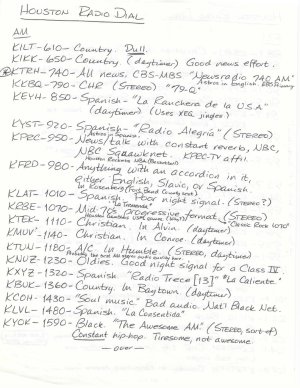
I loved the note on 980 KFRD. "Anything with an accordion." Wasn't that the truth? I remember it, as a young lad. Probably had more steel guitar on it than accordions, but a very unique little station back then in Rosenberg.
It also really got out. I think it had just 1,000 watts but I remember drives between College Station and Houston, and I could carry KFRD all the way on those trips.
Your notes indicate 850 KEYH as a daytimer in 1985. I thought that KEYH went full-time significantly earlier than 1985. Like 1979 when it went first went Spanish under Artlite.
I'm pretty sure it was daytime-only then.
You absolutely pegged KLTR. "Lite Rock 93.7" was, in my opinion, one of the safest, softest ACs in the State, maybe the nation, at the time. It was more painful than "Koda", because everyone knew that 99.1 was the choice one made in helping to go-to sleep. 93.7 was still finding its footing after coming out of its KRLY days so, in its infancy, a mirroring of 99.1 was apparently chosen. Thankfully, a couple years later, it picked up the pace until eventually turning over to "All Rock n' Roll Oldies Whenever" in 1993 ('92?)
Great list, Mark. I'm glad you second guessed yourself and posted this. Really takes one back to when Houston had a powerful AM/FM selection, without all the clutter of these suspect secondary facilities.
The turnover in formats and call letters is pretty spectacular, though. Very few stations in 2025 resemble what they were, whether in format or call letters, in 1985. Rimshotting Houston is a fool's errand, in my opinion, because the place is just so darn big.
Last time I was there, I finally bought a Key Map book. Should have bought one years before when their store was on West Alabama in walking distance from my place, but I've got it now...besides, the wall map version would have been too big for checked luggage!
IIRC KTUN was 1kw full time at that point, no longer a daytimer. I recall hearing it at night in west Texas in 1984.
Do you recall the nighttime pattern? It might have been aimed away from my Montrose location.
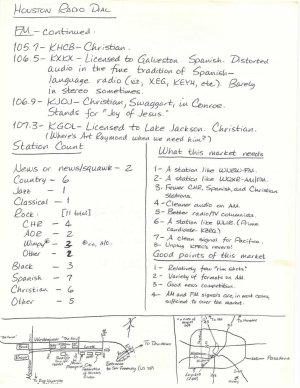
KGOL was on 107.5 by that time, though previously on 107.3 a few years earlier. Were you listening on a radio with an analog dial and referring to a listing that might have been out of date?
Almost everything was still analog then. I might have been referring to an outdated list. A list from the Chronicle TV magazine accompanied this artifact; the Chronicle wasn't all that good with radio coverage until they hired Jay Frank away from the Post.
Must have been the very end of the KZRQ days on 92.1. It was KYND when I got here, though still KZRQ when I had visited some months earlier.
KZRQ didn't last very long, as I recall.
KEYH was a daytimer at that point, IIRC, though they added limited night service some time later before going full time.
Thank you for sharing this. I knew quite a few that spoke of former formats and such. One guy I worked with had owned KRLY and sold it to a big company just before FM overtook AM listening. It was great seeing who was doing what. I didn't arrive in the market until July 1993. I think the thing that always amazed me was how a station was dominating and seemingly perpetually successful would be brought to it's knees in just a few years. We're talking something as dominant as KODA "Sunny 99" or KTRH is and has been for years and years
You mention St. Louis. My parents lived in Kansas City with family in Nashville. On trips back, they knew a couple in St. Louis we would visit. I loved it as I got to hear different stations. I recall country and religion on KXEN (I liked the call letters, so I always gave it a listen). I always gave WMRY FM a listen, that he paper said did news ar 45 past the hour (something I liked because it was different). And being 7 years younger than you, I recognized the localism and liked that on WOKZ Am & fm in Alton. I also listened to music I liked on St. Louis radio but mostly in the car. Going to see my parent's friends allowed me to fine tune my transistor radio to the more difficult to receive stations. All of this listening was from 1965 through the summer of '69.
WMRY was an interesting operation. (So was KXEN, for entirely different reasons.) The frequency had opened up in 1964 after East St. Louis' WAMV-AM/FM went under. That combo had a troubled history, switching back and forth between two wildly different formats: easy listening and R&B for an urban audience. Toward its end, the station did have the market's ABC network affiliation. In 1966, the Shrine of Our Lady of the Snows fired up WMRY. It started with "good music" but by the 1970s, when I arrived in the area, it was running a soft version of adult contemporary music along with brief inspirational messages. The messages weren't proselytizing or even particularly religious; they were more motivational and uplifting in nature. WMRY also ran a reading service for the blind on a subcarrier. In the 1980s, it started selling ads and went to a rock format that was similar to what would be known today as AAA. A couple of key personalities from KSHE came over and boosted the station's profile. Around 1991, the station was sold, then went through a variety of formats before settling on sports talk.
WOKZ was interesting, too. Though I lived in St. Charles County, maybe just 15 miles from Alton, I simply could not pick up the AM. The FM, though, was a class B, and simulcasted the AM during the daytime. As you mention, it was very much a locally-oriented station with a fairly typical adult contemporary format. It also had Associated Press network news, which wasn't all that common. St. Louis' Laclede Radio (KATZ) bought the FM late in 1978 and at midnight New Year's Day 1979 went all-disco as WZEN. I have a tape of that somewhere. Later it became more of an R&B station and is now KATZ-FM, having moved its city of license to Bridgeton, Missouri.
Back to Houston: I remember when KIKK was a big deal in the market. KFMK, too. And, of course, I was well aware of KLOL's impact on the market. KPRC was KTRH's head-to-head competitor. Now they're under the same roof. KIKK and KFMK are entirely gone; KLOL is just a set of call letters for an entirely different format. Longevity in radio is a rare thing.


 +
+


