• Get involved.
    We want your input!
    Apply for Membership and join the conversations about everything related to broadcasting.

    After we receive your registration, a moderator will review it. After your registration is approved, you will be permitted to post.
    If you use a disposable or false email address, your registration will be rejected.

    After your membership is approved, please take a minute to tell us a little bit about yourself.
    https://www.radiodiscussions.com/forums/introduce-yourself.1088/

    Thanks in advance and have fun!
    RadioDiscussions Administrators

How was We Built This City considered "bad?"

"Superstar" was edgy for the Carpenters at the time. It's a song written by Leon Russell and Delaney Bramlett based on a suggestion by Rita Coolidge about a groupie who can't wait for a band to come back to town so she can sleep with the rock star again.

Clearly, she's a kid who's been lied to ("Don't you remember you told me you loved me baby/You said you'd be coming back this way again...maybe")

Richard Carpenter decided to record it after seeing Bette Midler perform it on The Tonight Show with Johnny Carson. He wanted no blowback from the fan base or problems with airplay in conservative markets, so he changed the lyric from "and I can hardly wait to sleep with you again" to "and I can hardly wait to be with you again".

I always wondered how a Leon Russell song I heard on Progressive Rock stations like WNEW-FM wound up getting recorded by The Carpenters. Now I know! But I never knew it was from the perspective of a groupie hoping her favorite rock act would return to her town.

And this song is one of only a few big hits where the title is nowhere in the lyrics.
 
It's amazing to look back to when we played these songs as currents. The sensitivity to lyrics just a bit off color was intense.

I recall debating whether to play songs like Let It All Hang Out.

Yet in 1967 in conservative Ecuador where on Good Friday we had to play classical music or sign off... we brought this back from France and played the heck out of it...


You don't need to know French to know what Serge and Jane were singing about.

"I love you... me neither" is the translated title. The translated lyrics are at


... including the lines:

I go, I go and I go
Je vais, je vais et je viens

Between your loins
Entre tes reins

I come and I go
Je vais et je viens

Between your loins
Entre tes reins
There is an aircheck from February 1970 featuring Jack Armstrong on his last night at WDRC where he promises to read the translation to the Jane Birkin and Serge Gainsbourg song. When it comes time for the translation, though, Jack says: "Mmm. No, I can't say that. Mmm. No, I can't say that. ... And that's the translation, folks." What is even funnier is that that song reached #1 on the WDRC charts during the first week of February 1970 while most of the rest of the country refused to play it.
 
For my part, I think the dumbest songs I ever heard were "Fly, Robin, Fly," and "Get up and Boogie," both by Silver Convention. Between the two, "Get up and Boogie," has to be the worst--I liked the melody to "Fly, Robin, Fly," if not its repetitive lyrics. Yet in the cases of both songs, the girls singing them were German and English was not their first language so it would make sense for them to sing simple, repetitive songs like these two.
 
There is an aircheck from February 1970 featuring Jack Armstrong on his last night at WDRC where he promises to read the translation to the Jane Birkin and Serge Gainsbourg song. When it comes time for the translation, though, Jack says: "Mmm. No, I can't say that. Mmm. No, I can't say that. ... And that's the translation, folks." What is even funnier is that that song reached #1 on the WDRC charts during the first week of February 1970 while most of the rest of the country refused to play it.

My personal favorite along those lines was Big Tom Parker at KFRC, San Francisco. It was 1976 and he was playing Major Harris' "Love Won't Let Me Wait" as a Golden (KFRC's gold tended to be 1 to 5 years old at that time).

In case anyone's not familiar:


The final 30 seconds of the song has moans and groans from a woman.

Tom cracks the mic at the beginning of the fade and says:

"Waiter---more butter, please."


Just about drove off the road.
 
He wanted no blowback from the fan base or problems with airplay in conservative markets, so he changed the lyric from "and I can hardly wait to sleep with you again" to "and I can hardly wait to be with you again".
Don’t forget Richard Carpenter wouldn’t have been able to change the song lyrics without the permission of the song writers (or owners of the rights to the song)
 
Don’t forget Richard Carpenter wouldn’t have been able to change the song lyrics without the permission of the song writers (or owners of the rights to the song)
I’m not sure that’s true of a one-word change, but if it is, I’m sure Leon was happy he said yes. “Superstar” sold 2.5 million singles and was part of an album that sold 4.5 million copies.

That record paid Leon’s rent for a while.
 
Since we're on the subject of drug-influenced lyrics, we can't forget this one!
I got to have a nice long conversation with Peter Yarrow a little over 10 years ago, and though I never brought it up, he pointed out that Puff was not about drugs. After watching him do the song live, I take him at his word. It really is a song about a boy and his magic dragon friend.

As far as "We Built This City," others have mentioned that it wasn't their first foray into pop songs ("Sara" was a pretty good song from their 80s era) but it's definitely walking a tightrope when musicians known for their musicianship venture into pop territory. IMO, the outfit that handled it best was Asia. A "super group" of progressive rockers with immense musical talent who said "oh...you don't think we can write a pop song? Think again!"

 
Kev, Ted---right. KFRC in '76 was playing album versions (or edits that fooled you into thinking they were playing the album version) of currents from big albums, but for a year-old Golden, they were going to play the 45.
 
It's funny how people here complain about corporate radio and how much better it was back then. But when you look at the popular music at the time, it's not much different than what we have now. What people miss is that the 80s saw the rise of international music conglomerates. American record labels RCA, Columbia, and MCA were all sold to international companies based in Germany, Japan, and France. The music became influenced by international producers, such as Peter Wolf from Austria who wrote Sara and produced Starship for RCA. So if you want to view radio through consolidation, you have to also look at what happened to the music business after 1988, when the domestic record labels became international. These things were happening at the same time.
 
It's funny how people here complain about corporate radio and how much better it was back then. But when you look at the popular music at the time, it's not much different than what we have now. What people miss is that the 80s saw the rise of international music conglomerates. American record labels RCA, Columbia, and MCA were all sold to international companies based in Germany, Japan, and France. The music became influenced by international producers, such as Peter Wolf from Austria who wrote Sara and produced Starship for RCA. So if you want to view radio through consolidation, you have to also look at what happened to the music business after 1988, when the domestic record labels became international. These things were happening at the same time.
Mercury became part of Polygram and then the international BMG conglomerate. I wonder if the successful collaboration (and eventual marriage) of Shania Twain and the Englishman Mutt Lange would have happened if Mercury had remained an American label.
 
It's much more than 30 seconds during the "Night Version" of Duran Duran's "Hungry Like the Wolf", so named because radio DJs could only play it during Safe Harbor hours.
Listened to it....didn't know there were night versions of songs. I always thought no one ever utilized Safe Harbor.
 
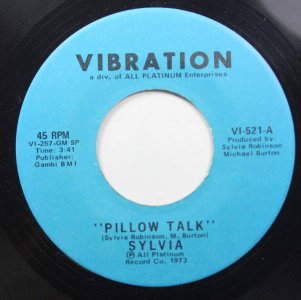
Did Sylvia's "Pillow Talk" have a longer version, too?
Yeah. The single ran 3:41:

619WiekoiYL._SL1000_.jpg

And the record makes so much more sense if you know it was on the "Vibration" label.

The album version, while longer, just extends the instrumental track past the climax (you'll pardon the expression) of the single. When Sylvia says "Oh My God", the single fades...the LP version keeps going, but Sylvia's over it and down at Denny's ordering a waffle.

 
Also fun was the extent to which record companies were willing to lie to get airplay.

Rick Sklar at WABC only added The Rolling Stones' "Honky Tonk Women" after London Records swore that Mick was singing "played a divorcee' in New York City" (it was "laid").

But the all-time topper goes to the fun folks at Warner Bros. Records, who lured major-market radio stations onto Prince's "Erotic City".

The story is in the four final paragraphs of this R&R column from 1984 about the increase in sexually suggestive lyrics:

 
Mercury became part of Polygram and then the international BMG conglomerate. I wonder if the successful collaboration (and eventual marriage) of Shania Twain and the Englishman Mutt Lange would have happened if Mercury had remained an American label.

It's a bit more complicated. The Mercury sale to Polygram happened before. In the 90s, Mercury was sold to Universal, which then combined it with MCA. So by the time Shania came along, Mercury was owned by Vivendi Universal. Mutt isn't English, but is from South Africa.

BMG is the German media company that bought RCA in 1988. They sold it to Sony in the 2000s. BMG now owns Broken Bow Records, the label of Jason Aldean, Lainey Wilson, and Jelly Roll.


Back
Top Bottom