• Get involved.
    We want your input!
    Apply for Membership and join the conversations about everything related to broadcasting.

    After we receive your registration, a moderator will review it. After your registration is approved, you will be permitted to post.
    If you use a disposable or false email address, your registration will be rejected.

    After your membership is approved, please take a minute to tell us a little bit about yourself.
    https://www.radiodiscussions.com/forums/introduce-yourself.1088/

    Thanks in advance and have fun!
    RadioDiscussions Administrators

I Want to Learn How To Program

Also, I'm not sure I'm the right guy to give you any advice going forward, because the biggest reason I got into radio was to get girls.
You and I are quite different in that regard, I think.

Any radio advice you may have to offer, though, is probably quite fine and I'm definitely interested!

c
 
The problem with many community and college stations is that programming is not their strong point. Even some locally programmed small town stations are programmed at the directive of the owner.

The best way to learn programming is to get your foot in the door where programming is an essential part of the station. You want a station where the ownership wants a certain portion of the listener pie and the program director is the person responsible for delivering those listeners.

Call stations. Visit stations. Make your desire known. You'll likely find somebody that will let you be somewhat of an unpaid intern who will hlp you learn. Such a situation puts you at the right place at the right time.
 
The late Bill Pearl had a great line that I've used since he said it to me: It's about understanding how people use the medium.

Thats why we dont use our website as much as most do these days, despite me being a big digital services adovcate.

Why? not how people consume media out here.

Its radio and social media along with our local message board. before i got here, when they interviewed me, i suggested compiling local messages/community calendar/local psa stuff on our website.

but we have a local online message board and facebook that people use so much more... and i wasnt going to try and change habits, but meet listeners where they are.


Watch every one of these videos from legendary PD and GM Pat Holiday. Pat Holiday's Musicom Academy of Radio Programming

While all of that is well and good, you still need the instinct. Those resources are excellent for someone already in the business who wants to move up, but for anyone else ... use them to see if you have that instinct. Remember the quote I included from Chuck Southcott in my original reply.

All the teaching resources in the world can't make up for that. They can certainly enhance your knowledge if you do have the basic instinct for it, but it can't replace that instinct.
 
All the teaching resources in the world can't make up for that. They can certainly enhance your knowledge if you do have the basic instinct for it, but it can't replace that instinct.
When I am asked when I learned how to program, I usually answer "when I was born".
 
When I am asked when I learned how to program, I usually answer "when I was born".

Yeah. I keep coming back to K.M.'s quote from Jhani Kaye.

I had a radio station in my head each time, before I started---I could hear it. The trick was to use all the tools and talents in the radio station to replicate it. A couple of times as a PD I was offered the opportunity to take myself off the air, but I found it was really useful to be on the air, to find any weak spots in equipment or execution, and to demonstrate what it should sound like.
 
I had a radio station in my head each time, before I started---I could hear it. The trick was to use all the tools and talents in the radio station to replicate it. A couple of times as a PD I was offered the opportunity to take myself off the air, but I found it was really useful to be on the air, to find any weak spots in equipment or execution, and to demonstrate what it should sound like.
Part of my ability to program lies in my early recognition of the fact that I was terrible on the air. Not bad, not mediocre. Terrible.

When I became a DXer in the late 50's, I'd find myself critiquing stations I'd hear, particularly the Top 40 ones. It was not just mechanics but the ability of people on the air to sound like humans... and if possible... friends.
 
Here are a few thoughts that just came in as I was reading the thread. I will describe in very roughly chronological order what led me to where I am now, beginning with my earliest interest in radio. I cannot guarantee coherence because it's late and I'm tired after a long, hot day.

Which started when I was very young, like 9 or 10. My mother had some intercoms (the wireless kind, probably based on technology similar to FM wireless mics), and I would use them to "pretend" to have a radio station by "broadcasting" from one intercom to a couple of others. Mainly, I'd stick it up to my tape recorder's speaker or the TV, but once, and only once as far as I can remember, I actually pretended read an ad from a catalog (I can vividly remember it, too. It was an ad for PC RAM (SIMMs and DIMMs!) on one of the back pages of a PC Connection catalog, circa 1998 or so).

After that, I advanced my interest in recording things, eventually upgrading to a proper tape deck and various boomboxes. I recorded off the radio a lot during this time (especially KABL and KFRC, since those were my favorites, but also Young Country at 93.3 FM, because I had a passing interest in country music at the time, and Radio Disney KMCY 1310, because it was Disney, and I was naturally into Disney a lot back then). When my mother got a show at a local LPFM in 2008, I got very interested, as it was the closest I'd gotten to my dream of having a radio station (as I've matured, I've come to realize that owning even a modest, low power station in this day and age is a ridiculous waste of time and money, but young me didn't understand that).

Anyway, while my mother did all the talking, I did all the programming, creating playlists of songs to play during the breaks, and it turned out that my music was the highlight. People would tune in just to hear the music I'd programmed!

This went on for roughly two years, and then politics happened, and we had to leave. That experience left me so sour I avoided radio for 10 years..

But then, during the pandemic, I began to reminisce about the radio dial I grew up with, which get me interested in recreating it. I did stuff on the computer, but it wasn't enough, so further research led me to the discovery of Part 15 broadcasting and the rekindling of my dream. Fast forward a couple years and here I am, on the cusp of... something.

Anyway, something I've noticed throughout the years is that when I'm tasked with setting up a playlist of music to play, people almost always seems to like what I do, and it works. I've never really followed any procedures or anything "proper", I just arrange the songs in a way that feels right. Is that the instinct that @K.M. Richards is referring to? Perhaps, but I don't know for sure, which is in part why I opened this thread.

My aim is to have a sort of soft AC sound, heavy on the gold (especially mid 60s through 70s), light on the currents (few to none from mid 90s to present). Rather similar to something like MeTV Music. Maybe someone can take a look at a sample of what I'm doing and tell me if I'm close, or totally off the mark. So, that said, would anyone here be adverse to this idea?

Anyway, I'll add more thoughts about how I feel about the business side tomorrow, but a thought or two about being on air to close out this post:

I don't really have any interest in going on air myself as a DJ or announcer (never say never, of course); I would rather tell a DJ or announcer what to play and/or say while they are on air. Aside from all the other business stuff, this seems to be to be essentially what a PD does in the most basic sense, correct?

EDIT: Huh, it looks like I already elaborated on some of this last March. I only remembered because someone happened to "like" it. Reading back, I was definitely not in a positive mood re: radio that day.

Anyway, it only furthers what I've posted here, so consider this post an addendum to that one, but without the pessimism.

c

 
Last edited:
Here are a few thoughts that just came in as I was reading the thread. I will describe in very roughly chronological order what led me to where I am now, beginning with my earliest interest in radio. I cannot guarantee coherence because it's late and I'm tired after a long, hot day.

Which started when I was very young, like 9 or 10. My mother had some intercoms (the wireless kind, probably based on technology similar to FM wireless mics), and I would use them to "pretend" to have a radio station by "broadcasting" from one intercom to a couple of others. Mainly, I'd stick it up to my tape recorder's speaker or the TV, but once, and only once as far as I can remember, I actually pretended read an ad from a catalog (I can vividly remember it, too. It was an ad for PC RAM (SIMMs and DIMMs!) on one of the back pages of a PC Connection catalog, circa 1998 or so).

After that, I advanced my interest in recording things, eventually upgrading to a proper tape deck and various boomboxes. I recorded off the radio a lot during this time (especially KABL and KFRC, since those were my favorites, but also Young Country at 93.3 FM, because I had a passing interest in country music at the time, and Radio Disney KMCY 1310, because it was Disney, and I was naturally into Disney a lot back then).

What you've described here will sound familiar to a great number of people who went into broadcasting as a career. We had that same fascination with what we heard on the radio, and experimented with home intercoms, tape recorders, walkie-talkies, whatever.

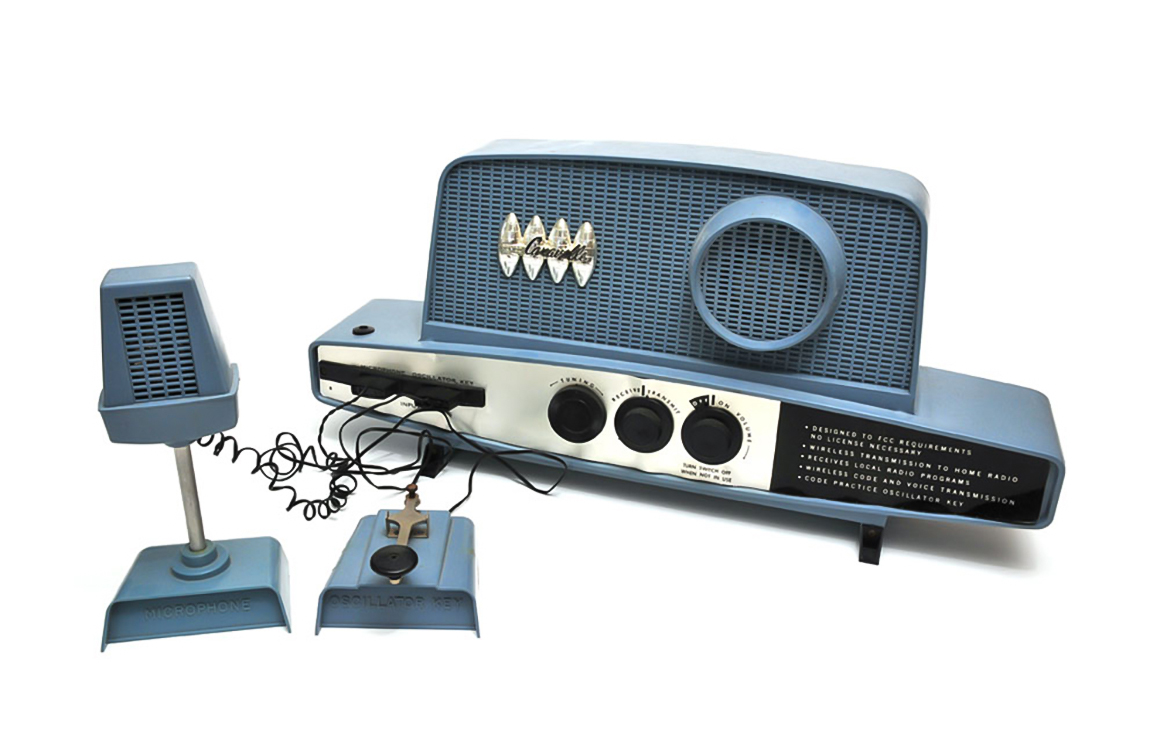
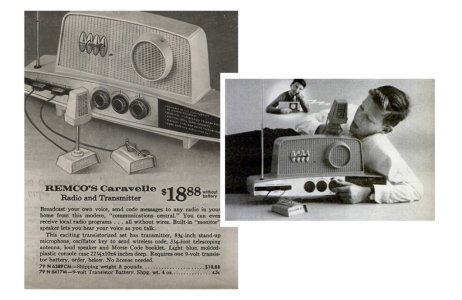
Bill Lee (now at WCBS-FM in New York and previously at KFRC, KMEL and others) and the late Harry Nelson (WRKO, KFRC and many others) did an interview with a Swedish radio journalist 40 years ago in which they both mention that they as kids (Bill in New York, Harry in Mississippi) had the Remco Caravelle---a 1962 "toy radio station" that sent out an actual signal. You'd choose a vacant frequency in your area, and the signal could be heard for about 500 feet.

They both would "play DJ", moving the microphone in front of the speaker on their record players when they wanted to play a song. Bill said he'd broadcast from his bedroom, Harry mentioned that some days he'd actually set up a card table in the front yard like a lemonade stand and do "remote broadcasts" ("It's a gorgeous day here in the front yard.")


caravelle.jpg

The radio bug hadn't hit me yet, but I still wanted one. My parents, working-class, couldn't afford it (that price including battery works out to $200 in today's money), and I was six. They were probably right, even if they had been able to swing it.


When my mother got a show at a local LPFM in 2008, I got very interested, as it was the closest I'd gotten to my dream of having a radio station (as I've matured, I've come to realize that owning even a modest, low power station in this day and age is a ridiculous waste of time and money, but young me didn't understand that).

Anyway, while my mother did all the talking, I did all the programming, creating playlists of songs to play during the breaks, and it turned out that my music was the highlight. People would tune in just to hear the music I'd programmed!

This went on for roughly two years, and then politics happened, and we had to leave. That experience left me so sour I avoided radio for 10 years..

I'm sorry that happened. I think all of us would have advised you to dust yourself off and get right back on the horse---to find another outlet in radio for your energy and talent.

But then, during the pandemic, I began to reminisce about the radio dial I grew up with, which get me interested in recreating it. I did stuff on the computer, but it wasn't enough, so further research led me to the discovery of Part 15 broadcasting and the rekindling of my dream. Fast forward a couple years and here I am, on the cusp of... something.

Anyway, something I've noticed throughout the years is that when I'm tasked with setting up a playlist of music to play, people almost always seems to like what I do, and it works. I've never really followed any procedures or anything "proper", I just arrange the songs in a way that feels right. Is that the instinct that @K.M. Richards is referring to? Perhaps, but I don't know for sure, which is in part why I opened this thread.

Whether it's what K.M. meant by "instinct", it suggests you have what we used to call "good ears"---the ability to hear songs people like and create sets of music, or an entire station, based on the flow and appeal of the music.

A cautionary note, though: If people know they're talking to the person who put something together, they tend to be polite.

One of the things I loved about life before I went to TV was that while people knew my name and my voice, they didn't know my face. I could actually be in line at the grocery store, or at a table at Fjord's, and overhear people talking about the music on KUKI. Sometimes it was very complimentary. Other times it was a worthwhile heads-up that the new 20-year-old PD (me) was leaning a little too hard in one direction.

My aim is to have a sort of soft AC sound, heavy on the gold (especially mid 60s through 70s), light on the currents (few to none from mid 90s to present). Rather similar to something like MeTV Music. Maybe someone can take a look at a sample of what I'm doing and tell me if I'm close, or totally off the mark. So, that said, would anyone here be adverse to this idea?

Anyway, I'll add more thoughts about how I feel about the business side tomorrow,

I have some thoughts on practicality, but let's wait until you've talked about your feelings about the business side first.

but a thought or two about being on air to close out this post:

I don't really have any interest in going on air myself as a DJ or announcer (never say never, of course);

I mentioned that I found enormous value in being on the air. Part of it is knowing whether what I'm expecting the jocks to do is reasonable, practicable and makes sense in the real-world context of the radio station.

If I had an idea about formatics, mechanics, tone, flow---I'd be the one to break existing format, try it out on my show and see if it was a good idea or not.

Bonus points: If it was a good idea, I knew how to perform it and could actually play it for them instead of describing it verbally and putting the pressure on them to figure it out.

I would rather tell a DJ or announcer what to play and/or say while they are on air. Aside from all the other business stuff, this seems to be to be essentially what a PD does in the most basic sense, correct?

Depends on the station and the PD. I'll just say up-front that the PDs who can't do the job the jocks do and then tell the talent how to do it are generally not respected and often actively hated.

Beyond that, any spark of creativity outside your own head is extinguished. The entire radio station rests on you instead of on the team that can help you bring the vision to life. Morale sucks, turnover is an issue and eventually the GM sees the problem.

Successful PDs inspire talent to do their best so that (let's just use this number) seven individuals (a PD and six jocks) create collaboratively to make a radio station that has its own personality (we used to call it "stationality") 24-7.
 
Last edited:
Everything Mike says is absolute truth. I will just elaborate on his ending ...

Depends on the station and the PD. I'll just say up-front that the PDs who can't do the job the jocks do and then tell the talent how to do it are generally not respected and often actively hated.

Successful PDs inspire talent to do their best so that (let's just use this number) seven individuals (a PD and six jocks) create collaboratively to make a radio station that has its own personality (we used to call it "stationality") 24-7.

That first statement is the "subpar" PD Mike mentioned in an earlier post ... the path through radio history has a large number of them who were eventually kicked to the roadside. One thing consolidation has brought about is a lower number of PDs as one person ends up programming multiple stations in a cluster. (I'm doing that myself with the Albuquerque cluster now.) That has the effect of pushing out those who don't have the instincts to program, and it highlights what Jhani and Chuck said (and Mike and I have echoed) about the different way we think. We can program almost anything.

During my career, I have done MOR, Classical, Beautiful Music, AC, Country, Mellow AOR, CHR, Standards, Urban ... and lots of production. I turned 69 seven weeks ago and I am still active in the business.

If you know what you are doing, have the instincts, and trust them, I am living proof that you can survive a lot longer than all the ones along the side of the road did. Just keep a clear enough vision to take advantage of the opportunities that present themselves.
 
Everything Mike says is absolute truth. I will just elaborate on his ending ...


That first statement is the "subpar" PD Mike mentioned in an earlier post

Point of clarification (just because people misconstrue otherwise clear statements): I did not name a "subpar" PD, nor necessarily have one in mind. I will say that some guys who were great jocks were not great PDs. They could execute a format*, but not lead a staff.

There were other subpar PDs who followed their "vision" in spite of all the reasons why it would not, could not work (and in many cases had crashed and burned already---sometimes in that market and more than once on the same damn radio station).

Those were the guys that I said "couldn't program the police band in a riot."


*Charlie Van Dyke and I (both former PDs) remarked on our morning show in Phoenix---probably more than once---that:

"Any idiot can execute a format. It takes genius to slowly strangle it over four hours like we do."


... the path through radio history has a large number of them who were eventually kicked to the roadside. One thing consolidation has brought about is a lower number of PDs as one person ends up programming multiple stations in a cluster. (I'm doing that myself with the Albuquerque cluster now.) That has the effect of pushing out those who don't have the instincts to program, and it highlights what Jhani and Chuck said (and Mike and I have echoed) about the different way we think. We can program almost anything.

Facts. I know a great News/Talk programmer. He's also been very successful in AC and Country formats.

During my career, I have done MOR, Classical, Beautiful Music, AC, Country, Mellow AOR, CHR, Standards, Urban ... and lots of production. I turned 69 seven weeks ago and I am still active in the business.

If you know what you are doing, have the instincts, and trust them, I am living proof that you can survive a lot longer than all the ones along the side of the road did. Just keep a clear enough vision to take advantage of the opportunities that present themselves.

Again, facts.
 
Last edited:
Depends on the station and the PD. I'll just say up-front that the PDs who can't do the job the jocks do and then tell the talent how to do it are generally not respected and often actively hated.
I love everything you wrote… except this. As I mentioned, I ,darned quickly that I was awful in front of thr macro phone. And, after listening to my awful attempts, I understood exactly why. So I had a lot of respect for those who could do it, and I could feel exactly what made some great. And I could distinguish between wannabe jocks and real talent.

Knowing why I was a really bad jock made recognizing real talent easier.
 
Depends on the station and the PD. I'll just say up-front that the PDs who can't do the job the jocks do and then tell the talent how to do it are generally not respected and often actively hated.

Reading that I'm reminded of the book by Howard Cosell: "I Never Played The Game." It was the book where he criticized the growing "jock-ocracy" that was taking place in sports. In particular Frank Gifford.

I know many legendary talents who were able to advance to PD and even GM. The hard part for many of them was being able to leave the microphone. They wanted to keep their hand in it somehow. One would even volunteer to read the commercials so he could keep his chops up.

I don't know if Randy Michaels was respected by the talent who worked for him.
 
I have a POV somewhere between the two of you.

Most successful PDs were reasonably good jocks. There were exceptions; unless my memory is faulty (again) Rick Sklar never did on-air shifts. I'm pretty sure Mike Schaefer (former APD at KIIS-FM and the in-house consultant/PD at Y97 when I was doing afternoons) didn't either ... at least not other than the afternoon when circumstances took me off the air one day and he couldn't reach any of the weekenders in time.

Schaef had one thing in common with you, David. He was terrible on the air that day.
 
I love everything you wrote… except this. As I mentioned, I ,darned quickly that I was awful in front of thr macro phone. And, after listening to my awful attempts, I understood exactly why. So I had a lot of respect for those who could do it, and I could feel exactly what made some great. And I could distinguish between wannabe jocks and real talent.

There's an exception to every rule, David. But I'd argue you could do what they did---hell, you did it for years and from a very early age---there were just people better at it. But you knew what the job was and how to do it.

Maybe a better way to put it is that a PD who's never been on the air (there have been a few over the years, promoted laterally from promotion or another management role) is going to have an uphill battle with jocks, unless he/she has great leadership and people skills.

Knowing why I was a really bad jock made recognizing real talent easier.

And that's huge. It meant that you didn't suffer from Dunning-Kruger effect, but so many bad jocks do.
 
There's an exception to every rule, David. But I'd argue you could do what they did---hell, you did it for years and from a very early age---there were just people better at it. But you knew what the job was and how to do it.
Not only was I bad on the air, I was initially scared of the microphone. I would literally shake all over, afraid to do something awful.
Maybe a better way to put it is that a PD who's never been on the air (there have been a few over the years, promoted laterally from promotion or another management role) is going to have an uphill battle with jocks, unless he/she has great leadership and people skills.
I felt this in a different way when I did Mega in Argentina for Emmis. I was a gringo who spoke Puerto Rican Spanish in a country where there was greate, egotistical, pride in all things Argentine. We changed format to something everyone said would not work. The jocks were at least happy to not have lost their jobs. But there was a lot of doubt and a "what's next when this fails" attitude.

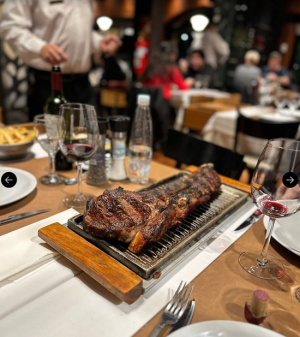
About 5 weeks in, we got "the book". We had a 20 share, and the next closest station was about half of what we delivered. It was like having my business suit torn off, revealing a superhero uniform. Yelling, jumping up and down, and someone got a bottle of (Argentine) champaign from across the street. And another bottle, and another. Hugging and kissing (men do French-style left and right cheek smacks there). Steaks at Puerto Madero.

1751234637448.png
And that's huge. It meant that you didn't suffer from Dunning-Kruger effect, but so many bad jocks do.
There are two aspects to Dunning-Kruger. The other involves highly talented or skilled persons who underestimate their abilities.
 
Reading that I'm reminded of the book by Howard Cosell: "I Never Played The Game." It was the book where he criticized the growing "jock-ocracy" that was taking place in sports. In particular Frank Gifford.

I know many legendary talents who were able to advance to PD and even GM. The hard part for many of them was being able to leave the microphone. They wanted to keep their hand in it somehow. One would even volunteer to read the commercials so he could keep his chops up.

I don't know if Randy Michaels was respected by the talent who worked for him.
Probably going tp go with yes


Back
Top Bottom