Especially the helpful caption on the stock art accompanying the South Windsor crash story:I doubt anyone writing copy for air wrote those two stories.
"police car on the street close up"

Especially the helpful caption on the stock art accompanying the South Windsor crash story:I doubt anyone writing copy for air wrote those two stories.
Okay, now you've told me it's an intern. That should have been entered in the alt text field. It describes images for visually impaired readers and helps search engines find images. Whoever did this put it in the caption field by mistake.Especially the helpful caption on the stock art accompanying the South Windsor crash story:
"police car on the street close up"
Lets the say the older you get the more simplistic you want things to be. Turn on the TV and not have to find the input, or look for the Sat Radio in the car.
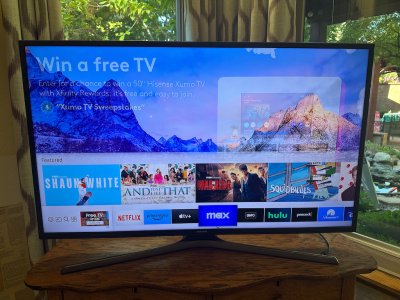
I know plenty of people who are technology challenged. My mother for one. I have to walk her through everything. I doubt those people are the minority.Don, let me introduce you to pretty much every TV sold in the United States in the last 15 years:
View attachment 5303
You turn it on and along the bottom margin are big, clearly labelled buttons with the logos of your program choices.
If I were to scroll to the left, you'd see my cable company's logo, then come NETFLIX, Prime, Apple TV+, AMC, HULU, Peacock, Paramount+, Disney+....and so on.
It's actually EASIER than punching channel numbers into a remote.
And..."look for the sat radio in the car"? You mean MY OWN car? You mean the one with the button either on the dash or on the screen that says "RADIO" and then offers me the choice of AM, FM or Satellite? That one?
If you're serious about this, you're more out of touch than the senior citizens you think you understand.
We had dozens of photos of cruisers, lights, police tape, fire engines, ladders and hoses in one folder (in the computer system's files, not physical file cabinets) for easy recall when we needed to slap some art on a fire or crime story that didn't have any when turned in. They all bore labels like "police 2" or "fire 13," but never a caption, so none of those labels ever appeared on the website. And it was the responsibility of the editor putting the story on the website, never the reporter who wrote the story. Alas, that was -- in my case -- nearly five years ago.Okay, now you've told me it's an intern. That should have been entered in the alt text field. It describes images for visually impaired readers and helps search engines find images. Whoever did this put it in the caption field by mistake.
Again, anecdotal evidence is not evidence at all.I know plenty of people who are technology challenged. My mother for one. I have to walk her through everything. I doubt those people are the minority.
Really unless you buy an old person flip phone every phone will be a smart phone. The question becomes how many people know how to use it beyond make a call. There is a reason people don't want to see AM die and it's because it's a comfort thing. The more we stray into technology we lose that intimate feel. This is why people hate change. The younger generations don't know any better so they embrace the new way of thinking.Again, anecdotal evidence is not evidence at all.
Some real-world stats:
- Ninety-eight percent of people age 60 or older own a mobile phone, and four out of five have a smartphone.
- Three in four older Americans send text messages at least once a day, and a majority say texting is their preferred form of communication. About 46 percent say they texted more this year than last.
- Sixty-five percent of adults aged 60 and older spend 3 hours or more each day on their phones. On average, older adults have 25 apps installed on their phones.
- When asked what kind of smartphone apps they’d be willing to try in the next six months, older Americans were most interested in e-book, podcast, or home security apps.
Here's the full report: Senior Smartphone Trends to Watch in 2022 | The Senior List
Really unless you buy an old person flip phone every phone will be a smart phone. The question becomes how many people know how to use it beyond make a call.
There is a reason people don't want to see AM die and it's because it's a comfort thing. The more we stray into technology we lose that intimate feel. This is why people hate change. The younger generations don't know any better so they embrace the new way of thinking.
I'm 43, Maybe I just know a lot of people that are not technology savvy.Which is line two and three of the pull quote:
- Three in four older Americans send text messages at least once a day, and a majority say texting is their preferred form of communication. About 46 percent say they texted more this year than last.
- Sixty-five percent of adults aged 60 and older spend 3 hours or more each day on their phones. On average, older adults have 25 apps installed on their phones.
Again, how old are you, Don?
I'm 43, Maybe I just know a lot of people that are not technology savvy.
This brings us back to the streaming thing. I don't see any radios other than in the car. Be it on the beach or walking, it's all streamed via some sort of bluetooth device. So where are these radio listeners coming from. Do people spend that much time in their cars?
And they are streaming music in their cars not listening to the radio. CarPlay is a great feature.Bingo. That's the answer. Not "everyone I know is (blank), so that must represent society at large."
Adults 27 to 42 (Millennials) have jobs, Don. And cars. The average American commute time is 27.6 minutes each way. And a lot more in the biggest cities.
It's not supposed to impress. It's supposed to provide information as efficiently as possible in a medium that's less efficient in providing information compared to print. In other words, people can read faster than they can listen.TV producers and reporters tend to be creatures of broadcasting---very few worked in print. So from day one (college?) they've been trained to write for the ear. Print and broadcast writing are (or should be) different animals. And if you look at broadcast writing, most of it will probably not jump out at you as impressive. But if it tells the story clearly and understandably in 20, 30, 40 seconds---it's well-written and is doing its job.
Unfortunately some older people are resistant to change for three reasons: Stupid stubbornness, intellectual laziness, and passive aggressive behavior. That might sound harsh, but I see examples repeatedly.There is a reason people don't want to see AM die and it's because it's a comfort thing. The more we stray into technology we lose that intimate feel. This is why people hate change.
You were SO close…And they are streaming music in their cars not listening to the radio. CarPlay is a great feature.
What I can't figure out is their exit strategy. Circulation declines, causing readership to decline, causing ad revenue to decline, rinse and repeat. I think these guys look at the real estate, one of the things they understand the best, and go for that, and once they've sold that off, are left with not much.These sales produced cash, but also reflected an ability to downsize because of shrunken staffs. They’re not shrinking into profitability. They’re all still struggling, and the Union-Tribune was sold this week to a hedge fund that buys up newspapers and bleeds them dry (Alden Capital).
Mark, you chose the clip that, when I was News Director at KFBK, I played for every new hire as an example of how much you can get said in 60 seconds!It's not supposed to impress. It's supposed to provide information as efficiently as possible in a medium that's less efficient in providing information compared to print. In other words, people can read faster than they can listen.
At the University of Missouri, where I graduated during its peak, writing for the radio and TV stations was very different than it was for the news-editorial and magazine sequences. Every student entering the J-school program had to take News 105, the initial newswriting course. You couldn't even get into the J-school until you were a junior. Before that, every student had to have two English composition courses, though you could test out of the first one.
If you were in the broadcast sequence as I was, you would have had a foundation in English writing even before the J-school let you in. Next you would have gotten a basic grounding in newswriting. After that, learning how to write for broadcast was a matter of unlearning some things and learning others. For example, use of the passive voice was a big no-no. Writing snappy ledes was a big plus, and fortunately I was good at that. I also got the reputation of being good at writing seven-line stories, or roughly 30 seconds.
You also had to adapt to different styles of broadcast writing - writing for a public radio station on the one hand, and writing for a commercial TV station on the other. Writing around the actuality (sound bite) and natural sound for radio; writing to the film for Channel 8. And you had to learn how to watch out for some of the bad writing found on the AP and UPI broadcast wires, where rewriting was almost always necessary.
I used to be a better writer than I am now. Thirty years of corporate life, and the hedging and pussyfooting that's sometimes needed in that environment, worked against some of the things I learned earlier in J-school. For the last 15 years of my career, I worked a lot with lawyers, and that can creep into my writing even still. There was also the matter of having had a broadcast journalism career that crashed and burned, but never mind that. The jargon of technology became second nature to me, too.
So with all that, I'll also say that you never want to watch a TV newscast while sitting next to me. I'm always critiquing what I'm seeing and hearing. Maybe it's old-person disease, but I think the writing, in particular, has gotten worse over time. I've been a regular watcher of the KTVU Ten O'Clock News for more than 20 years. At the beginning of that period, there was some great writing, from George Watson in particular, but from others, too. It's steadily deteriorated, and now the newscasts feel like they've been hastily assembled, with clumsy writing - including the passive voice! - that sometimes causes the anchors to stumble. Scripts often don't match the video. Supers (chyrons) are misspelled.
It's another symptom of old-timers' disease, but I think the 1970s were the best in terms of attentive and crisp broadcast writing. Look at what Tom Synder could do in a minute in 1976. You wouldn't see that now.
I should have known that journalism wasn't for me when I got an A in advanced calculus. The professor in that class begged me to switch to the College of Engineering (at the University of Missouri). Well, I guess I ultimately listened because I went back about 10 years later and got a masters' degree...in computer science. But I know the reputation.Radio is also a refuge for people who are bad in math. But then, so are print media. And journalism schools.
In Alden’s case, they usually come in after the paper has already sold the physical building and moved into rented office space.What I can't figure out is their exit strategy. Circulation declines, causing readership to decline, causing ad revenue to decline, rinse and repeat. I think these guys look at the real estate, one of the things they understand the best, and go for that, and once they've sold that off, are left with not much.
It feels a lot like what's happened to Sears. Lampert wanted the real-estate but had no operating retail experience, and made bad choices for operating executives.


