• Get involved.
    We want your input!
    Apply for Membership and join the conversations about everything related to broadcasting.

    After we receive your registration, a moderator will review it. After your registration is approved, you will be permitted to post.
    If you use a disposable or false email address, your registration will be rejected.

    After your membership is approved, please take a minute to tell us a little bit about yourself.
    https://www.radiodiscussions.com/forums/introduce-yourself.1088/

    Thanks in advance and have fun!
    RadioDiscussions Administrators

Is old music killing new music?

Do you have any links that show the labels and explain the differentiation you describe?

Here's one describing the many RCA labels. From what I can see, they're all pre-1970s:


The RCA Red Label was its high quality classical line. They did a lower quality line for country and jazz. But that was mainly in the 30s.

I've seen a couple, but do not believe I have any in my (small) collection.

Those examples all have the 1970s modern RCA logo, so those aren't the original labels for those singles.

I think the poster was talking about "race records," which were marketed to black people in the 30s and 40s. They were mostly gone by the 50s. DJs like Alan Freed and John R worked to get young white kids interested in that music, so that kind of marketing disappeared quickly.
 
I have an unconfirmed feeling that what you describe is Urban Legend, and not real. The RCA records I had back then were all the same standard label, including "r&b songs" that I loved. I never saw an orange RCA label, either in the promotional ones RCA sent to WJMO or on 45's I'd buy for myself.

Do you have any links that show the labels and explain the differentiation you describe?
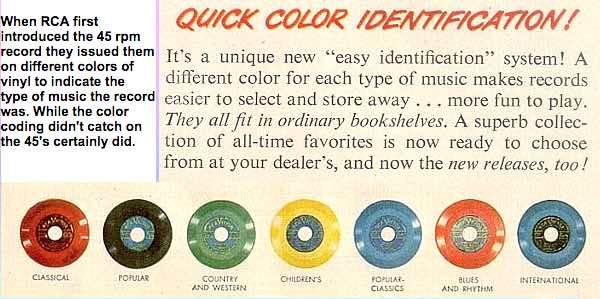
The color coding of early 45s was a real thing. But it didn't last long, because the Korean War caused a scarcity of colored vinyl, so in the early '50s they gave up on the idea, except for the red classical records.

13ae8e214f8fbcf00334cbb4a1e5a0f3.jpg
 
The color coding of early 45s was a real thing. But it didn't last long, because the Korean War caused a scarcity of colored vinyl, so in the early '50s they gave up on the idea, except for the red classical records.

13ae8e214f8fbcf00334cbb4a1e5a0f3.jpg
That is really interesting. Thanks.

At the time of the Korean conflict I was not even in first grade, and not yet a record buyer. I did start radio listenin, particularly to Alan Freed in Cleveland. He played lots or r&b songs, but at tat age I just thought they were “cool” songs and did not make any distinctions.

I remember a couple of 45’s that I bought towards the 1956 marker were on colored plastic, but that seemed to be tied to some kind of promotion.

Looking at Billboard, the pre-Korea years were the very start of the use of 45s so I wonder if colored plastic was promotional to make people buy new record players.

Kids in my class thought that Chuck Berry was much more hip than Paul Anka, so there ere no color lines as radio Was color blind.
 
The color coding of early 45s was a real thing. But it didn't last long, because the Korean War caused a scarcity of colored vinyl, so in the early '50s they gave up on the idea, except for the red classical records.

13ae8e214f8fbcf00334cbb4a1e5a0f3.jpg
I had a yellow 78 with "Happy Birthday" and a green one with "Here Comes Peter Cottontail". Or maybe it was the other way around.
 
I think the poster was talking about "race records," which were marketed to black people in the 30s and 40s. They were mostly gone by the 50s. DJs like Alan Freed and John R worked to get young white kids interested in that music, so that kind of marketing disappeared quickly.
I am likely the only one here who was both an Alan Freed and Pete “Mad Daddy” Meyers listener as a kid in Cleveland. I liked them so much that I bought one share of Storer Broadcasting stock!

I don’t recall either of them talking about race or sub-classifying the music. They just played songs we liked. stations at the time we’re feeling the effects of TV and looking for what to do at night, which is why those two were on late evening and sponsored mostly by a big downtown record store… and a famous Cleveland jeweler who later helped finance Norm and Bob to buy WDOK and create Top 40 WIXY around 1964.

Freed recognized that kids wanted something different from Sinatra and Doris Day and it was hip and cool to tell your mates at school what song you liked best from the previous evening’s show!
 
I had a yellow 78 with "Happy Birthday" and a green one with "Here Comes Peter Cottontail". Or maybe it was the other way around.
As I recall, Mr Cottontail was a white rabbit and definitely not woke. (Insert Grin icon here)
 
Exactly. There are two types of music: Good & bad. That's what Duke Ellington said.

In Muscle Shoals, Rick Hall ran the FAME recording studio built on that same idea. In Memphis, they did the same thing at STAX.
After doing a few AMTs and some callout, I'd say that in radio there are three kinds: good, bad and mediocre.

An awful lot of "it's ok" responses are gotten in testing. Usually, that means the listener would not tune out if one is played, but if there are two or more in a row, they would. For one, they think, "OK, a good one is next". For two, they think "this station sucks".

Of course, songs that are hated will produce instant tuneout if the listener is near their radio, such as in the car.

That's why that "mediocre" score, often considered to be a 4, 5, or 6 on a ten point scale, will not get play on most stations. It takes a 7 or above, with no subset (gender, age group, ethnicity, cluster group, etc) scoring below maybe a 6.8 to get on the playlist and even then with a very slow rotation and scheduling rules so that the low score song is surrounded by very strong ones.

 
The color coding of early 45s was a real thing. But it didn't last long, because the Korean War caused a scarcity of colored vinyl, so in the early '50s they gave up on the idea, except for the red classical records.

13ae8e214f8fbcf00334cbb4a1e5a0f3.jpg
Singles in the 70's were bad enough, but colored vinyl was really terrible quality. The first few grooves would easily get 'back-burned' if cued up more than once. The further and quicker you turned the record backwards with the needle down, the more unusable the single became.
 
Singles in the 70's were bad enough, but colored vinyl was really terrible quality. The first few grooves would easily get 'back-burned' if cued up more than once. The further and quicker you turned the record backwards with the needle down, the more unusable the single became.
The lower quality of colored vinyl (and picture discs, for that matter) is paradoxical to colored vinyls and picture discs being among the sought after copies for collectors, with prices being very steep at times. Granted, collectors would like to buy a "rare" edition, but many people buy vinyl because of the sound quality, especially compared to MP3s or Spotify.
 
The lower quality of colored vinyl (and picture discs, for that matter) is paradoxical to colored vinyls and picture discs being among the sought after copies for collectors, with prices being very steep at times. Granted, collectors would like to buy a "rare" edition, but many people buy vinyl because of the sound quality, especially compared to MP3s or Spotify.
Yeah, but back-burned sections of vinyl singles don't sound very good at all. Even to someone with bad hearing that thinks AM sounds fine.
 
Status
This thread has been closed due to inactivity. You can create a new thread to discuss this topic.


Back
Top Bottom