
• Get involved.
    We want your input!
    Apply for Membership and join the conversations about everything related to broadcasting.

    After we receive your registration, a moderator will review it. After your registration is approved, you will be permitted to post.
    If you use a disposable or false email address, your registration will be rejected.

    After your membership is approved, please take a minute to tell us a little bit about yourself.
    https://www.radiodiscussions.com/forums/introduce-yourself.1088/

    Thanks in advance and have fun!
    RadioDiscussions Administrators

Japan to turn off AM's, except for Public Broadcaster NHK

How is digital radio faring in Japan? Is it closer to the UK's highly successful DAB radio or HD radio's weak reception in the U.S. ?
Japan has not adopted a digital broadcasting system like IBOC or DAB and there are no plans to do so.

Because smartphone use in Asia has outpaced the U.S. by several years, radio in general isn't by percentage, used as much as here in the States. Note the percentage of use on this chart:
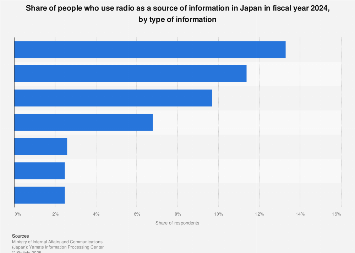
Much of what is called "radio" is more likely a phone app:
 
[Disclaimer: this will never happen.]

A sensible solution would be for the US Government to first decommission the commercial AM band. Then select one AM frequency to broadcast emergency information and set up strategic transmitters to cover the entire country by purchasing AM stations that have gone dark.

Then make available at a very low cost, or no cost to people below the poverty level, a small device known as an "emergency receiver" (or a more clever name an ad agency might come up with) that everyone would be encouraged to keep close by.

During times of non-emergency it could broadcast national weather information, Amber alerts and other useful info.

In case of an imminent threat, if there's some way for the AM signal to trigger an alarm that would be perfect -- not sure it it's possible.
 
Why would they need AM in an emergency? Aren't FM transmitters every bit as robust?
I guess technically it isn't about the reliability of different transmitters, but more about the propagation effects between FM and AM. FM is received line-of-sight, where AM signals can get over terrain.
The real issue is whether enough people still have access to AM receivers in Japan to make keeping AM broadcasts around worthwhile.
 
Much of what is called "radio" is more likely a phone app:
Radio Nikkei, the Japanese commercial shortwave broadcaster I mentioned upthread, heavily promotes its app on their website. Would be curious to know what percentages of the audience are listening to the app as opposed to the shortwave outlets.
 
Radio Nikkei, the Japanese commercial shortwave broadcaster I mentioned upthread, heavily promotes its app on their website. Would be curious to know what percentages of the audience are listening to the app as opposed to the shortwave outlets.
If it's anything like other government-controlled broadcasters, I'd assume that if there were a way to document the numbers of SW listening (which there isn't), that app use is likely gaining acceptance over OTA listening. Whether it's surpassed the small number of OTA listening, or they're both just low numbers, is the real question.
 
Not sure whether all of the space formerly occupied by U.S. channels 2 - 6 (54 - 88 MHz) has already been repurposed but some of that could become an expanded FM band. Those frequencies are just under the existing FM band so the same technology for building FM radios can be used for new expanded band radios.

I'm surprised Michi hasn't noticed this post and added a :love: to it.
 
A sensible solution would be for the US Government to first decommission the commercial AM band. Then select one AM frequency to broadcast emergency information and set up strategic transmitters to cover the entire country by purchasing AM stations that have gone dark.

You just reinvented CONELRAD.
 
[Disclaimer: this will never happen.]

A sensible solution would be for the US Government to first decommission the commercial AM band. Then select one AM frequency to broadcast emergency information and set up strategic transmitters to cover the entire country by purchasing AM stations that have gone dark.
It already has happened, except with 50 kW clear-channel stations which haven't gone dark:

 
You just reinvented CONELRAD.
LOL! 😁

But the difference is that the general public is expected to rely on "radios" which many people, especially younger folks, don't own anymore. When they buy a new car it might only have FM.

My idea would be to have a device dedicated to providing emergency information. Such a device could probably be made available for less than 10 bucks and people could be encouraged to always have one on hand in case of an emergency.

That way there's no searching through social media, AM, FM, satellite, etc. Just press a button and find out what to do.
 
My idea would be to have a device dedicated to providing emergency information. Such a device could probably be made available for less than 10 bucks and people could be encouraged to always have one on hand in case of an emergency.

That way there's no searching through social media, AM, FM, satellite, etc. Just press a button and find out what to do.
Most modern weather radios function this way today. I purchased an eSky radio on Amazon for $20 that can receive weather alerts from NOAA and Environment Canada.
 
It already has happened, except with 50 kW clear-channel stations which haven't gone dark:

[Disclaimer: this will never happen.]

A sensible solution would be for the US Government to first decommission the commercial AM band. Then select one AM frequency to broadcast emergency information and set up strategic transmitters to cover the entire country by purchasing AM stations that have gone dark.

Then make available at a very low cost, or no cost to people below the poverty level, a small device known as an "emergency receiver" (or a more clever name an ad agency might come up with) that everyone would be encouraged to keep close by.

During times of non-emergency it could broadcast national weather information, Amber alerts and other useful info.

In case of an imminent threat, if there's some way for the AM signal to trigger an alarm that would be perfect -- not sure it it's possible.

It's a good idea, especially in areas with high risk of forest fires, which happen frequently in the American west. FM reception is often very intermittent in hilly or mountainous areas. AM stations come in much better. In recent severe fire in northern California, the cell phone towers in the middle of the fire have been damaged and are inoperable. In the deadly Santa Rosa and Paradise fires of recent years, the cell phone towers burned up. So, it's difficult to rely on cell phone service or internet service.
More than half of California residents live in the hills and mountains surrounding the large urban valleys. That's called the "woodlands interface." FM reception is not good in hilly areas - the signal fades in and out. AM stations come in much better. In recent severe fire in northern California, the cell phone towers in the middle of the fire have been damaged and are inoperable.

If the govt. is going to remove AM stations, then they could leave 1 or 2 for emergency broadcast to western U.S. urban areas, where millions of people live the hills and mountains above the valley floor. ( Denver - Salt Lake - Phoenix - Los Angeles- Fresno- San Francisco - Portland, etc.)
 
Last edited:
Radio Nikkei, the Japanese commercial shortwave broadcaster I mentioned upthread, heavily promotes its app on their website. Would be curious to know what percentages of the audience are listening to the app as opposed to the shortwave outlets.
Just a rough guess, but I would think that many of the OTA Nikkei listeners are Japanese fishermen & coastal mariners. The two stations were apparently important enough for Sony to put both frequencies on their EX5MK2 MW-FM radio -- with the shortwave stations being just two crystal controlled receiver circuits, each triggered by a button -- no other SW available on the radio.

Other Nikkei listeners may use the app more.
 
Radio stations can be damaged by wildfires, storms, etc. also. If we left the AM band (and its usage policies) unchanged, and if "critical" stations were put off the air there would almost certainly be others that could fill the void. They might continue to use daytime facilites at night and the FCC could ad hoc select which ones would be the backup stations for that particular region if there became a massive interference overlap.

Just came to mind about living in an emergencies in decades past. (Never actually experienced one personally, yet.) Instructions mass mailed supposedly to al U.S. households said, "Do not use the telephone." If information getting today relied on internet and cell service rather than OTA, would the "system" be overloaded with so many more "users" coming aboard?
 
Last edited:
Adding onto this topic from a discussion I had with some Gen-Z ladies just yesterday and the topic of radio came up. Granted anecdotal and a small sample, but some interesting points came out of the discussion.

Of course, we talked about how many hours a week they thought they listened to traditional radio, AM or FM. They all said without hesitation, that they don't, and would never listen to AM. Their reasons while surprising, were not really when you think about it.

One woman said; "that's where old grandpa's go for their political talk and news." "We don't like that kind of talk on the radio". (the other three nodding in agreement). "The on-air people are intolerant, old and cranky too." "Younger adults don't think that's entertaining or interesting." "There's already plenty of that *hit on social media." "The last thing I want to do is be stuck in traffic hearing hate speech on the radio." I then mentioned that some AM stations were being given FM frequencies to carry their programming on FM too. One of the women said; "That's too bad because if I started running into hate-talk stations while looking for music, I'd just switch to Spotify full-time and not bother with radio at all." "After all, there's probably only one or two stations most of us listen to, and if they get harder to find because of political mean-talk, younger people are going to avoid radio altogether."

Overall, I thought their impressions of AM were interesting, but was taken aback that they felt if AM programming encroached on FM, they would abandon radio altogether. Ladies and gentlemen of traditional radio; there is your future audience ready to go somewhere else if you continue moving AM to the FM band.
 
deleted .................................
 
Adding onto this topic from a discussion I had with some Gen-Z ladies just yesterday and the topic of radio came up. Granted anecdotal and a small sample, but some interesting points came out of the discussion.

Of course, we talked about how many hours a week they thought they listened to traditional radio, AM or FM. They all said without hesitation, that they don't, and would never listen to AM. Their reasons while surprising, were not really when you think about it.

One woman said; "that's where old grandpa's go for their political talk and news." "We don't like that kind of talk on the radio". (the other three nodding in agreement). "The on-air people are intolerant, old and cranky too." "Younger adults don't think that's entertaining or interesting." "There's already plenty of that *hit on social media." "The last thing I want to do is be stuck in traffic hearing hate speech on the radio." I then mentioned that some AM stations were being given FM frequencies to carry their programming on FM too. One of the women said; "That's too bad because if I started running into hate-talk stations while looking for music, I'd just switch to Spotify full-time and not bother with radio at all." "After all, there's probably only one or two stations most of us listen to, and if they get harder to find because of political mean-talk, younger people are going to avoid radio altogether."

Overall, I thought their impressions of AM were interesting, but was taken aback that they felt if AM programming encroached on FM, they would abandon radio altogether. Ladies and gentlemen of traditional radio; there is your future audience ready to go somewhere else if you continue moving AM to the FM band.
That's interesting, atlthough surprising that they would abandon the whole medium of radio. People have always had stations which they never listen to because they don't care for the format, but to abandon all FM stations because one station is hate-talk?
I think Spotify carries some hate-talk podcasts, but no one is forced to listen to them there either.
 
That's interesting, atlthough surprising that they would abandon the whole medium of radio. People have always had stations which they never listen to because they don't care for the format, but to abandon all FM stations because one station is hate-talk?
I think Spotify carries some hate-talk podcasts, but no one is forced to listen to them there either.
It's image. AM radio has that image now; if it transfers to FM, it's just going to multiply the problem.
 
Status
This thread has been closed due to inactivity. You can create a new thread to discuss this topic.


Back
Top Bottom